The thyroid gland secretes thyroxine, which regulates the body’s corresponding organs, prompting the body to expend energy, maintain body temperature, and control blood pressure and heart rate. Once the cells in the gland mutate and get out of control, thyroid cancer occurs.
While the medical community does not yet know the cause of many cancers, there is some understanding of the factors that may increase the risk of developing cancer. Any factor that increases the risk of developing the disease is called a “risk factor”. The presence of a risk factor does not necessarily mean that you will get cancer; the absence of a risk factor does not mean that you will not get cancer.
For thyroid cancer, the following factors, including age, sex, and radiation exposure, can affect the risk. Please consult your doctor for details.
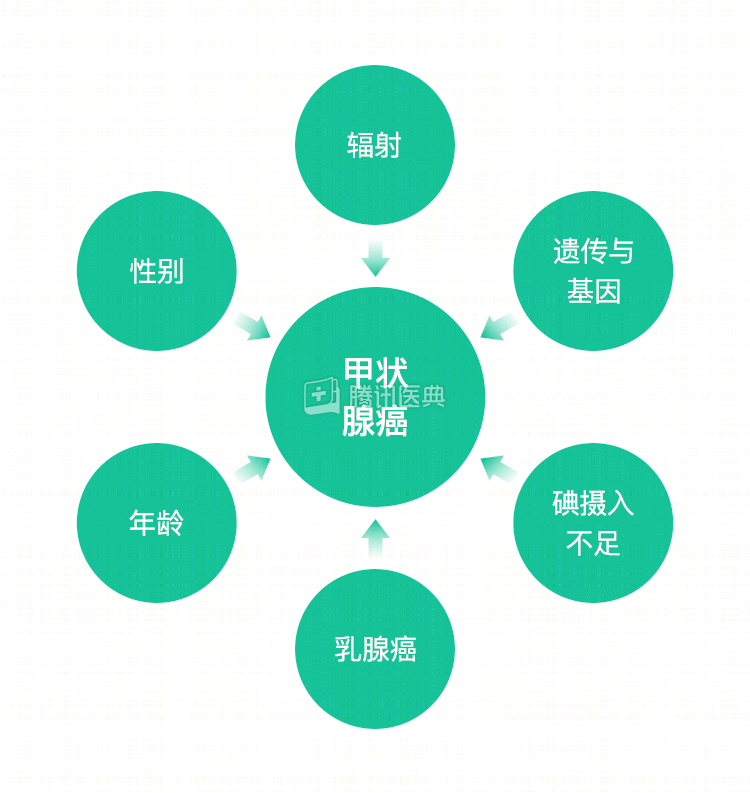
- Age 25 to 65 years.
- Female.
- Female.
Women are three times more likely to develop thyroid cancer than men. Although thyroid cancer can occur at any age, women are more likely to develop thyroid cancer between the ages of 40 and 50. In men, the high incidence is much later, between the ages of 60 and 70. Men’s cancers grow and metastasize more quickly.
- Childhood radiation exposure to the head, neck, or atomic bomb radiation. Cancer can occur as early as 5 years after irradiation.
Children who have been treated with radiation have a higher chance of getting thyroid cancer. Adults have a lower risk of getting thyroid cancer than children when they are also exposed to radiation.
People whose father, siblings, and children have thyroid cancer are at a higher risk of developing the disease themselves.
- Thyroid cancer is also associated with certain specific genes or genetic problems.
One of these is familial adenomatous polyposis (FAP), which is characterized by polyps in the colon. People with FAP have an increased chance of developing thyroid cancer.
Other genetic problems that increase the risk of thyroid cancer include familial medullary thyroid cancer, multiple endocrine neoplasia type 2, Cowden disease (a rare genetic disorder also known as multiple malignant tumor syndrome).
Medullary thyroid cancer is sometimes caused by inheriting a genetic mutation from a parent. The mutated gene can be tested for before medullary thyroid cancer arises. First, the patient is checked for the presence of the mutated gene. If present, other family members can also be tested. If the patient’s family members, including young children, are found to have the mutated gene, the risk of developing the disease can be reduced by thyroidectomy.
- Asians
- Inadequate dietary iodine intake
The thyroid gland needs to use iodine from food to synthesize thyroxine. In areas where iodine intake is low, people are more likely to develop certain thyroid cancers. That’s why many countries around the world are adding iodine to salt or other foods.
In addition, some studies have shown that people with breast cancer are at higher risk of developing thyroid cancer, especially in the first 5 years of diagnosis. However, the exact link between breast and thyroid cancer has yet to be studied.