On August 7, the article “Veterinary Drugs Against Cancer: The Road to Survival for the Hard to Identify Efficacy” in Xinjing News surfaced a special group of people in China, the “fen-phen anti-cancer people”.
This is a very special group of people who are cancer patients, or family members of cancer patients, and they are trying to use a veterinary drug for parasites in dogs, fenbendazole, in a paradoxical state of mind that is both confused and determined, fearful and fearless, steady and desperate. “The future of the “anti-cancer treatment” is unknown.

(A search in social media reveals a large number of fenbendazole anti-cancer exchange groups, source: web)
A news story from the US – the last straw for cancer mothers
Yoyo is part of this group, and her 65-year-old mother was diagnosed with non-small cell lung cancer in May 2018, and had to take a blind trial of Troche after poor results with conventional treatment and resistance to targeted therapy with Erythroxa in May 2019.
Perhaps those who understand lung cancer treatment can see the process above – Yoyo’s mother is running out of options.
Despair came crashing down on her like a wall, and there was no room to fight back.
At that moment, a news report from the United States gave Yoyo a sense of hope that someone had been cured of cancer by taking a “dog drug” called fenbendazole. In Yoyo’s own words, it was like catching the last straw and giving it a try.
Since May 11, 2019, Yoyo has been giving her mother fenbendazole, a veterinary drug for parasites in dogs, in addition to the cancer medication prescribed by the hospital, and several other medications that go along with fenbendazole, as recommended by the fenbendazole anti-cancer group she joined. .
In the beginning, Yoyo felt a bitterness every time she saw the white bottle with the word “veterinary” in red, but there was nothing she could do about it but pretend it was normal.
Like many in this group, Yoyo continues her and her mother’s “dog medicine” cancer regimen, and today, on day 1 of their 14th week on the drug ……
“A model of success” – the legendary Joe
When the story of “fenbendazole, the dog that cures cancer,” gets passed around, it often includes a legendary “poster child” who was saved by this approach – the legendary “Master Joe. The “Joe” of the story.
There is a real Joe, Joe Tippens, who lives in Oklahoma, U.S.A. Joe introduced himself in a June 20, 2018 blog post. He is a successful businessman whose mantra is “attitude is everything” and who likes to use positive thinking as a way to overcome adversity.
In August 2016, two days before he was set to move to Zurich, Switzerland, and take a job with a major private equity partner, Joe was diagnosed with “small cell lung cancer.

(Master Joe himself, source: screenshot of video interview on KOCO News)
Master Joe immediately faxed his case to the MD Anderson Cancer Center in Texas, the top institution for cancer treatment in the U.S., and began a standardized and aggressive anti-cancer treatment with radiation (including preventive head irradiation) and chemotherapy, which was painful, with less than optimal results… …
Master Joe was found at a January 2017 checkup that the malignancy had metastasized to his stomach, liver, pancreas, bladder, and bones, and experts at MD Anderson predicted that he had roughly 3 months to live and referred Master Joe to a clinical trial of a new drug that, if effective, could extend Master Joe’s life by roughly 1 year ……
Everything sounds like a foregone conclusion.
But, in his usual positive spirit, Joe started looking for “off-the-wall” treatments. He found a veterinarian posting on the Oregon State OSU team’s forum, which he frequents, “If you have cancer or know someone who has cancer, please leave me a message,” and because he knew the poster, he reached out to him.
The veterinarian introduced Joe to an off-the-wall treatment regimen using the canine antiparasitic drug PanacurC, also known as the dog drug fenbendazole, and after using this regimen, when he was checked again in May 2017, the tumor was “completely cleared. “
The tumor was cleared.
The miracle protocol – the Joe package
The veterinary program that Mr. Qiao is on is called the “Qiao Package. The reason it is called a package is because the veterinary drug fenbendazole is not used alone.
The Joe package is this:
Fenbendazole 1g/day (Master Joe uses merck’s PanacurC, which contains 222mg of fenbendazole in 1g without excipients), with a break of 4 days after 3 natural doses in a week;
- Vitamin E 400-800mg/day, every day, 7 days a week;
- Curcumin 600mg/day, every day for 7 days a week;
- CBD oil (cannabidiol) 1 to 2 scoops (about 25mg)/day, every day, 7 days a week.
Curcumin supplement
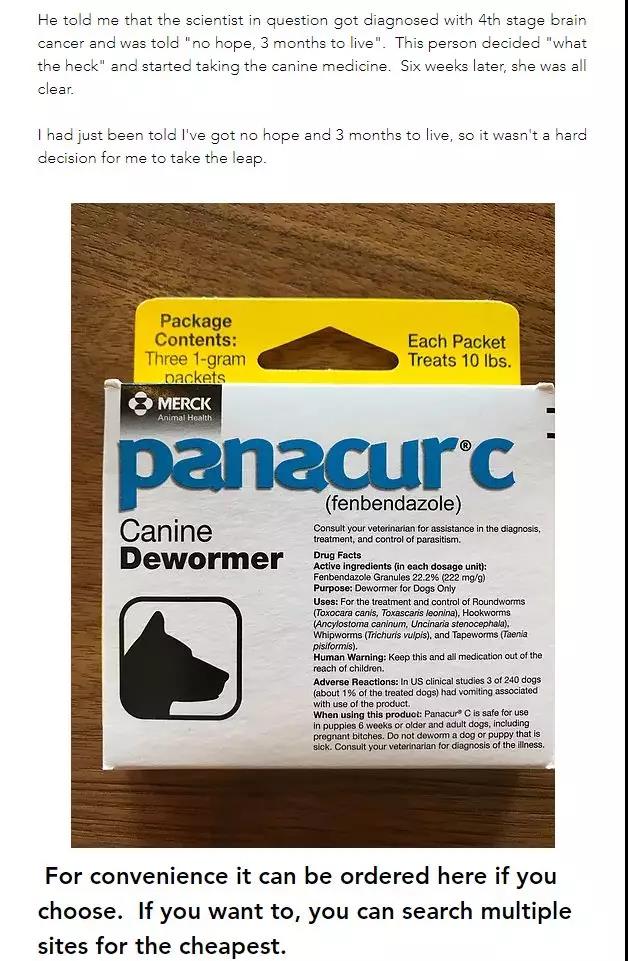
(PanacurC used by Master Joe, source: screenshot from Master Joe’s blog)
In China, where CBD oil is hard to come by, many similar packages have been created. A while back, a search for fen-phen packages on a certain website showed many “dog medicine” packages sold under the name Joe’s Package. The company is now no longer searchable.
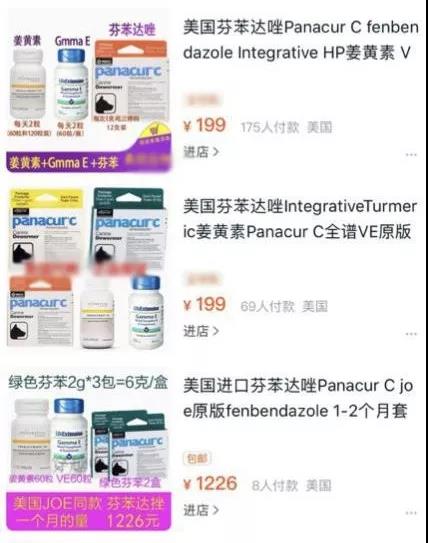
(Screenshot courtesy of Serious Crimes Unit 37)
Fenbendazole found to inhibit tumors – the “wrong” product from the lab
The fact that fenbendazole, a “dog drug,” is being used for cancer treatment didn’t come out of some delusional person’s head, but from a serious scientific experiment. But the discovery that the dog drug could fight cancer was not the goal of the experiment, but the product of a “mistake” made by an experimental accident.
This was a day in 2008 in Baltimore, Maryland, where the hematology lab at the Johns Hopkins School of Medicine, a leading medical research institution, was filled with graduate students lazily doing the rather boring basics of raising rats.
Of course, they weren’t raising just any mice, but a special kind of mouse used as an animal model for cancer – the SCID mouse. Simply put, these mice are specially genetically screened and bred to have severe immune deficiencies.
After injecting lymphoma cells into these mice, because the mice do not have an immune system to clear the tumor cells, these lymphoma cells can grow rapidly in the mice and grow huge tumors. Medical experts can then use these tumor-growing mice to study cancer.
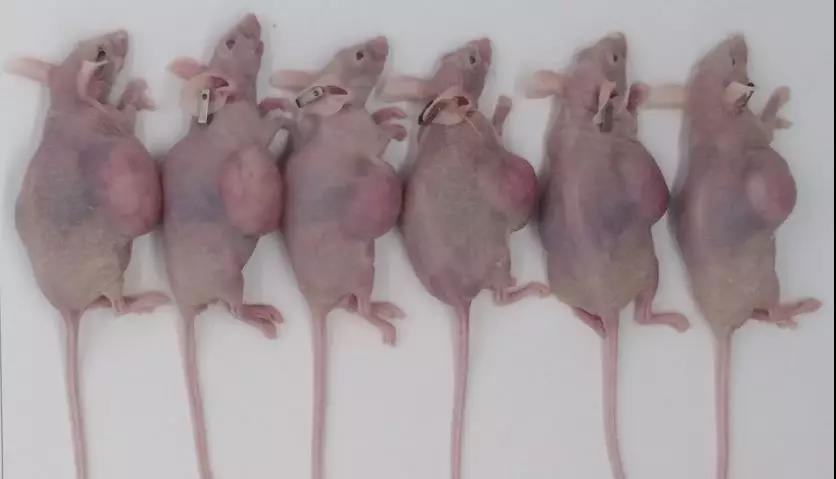
(SCID mice “arranged” to grow tumors, source: web)
The SCID mice are expendable, and each day these medical graduate students hand over dozens to hundreds of them, and in batch after batch they find some “tough mice” that either don’t grow tumors at all or grow only a little bit of tumor that doesn’t meet the requirements of the experiment.
In the eyes of these graduate students, these “mouse toughs” were the product of a mistake or failure and were disposed of.
However, it’s a waste of research money to always have these “strong mice”, so why is that?
Some researchers have traced the whole process of raising these “rat toughs” and suddenly found that, eh?
These guys all took fenbendazole, a veterinary anti-parasitic drug.
It turns out that SCID mice are naturally immune deficient, so they get infected with any bacteria, viruses, or parasites in their environment, and they die quickly. Therefore, the feed given to these mice had to be autoclaved, and some of them were accidentally given a little bit of antibiotic and anti-parasitic drug, fenbendazole, and a lot of extra vitamins to make up for the loss of vitamins in the feed from autoclaving.
This “substandard” feed with fenbendazole and vitamins was fed to SCID mice in the lab because of a work error. As a result, this mistake created a group of “strong mice” that did not grow “good” tumors on the fenbendazole and vitamins.
What?
What? Could a series of lab errors have accidentally revealed a way to fight cancer?
The lab members set up an emergency team and randomly divided 20 SCID mice into four groups: the first group was fed a normal diet; the second group was fed a fenbendazole diet; the third group was fed a diet with vitamins; and the fourth group was fed a diet with both fenbendazole and vitamins. Then they were injected with the same number of cancer cells, and the resultant tumor growth rate was group 2 > group 1 > group 3 > group 4.
So the animal test actually proved that fenbendazole alone not only doesn’t fight cancer, but accelerates tumor growth; only fenbendazole and vitamins can inhibit tumor growth.
“Dog medicine” against cancer – not proven to work
Since seeing the promise in mice, a group of Indian researchers have begun a formal project to study the mechanism by which fenbendazole works against cancer.
In 2012 and 2018, these researchers published findings that confirmed that fenbendazole can indeed affect cancer cells by inhibiting protease activity and interfere with their survival by destabilizing their “microtubule” system, as well as interfere with their metabolism of glucose, allowing them to die from lack of energy. It also interferes with the metabolism of glucose, allowing cancer cells to die from lack of energy.
Simply put, fenbendazole is a compound that breaks down the energy system, the support skeleton, and the messaging channels in cells, and is harmful to the more metabolically active and rapidly dividing cells, which are the most metabolically active and fastest dividing cells.
However, why does fenbendazole work against cancer only in combination with vitamins, while alone it makes cancer develop faster? Researchers haven’t found the answer.
So the mechanisms by which fenbendazole works against cancer are still in the early stages of research and are not well understood.
However, medicine has a very specific path of development, and that is “clinical trials. Many medical treatments and drugs are not well studied, but as long as they do “work,” they can be put into clinical trials – given to patients first, and if they do work, then they can be studied later.
So is fenbendazole in clinical trials? I searched for information about clinical trials in China and abroad and found no information about clinical trials of fenbendazole against cancer.
It is important to understand that for a drug to be proven to be “effective”, it has to go through at least three steps of phase I, II, and III clinical trials:
- Phase I tests the initial clinical pharmacology and safety of the new drug in humans, as well as determining the safe dose range, and typically involves 20-30 normal healthy people.
- Phase II focuses on the initial therapeutic effects of the new drug and requires no less than 100 patients.
- Phase III builds on the Phase II clinical trial by expanding the trial population and confirming therapeutic effects, requiring patient participation.
After these three steps, which demonstrate safety and efficacy, a new drug can be approved for use in treating patients.
As for the evaluation of the therapeutic effect, a randomized double-blind controlled trial is now used internationally to confirm it.
That is, patients participating in the trial are randomly divided into two groups, one using the new drug and the other taking only a placebo (such as a starch tablet), and then comparing the effects of the two groups of patients after the drug is administered.
In this process, it is also required that neither the doctor, nor the patient knows exactly who is on the new drug and who is on the placebo. This ensures that the results of the trial are not interfered with by human factors.
Unfortunately, the anti-cancer effects of fenbendazole have not yet been tested in clinical trials, which means that its efficacy has not yet been verified, and it is not known whether this “dog drug” can be used in humans, whether it is safe to use in humans, or what adverse effects can occur.
Even for Joe, he is still on the fenbendazole regimen, he is still on radiation and chemotherapy, and he is actively involved in the clinical trial of the new drug that MD Anderson has arranged for him. So, Master Joe also made it clear in his blog that he wasn’t sure whether it was the conventional radiotherapy, the new drug clinical trials, or fenbendazole that did the trick and saved his life.
Papers and data – is that what cancer patients and families want?
After reading the above and looking at the cold literature and data, if …… is only if you are a cancer patient or a patient’s family, will you fall into disappointment again, or even despair?
No, that’s not what we’re going to do.
There are so many possibilities in life, and the individual differences between people are so great, that with the medical research available today, there is not a lot of certainty about what effect a certain method will have on a particular person. So, again, it’s too early to say that fenbendazole can’t be used to fight cancer.
If you are in the midst of a desperate cancer battle, we are not in a position to tell you to try an “off-the-wall” approach like fenbendazole.
But there is hope, even if it’s faint, in the light of the future.
This is what you should remember about this mysterious cancer “dog drug”
.
To conclude:
Fenbendazole alone does not inhibit tumor cell growth;
- The use of fenbendazole in combination with vitamins can retard tumor cell growth, but only at the animal stage;
- Whether fenbendazole can be used in humans and whether it has anticancer effects in humans is inconclusive;
- The “success stories” of individuals are not convincing;
- It is not recommended that cancer patients should place their hopes entirely on “non-mainstream” treatment options and forgo standard treatment.