A 66-year-old man with rough, hard, and color-changing skin on his fingers and toes for more than 3 months thought it was just a common skin condition and did not pay attention to it, but only after a serious examination at the hospital did he find out that it was advanced gastric cancer and that he had lost his chance for surgery.
If you think a skin problem must be just a skin disease, you are probably missing out on early diagnosis and treatment of some serious diseases. Skin disease can be an early manifestation of a visceral tumor, and many skin symptoms can be “warning bells” for a visceral tumor. In patients with a combination of skin symptoms, the two occur together in 61% of cases, with tumors preceding skin symptoms in 22% and skin symptoms preceding tumors in 17% of cases.
What skin symptoms may be associated with gastric cancer? Be alert to the possibility of gastric cancer when the following unexplained skin symptoms occur
Herpes zoster
Herpes zoster is commonly known as spider sores, also known as snake sores, fire band sores, snake sores, and snake pimples. The main feature is clusters of blisters on the skin, distributed in bands along the nerves on one side of the body, often accompanied by significant neuralgia.
Herpes zoster is twice as common in tumor patients and is also common in older, frail patients with gastric cancer. Therefore, the presence of herpes zoster in older people should be taken seriously as a possible precursor to gastric cancer.
Dermatomyositis
Dermatomyositis is primarily characterized by cutaneous and muscular symptoms, and characteristic skin lesions include:
- purple spots on the eyelids;
- Flat, purplish papules on the joint areas of the back of the hands, mostly symmetrically distributed, with furfuraceous scales adhering to the surface;
- Abnormal color changes in the skin.
When muscles are involved in the manifestation of myositis, the affected muscle groups may be weak, painful, and painful to pressure.
The incidence of dermatomyositis is 5 to 7 times higher in patients with malignancy than in the general population. One study reported that 45.2% of 157 patients with dermatomyositis were diagnosed with gastric cancer. Therefore, patients with dermatomyositis, especially those over 40 years of age, should be on high alert for the development of gastric cancer.
Echinococcosis nigricans
Echinoderma nigricans, also known as acanthosis nigricans or pigmented papillary dystrophy, is characterized by darkened, papillary or velvety hyperplasia of the skin, mainly in the form of symmetrical, soft, brownish-gray patches of skin on the neck, axillae, elbow surfaces, popliteal surfaces, abdominal surfaces of the body, and anogenital areas. Malignant acanthosis nigricans has the same presentation as benign, but progresses rapidly and often presents with pruritus.
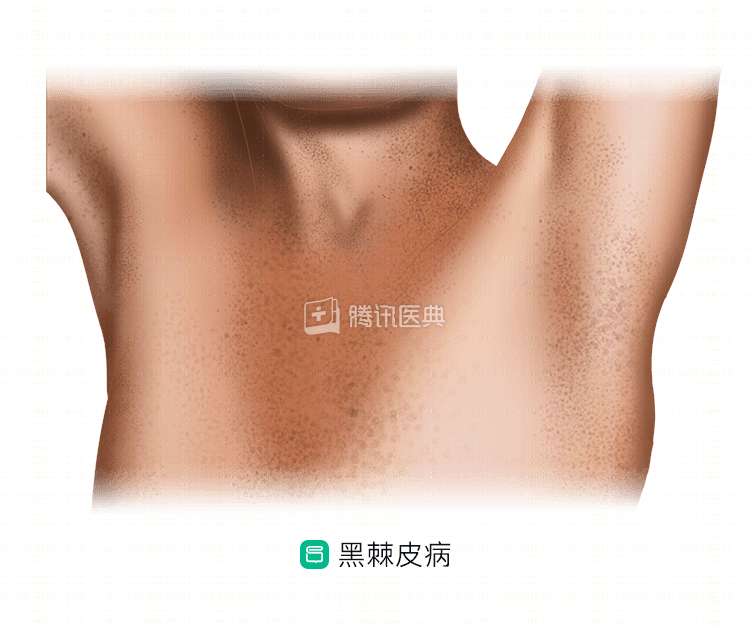
Echinococcosis nigricans is associated with the development of adenocarcinoma of the gastrointestinal tract, particularly with gastric cancer, but is also seen in other tumors such as lung, breast, and ovarian cancers, as well as hematologic disorders. Acanthosis nigricans often appears before the tumor is diagnosed and is one of the early clues for the diagnosis of gastric cancer.
Erythroderma
Erythroderma, also known as exfoliative dermatitis, is characterized by extensive erythematous infiltrates with furfuraceous desquamation. In gastric cancer with erythrodermatitis, there is often widespread edematous erythema (generalized flushing of the skin throughout the body) with massive desquamation.
Bullous palm
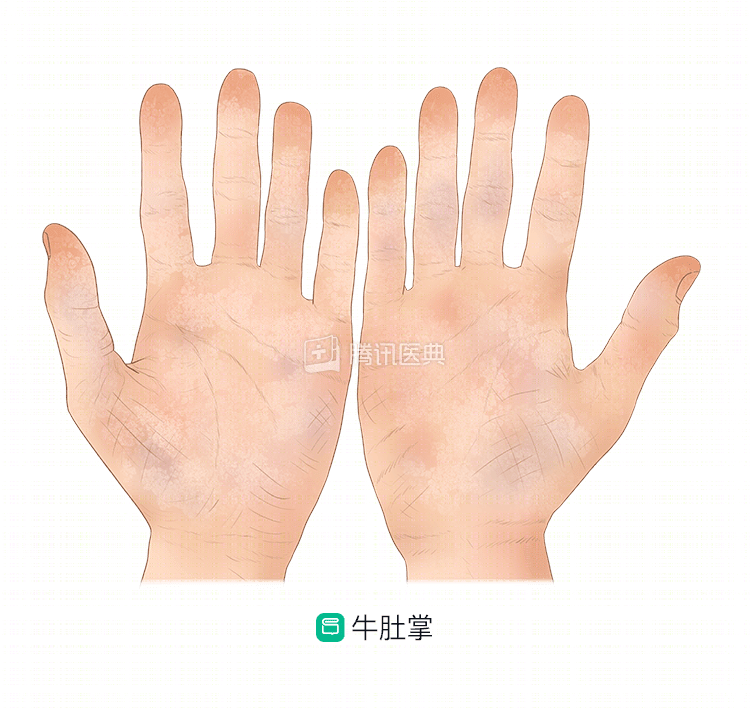
Bullous palm presents as a thickening of the palm, with numerous folds of palm skin with a soft, velvety texture and brown pigmentation, in all cases associated with tumors, often with acanthosis nigricans, most often in patients with lung and gastric cancers.
Geriatric warts, seborrheic warts
The Leser-Trelat sign is characterized by seborrheic keratosis of the skin (also known as senile warts, seborrheic warts) and is commonly seen in older patients. The disappearance of skin lesions after tumor treatment has been reported, so Leser-Trelat sign has been suggested to be a concomitant cancer syndrome, but others are skeptical. Gastric cancer is the tumor that most often develops Leser-Trelat sign.
Sebaceous adenoma
Muir-Torre syndrome is a rare presentation with sebaceous adenomas being the most common. The skin is observed visually as primarily papular waxy lesions with small hemispheric elevations on the skin surface, mostly on the face, scalp, and trunk. The second is keratoacanthoma, the skin manifests as molluscum sebaceum, starting as a small papule with a central depression, later the lesion expands rapidly, forming an ulcer in the center, sometimes disappearing spontaneously, preferably on the face.
Muir-Torre syndrome is most often associated with adenocarcinoma of the stomach, small intestine, and colon.
Pigmentation of the face, mouth, and lips
Pentz-Jeghers syndrome is characterized by multiple malformation-like polyps in the gastrointestinal tract and hyperpigmentation of the lip, face, and oral mucosa. The incidence of gastrointestinal tumors with this syndrome is 2% to 3% and may be due to malignant transformation of multiple malformation-like polyps.
In summary, the presence of unexplained skin symptoms must be taken seriously, but there is no need to be overly alarmed. The above skin symptoms may suggest gastric cancer or other malignancies, but they are usually low-probability events or episodic events, and the presence of skin symptoms does not necessarily accompany malignant disease. In any case, prompt medical attention and clear diagnosis is the best option.