There are two main types of surgery for kidney cancer, one is radical nephrectomy, in which the entire kidney is removed, and the other is surgery to preserve the kidney unit, also called partial nephrectomy. It is simply removing the tumor along with some of the surrounding normal kidney tissue, while preserving most of the functional kidney tissue.
Which patients are candidates for kidney unit-preserving surgery?
There are three absolute, relative, and optional indications for renal unit-preserving surgery:
- The following conditions necessitate renal unit-preserving surgery (absolute indication)
Including isolated kidneys or bilateral renal tumors, total nephrectomy in these patients will inevitably lead to renal failure and therefore partial nephrectomy must be performed, otherwise hemodialysis or renal transplant replacement therapy is required.
- The following conditions favor kidney unit-preserving surgery (relative indications)
Patients may have overall factors that impair renal function, such as diabetes, hypertension, kidney stones, chronic infection, lupus, or other factors, and these patients may experience decreased renal function or even require intermittent dialysis treatment after removal of the kidney.
- The following conditions may also be considered for kidney unit preservation surgery (optional indication)
Elective partial nephrectomy is the removal of one kidney in the presence of normal kidney function on both sides. In these patients, removal of one kidney does not lead to renal failure, and a portion of the kidney is removed to preserve as many kidney units as possible for future renal reserve.
Today, surgery to preserve the renal unit is widely used in the treatment of kidney cancer because it requires remodeling of the kidney and requires more surgical skill than radical nephrectomy, and may be associated with risks of bleeding, urinary leakage, infection, and poor healing of the kidney suture. Both physicians and patients are exposed to the risks of kidney unit preservation surgery.
Fortunately, most patients with urinary leakage can be cured with conservative treatment such as leaving a temporary renal stent tube in place; postoperative bleeding has a 1% to 2% chance of occurring and can now be stopped by blocking the bleeding vessel with renal artery embolization. Therefore, the risk of complications with kidney unit-preserving surgery is not high and is safe and feasible.
How is the renal unit-preserving procedure performed?
It can be performed in both open and laparoscopic fashion. Laparoscopic surgery to preserve the renal unit is only performed in a few hospitals with a high number of kidney cancer cases for now because of the high technical requirements, but more and more surgeons are learning and performing this type of surgery. This depends not only on the patient’s condition such as tumor size, location, previous surgical history, etc., but also on the surgeon’s clinical experience and surgical technique, and the patient needs to assess the risks and benefits involved on his or her own.
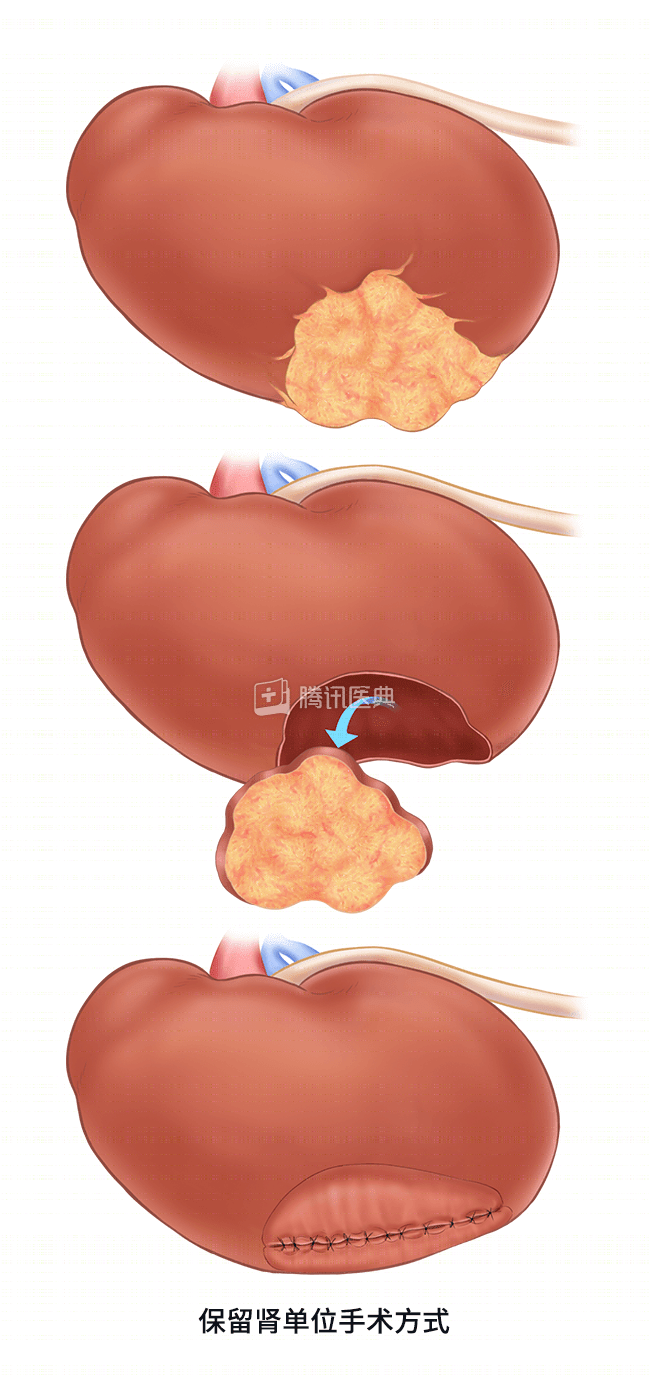
A partial nephrectomy involves finding the renal artery and temporarily blocking it, then exposing the tumor and removing the tumor and some of the normal kidney tissue around it, while preserving most of the normal kidney. The wound is closed with sutures to prevent bleeding. Finally, the temporarily clamped artery is loosened and the wound is closed after complete hemostasis.
A partial nephrectomy usually takes about 1 to 2 hours to perform, depending on the size, location, and degree of endogenousness of the tumor, and the exact time required depends on the skill and experience of the surgeon.
Will the tumor recur after kidney unit preservation surgery?
Will the tumor recur after kidney unit preservation surgery?
After partial nephrectomy for limited tumors, the rate of local recurrence is low, and the follow-up content is similar to that of total nephrectomy. Recurrence in the residual kidney is considered to be local recurrence, and the rate of recurrence depends largely on tumor grade. Enhanced CT or MRI is required at the time of follow-up. If there is an enhancing mass shadow in the kidney there should be a high suspicion of tumor recurrence, which suggests active blood flow in and out of the tumor and a high suspicion of malignancy.
It is important to emphasize that patients with pathologically diagnosed tumor micrometastases or vascular thrombosis have a higher rate of recurrence of residual renal cancer, and these patients require more frequent CT or MRI examinations, usually every 3 months until 2 years after surgery, then every 6 months, and then annually after 5 years. Once the review reveals a local recurrence of the kidney tumor, immediate surgery is required to remove the remaining kidney.
Consult your doctor immediately after a recurrence. The first step is to complete a systemic workup to assess the site and severity of the recurrence or metastasis. If a local recurrence is evaluated by your doctor to be surgically treatable, consider surgery. If surgery is not possible, systemic systemic therapy, including targeted therapy and immunotherapy, should be the main treatment. Localized radiotherapy can be used as an adjunct to provide both symptomatic relief and better outcomes.