A 70-year-old man was out of bed the day after robotic-assisted laparoscopic radical prostate cancer surgery, was successfully discharged 5 days later, had his urinary catheter removed 10 days later, and was urinating essentially normally 1 month later, which would have been unthinkable in an era dominated by open surgery.
This older man recently returned for a follow-up visit, and 1 year after surgery, his PSA remains below 0.001, thanks to the emerging technology of robotic surgery.
With the rapid advances in modern technology, this minimally invasive technique has been widely used in urologic surgery and is becoming more and more sophisticated. In March 2018, for example, a total of 2,854 robotic surgeries were performed in mainland China that month, including 1,260 urologic surgeries. We are now able to complete many difficult surgeries such as radical prostate cancer, total radical cystectomy, and partial nephrectomy under robotic laparoscopy with satisfactory outcomes, and have reached the international advanced level in technology.
Patients and families often ask: How is robotic radical prostate cancer surgery done? Is it a machine operating? Or is there a miniature robot running into the patient’s stomach to do the surgery?
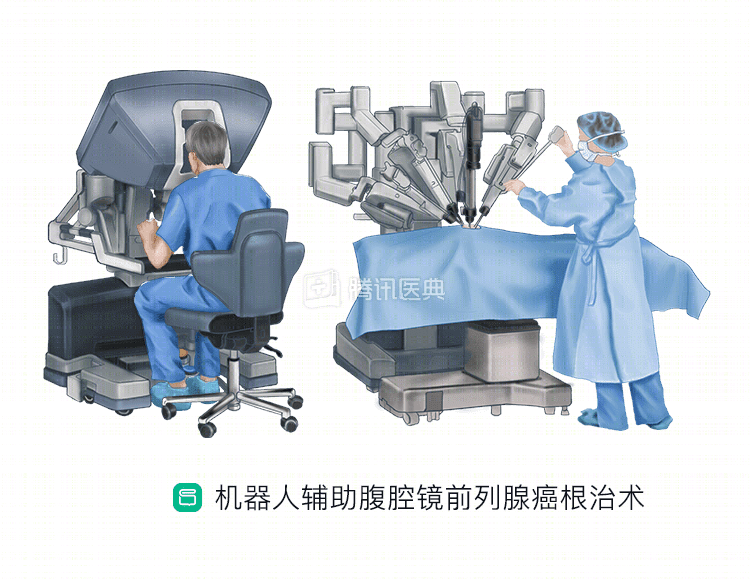
In fact, the full name of what is called robotic surgery is robot-assisted laparoscopic surgery. It is still essentially a minimally invasive laparoscopic surgery, or in layman’s terms, robotic surgery is an upgraded version of laparoscopic surgery. There is not much difference between robotic surgery and ordinary laparoscopic surgery in terms of incision location, size, and the number of puncture cannulas.
In the case of radical prostate cancer surgery, for example, both require about 4 to 5 small holes of about 1 cm in the patient’s stomach, with the difference being:
- Robotic surgery puts in a robotic arm that can be remotely controlled by the surgeon;
- Laparoscopic surgery involves placing ordinary laparoscopic instruments directly through the surgeon’s hands.
In fact, the robot is just a tool and an assistant for the surgeon, and the surgeon still does the surgery, controlling the robotic arm through an operating platform like an airplane model to complete the surgery.
Of course not all patients are suitable for robotic surgery; for example, patients with a history of prior abdominal surgery and severe abdominal adhesions would be better served by open surgery. In addition, some procedures that can also be successfully performed by traditional laparoscopy, such as radical kidney cancer treatment, adrenalectomy, and renal cyst decompression, do not need to be pursued robotically.
The main advantages of robotic surgery compared to conventional laparoscopic and open surgery are:
- The field of view is clear and realistic: the surgical field of view is magnified 10 times, allowing the fine structures of every organ in the abdominal cavity, even small blood vessels, to be seen clearly; and the field of view of robots from the 4th generation onward, which are now widely used in clinical practice, is three-dimensional, so that the surgeon can see through the screen as if he or she were inside the patient’s stomach when performing the operation.
- The robot has a three-dimensional view, which makes it less likely to be accidentally injured.
- Flexible and multi-dimensional operation: The robot arm is particularly flexible, and can have multiple dimensions of movement, such as up, down, left, right, forward, backward, and rotation, so it can be said to be more flexible than human hands. We have had trainees in our training courses operate the robot arm to peel grapes and then sew them back together intact, a whole set of operations that are so delicate and precise that it might take a thousand training sessions to achieve if operated by human hands alone, but is much easier for the robot.
- Operator comfort, less fatigue: The robot arm is stable and precise, and more importantly, it doesn’t get “tired” or “shaky” or “strike.
The robot arm is stable and accurate, and more importantly, it doesn’t get tired, it doesn’t get shaky, and it doesn’t “strike. The robot arm is a very powerful and powerful tool that can be used to perform a number of surgeries in a row. The robot is a true “model worker”.
Of course, any technology is a double-edged sword and should be viewed with a dialectical view. While robotic surgery has many advantages, it currently has shortcomings such as being more expensive and more time-consuming if intermediate open surgery is needed. The patient and family should not be superstitious about a particular technology or procedure, and should have full communication with their physician about the treatment they choose.
Related articles: