Approval Date.
Trimetazidine Hydrochloride Extended Release Tablets Instructions
Please read the instructions carefully and use under the guidance of your physician
[Medication Name]
Generic Name: Trimetazidine Hydrochloride Extended Release Tablets
English name: Trimetazidine Dihydrochloride Sustained-release Tablets
Hanyu Pinyin: Yansuan Qumeitaqin Huanshi Pian
[Ingredients].
The main ingredient of this product is trimetazidine hydrochloride, whose chemical name is 1-(2,3,4-trimethoxybenzyl)piperazine dihydrochloride.
Chemical structure formula.
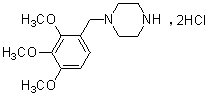
Molecular formula: C14H22N2O3・2HCl
molecular weight: 339.26
[Properties] This product is a pink film-coated tablet, which appears white or off-white after removing the coating.
[Indications].
As an add-on drug, this product is used for symptomatic treatment of adult patients with stable angina pectoris who are poorly controlled or intolerant to first-line anti-anginal therapy.
[Specifications].
35mg
[Dosage].
Take 35mg (1 tablet) orally twice daily with breakfast and dinner.
Evaluate the treatment effect after three months and discontinue if there is no therapeutic effect.
Patients with renal impairment.
For patients with moderate renal impairment (creatinine clearance [30-60]ml/min) (see [Precautions] and [Pharmacokinetics]), the recommended dose is one 35 mg tablet daily during breakfast.
[Adverse Reactions].
Adverse reactions, i.e., adverse events considered at least potentially associated with trimetazidine treatment, are listed below at the following conventional frequencies: very common (≥1/10); common (≥1/100 to <1/10); uncommon (≥1/1,000 to <1/100); rare (≥1/10,000 to <1/1,000); very rare (<1/10,000); and unknown (cannot be estimated from available data).
|
System organ classification |
Frequency |
Preferred terminology |
|
Neurological disorders |
Common |
dizziness, headache |
|
unknown |
Parkinson’s syndrome (tremor, dyskinesia, hypertonia), gait instability, restless legs syndrome, its otherrelated movement disorders, usually reversible after discontinuation, sleep disorders (insomnia, somnolence) > |
|
|
Ear and Inner Ear Disorders of the Labyrinth |
unknown |
glare |
|
Heart disease > |
Palpitations, extrasystoles, tachycardia |
|
|
< span style="color:black; font-family:equine">Vascular disease |
rare |
Low arterial pressure, upright hypotension (which may be associated with generalized weakness, dizziness, or falls, especially in patients on antihypertensive medication ), flushing |
|
Gastrointestinal Disorders |
Common |
Abdominal pain, diarrhea, indigestion, nausea and vomiting |
|
unknown |
Constipation |
|
|
Dermal and Subcutaneous Tissue Disorders |
Rash, itching, hives |
|
|
unknown |
Acute generalized eruptive pustulosis (<) span style="font-family:Arial">AGEP), angioneurotic edema |
|
|
Systemic disease and site of administration conditions |
Common |
Frailty |
|
Diseases of the blood and lymphatic system |
unknown |
Granulocyte deficiency, thrombocytopenia, thrombocytopenic purpura |
|
hepatobiliary disease |
unknown |
Hepatitis |
Report of suspected adverse reactions:
Reporting of adverse reactions to post-marketing drugs is important. Timely reporting supports ongoing monitoring of the benefit/risk assessment of the drug. Healthcare professionals should report any suspected adverse reactions as required.
[Contraindicated].
– Contraindicated if allergic to any of the components of the drug.
– Parkinson’s disease, Parkinson’s syndrome, tremor, restless legs syndrome, and other otherrelated movement disorders.
– Severe renal impairment (creatinine clearance < 30ml/min)
[Caution].
This medication is not intended for use as symptomatic treatment of angina pectoris episodes or for initial treatment of unstable angina or myocardial infarction. This drug should not be used for treatment prior to or during the first few days after admission to the hospital. During an angina attack, coronary artery disease should be reassessed and adjustments in therapy (pharmacotherapy and possible revascularization) should be considered.
Trimetazidine can cause or exacerbate Parkinson’s symptoms (tremor, motor inability, hypertonia) and should be checked regularly, especially in elderly patients. Appropriate testing should be performed by a neurologist when suspicious conditions arise.
Trimetazidine should be completely discontinued when movement disorders occur, such as Parkinson’s symptoms, restless legs syndrome, tremor, and gait instability.
These events have a low incidence and are usually reversible after discontinuation. Most patients recover within 4 months after discontinuation of trimetazidine. If Parkinson’s symptoms persist for more than 4 months after discontinuation, a neurologist’s opinion should be sought.
Falls associated with gait instability or hypotension may occur, especially in patients taking antihypertensive medications (see [Adverse Reactions]).
Caution should be exercised when prescribing trimetazidine in patients with anticipated increased exposure to.
- style=”margin-left: 45pt”>
-
Moderate renal impairment (see [Dosage] and [Pharmacokinetics])
-
Over 75 older than 75 years of age (see [Dosage]).
This product is not recommended for use in women who are breastfeeding. (See [Use in Pregnant and Lactating Women])
Effects on the ability to drive and use machines
Clinical studies have shown no hemodynamic effects of trimetazidine, however cases of dizziness and drowsiness have been observed post-marketing (see [Adverse Reactions]), which may affect the ability to drive and use machines.
Use with caution in athletes.
[For Pregnant and Lactating Women].
Pregnancy
No data are available on the use of trimetazidine in pregnant women. Animal studies have not shown direct or indirect harmful effects in terms of reproductive toxicity (see [Pharmacologic Toxicology]). For safety reasons, it is best to avoid taking this drug during pregnancy.
Lactation
Whether trimetazidine and its metabolites are excreted via breast milk is unknown. Risk to the newborn/infant cannot be excluded. Trimetazidine should not be administered during breastfeeding.
BirthBirthAbility
Reproductive toxicity studies have shown no effect on fertility in female and male rats (see See [Pharmacology Toxicology]).
[Pharmaceuticals for Children].
The safety and efficacy of trimetazidine in people younger than 18 years of age have not been established. No available data.
[Geriatric Use]
Trimetazidine exposure may be increased in elderly patients due to the presence of an age-related decline in renal function (see [Pharmacokinetics]). In patients with moderate renal impairment (creatinine clearance 30-60 ml/min), the recommended dose is one 35 mg tablet daily during breakfast.
Caution should be exercised when increasing the dose in elderly patients (see see [Precautions]).
[Drug Interactions].
No drug interactions have been observed.
[Drug overdose]
Limited information is available regarding trimetazidine overdose. Symptomatic treatment should be administered.
[Pharmacology and Toxicology].
Pharmacology
Trimetazidine maintains a stable intracellular environment by protecting cellular energy metabolism in the presence of hypoxia or ischemia and preventing a decrease in intracellular ATP levels, thereby ensuring the normal function of the ion pump and the normal functioning of transmembrane sodium-potassium flow. Trimetazidine inhibits β-oxidation of fatty acids by blocking long-chain 3-ketoesteryl CoA thiolase, thereby promoting glucose oxidation. In ischemic cells, a lower amount of oxygen consumption is required to obtain energy through glucose oxidation compared to the β-oxidation process. Enhanced glucose oxidation optimizes cellular energy processes and thus maintains proper energy metabolism during ischemia. In patients with ischemic heart disease, trimetazidine acts as a metabolic agent to maintain high-energy phosphate levels in cardiac myocytes. The anti-myocardial ischemic effect was achieved without affecting hemodynamics.
Toxicological studies
Genotoxicity.
In vitro and in vivo tests to assess potential genotoxicity were negative.
Reproductive toxicity.
No significant embryo-fetal toxicity or offspring organ growth and development toxicity was observed in mouse and rabbit reproductive toxicity tests. A perinatal reproductive toxicity test in rats showed no significant abnormalities.
[Pharmacokinetics].
Absorption
After oral administration, the mean time to peak is 5 h. Plasma drug concentrations are maintained at levels greater than or equal to 75% of peak concentration after 24 h and can be maintained for 11 h. The latest time to steady-state drug concentration is around the 60th hour.
The pharmacokinetic profile of trimetazidine hydrochloride extended-release tablets 35 mg is not affected by eating.
Distribution
Apparent volume of distribution was 4.8 L/kg; protein binding was low: in vitro measurements showed a protein binding rate of 16%.
Clearance
Trimetazidine is cleared primarily by urine as a prototype. Clearance half-life of trimetazidine hydrochloride extended-release tablets: 7 hours on average in healthy young volunteers and 12 hours in subjects over 65 years of age.
Trimetazidine is primarily cleared by the kidneys and correlates directly with creatinine clearance and, to a lesser extent, with decreased hepatic clearance with age.
Special Populations
Elderly people:In a clinical trial in elderly people, subjects took daily2tablets in2doses , analyzed using population kinetic methods, showed increased plasma drug exposure. Older subjects may have increased trimetazidine exposure due to the occurrence of age-related decline in renal function. .
A specific pharmacokinetic study in elderly or very elderly subjects (≥ 85 years) aged 75-84 years showed that trimetazidine exposure in elderly subjects with moderate renal insufficiency (creatinine clearance of 30 to 60 ml/min) was higher than in younger subjects with moderate renal insufficiency. subjects (30 to 65 years of age) and 1.0 and 1.3 times greater than those in younger subjects with moderate renal insufficiency (30 to 65 years of age).
Renal impairment: Compared with healthy young volunteers with normal renal function, patients with moderate renal impairment ( creatinine clearance between 30 and 60 ml/min) had an average increase in trimetazidine exposure of up to 1.7-fold, and patients with severe renal impairment (creatinine clearance lower than 30 ml/min) had an average increase in trimetazidine exposure of up to 3.1-fold . No new safety concerns were observed in this population compared with the general population.
Children: no pharmacokinetic trimetazidine was performed in a pediatric ( <18 years) population. Kinetic studies.
[Storage] Keep sealed.
[Packaging] This product is packed in polyvinyl chloride solid pharmaceutical rigid tablets and pharmaceutical aluminum foil sealed with an outer center seal bag. Each plate of 10 tablets, 3 plates per bag, 1 bag per box.
[Expiration Date] 24 months
[Executive Standard]
[Approval Number]
[Manufacturer
Company Name: Jiangsu Hengrui Pharmaceutical Co.
Manufacturing Address: No. 38, Huanghe Road, Lianyungang Economic and Technological Development Zone
Postal Code: 222047
Phone number: 800-8283900 400-8283900
Fax number: 0518-85463261
Website:http://www.hrs.com.cn