Many patients are fearful when they hear that they need to “make an incision in the clavicle”. In fact, the doctor will strictly evaluate the indications and contraindications before the procedure, and mediastinoscopy is generally safe as long as the patient is not overly nervous and cooperates actively with the doctor.
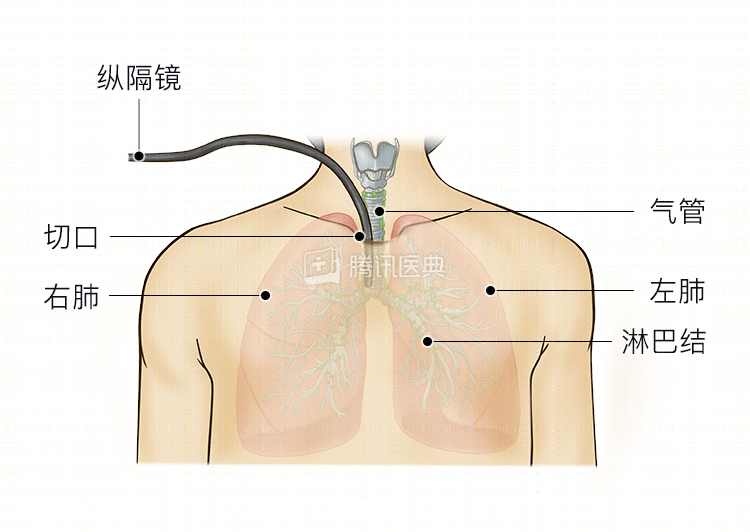
What should I do to prepare for the exam?
The following information needs to be communicated to the doctor:
- Medications being taken and history of drug allergies.
- Whether you are taking antiplatelet agents (e.g., aspirin, clopidogrel) or anticoagulants (e.g., warfarin).
- Whether you are pregnant or may become pregnant.
- Whether you have had a mediastinoscopy or cardiac surgery. Because surgical scars may interfere with a second exam.
- Whether you have a neck condition or have had an injury. Especially if the neck muscles are overstretched.
- Whether there has been any chest disease, including congenital disease.
- Whether there has been radiation therapy to the neck or chest.
Mediastinoscopy requires general anesthesia, please be prepared for the following:
- Follow the doctor’s orders to fast and abstain from food and water. Otherwise, the procedure may be cancelled. If you need to take medication on the day of the procedure, please take it with a small sip of water.
- Remove jewelry, glasses (contact lenses), braces, or removable dentures, and retrieve them after the exam.
- If you do not need to be hospitalized, ask a friend or relative to drive you home in advance.
- The doctor may also order certain blood tests, such as a complete blood count (CBC) or clotting factor test, before the exam.
- Before the procedure, you can ask your doctor about the purpose of the test, its significance, adverse effects, and procedure, and sign an informed consent form.
Is mediastinoscopy painful?
Before the exam, your doctor may use medication to help you relax and then administer general anesthesia. You may feel sleepy for several hours after waking up, even for 1 to 2 days, and experience aches and pains.
The throat may also be slightly sore from the placement of a catheter to help you breathe. Taking a lozenge and gargling with warm salt water will help.
What may happen after the test?
If the incision sutures are not absorbable, the patient will also need to return to the hospital to have them removed within 10 to 14 days after the procedure. This usually leaves only a small scar.
Complications of mediastinoscopy are uncommon, but bleeding, infection, lung atrophy, esophageal laceration, vascular injury, or damage to the recurrent laryngeal nerve (which may cause permanent hoarseness) may occur.
After the examination, the patient is advised to stay in the hospital for 1 day for observation. Contact your doctor immediately if:
- bleeding at the incision sutures;
- fever;
- Severe chest pain;
- swelling in the neck;
- Shortness of breath;
- Difficulty swallowing;
- Heartiness that lasts for several days or continues to worsen.
Related reading:
Co-reviewed by: Guangdong Provincial People’s Hospital Guangdong Lung Cancer Institute Dr. Dong Song Dr. Zhang Chao