In 2014, olaparib was formally appointed by the Food and Drug Administration (FDA) for the treatment of advanced ovarian cancer. on August 17, 2017, the FDA reapproved olaparib for use in the maintenance treatment of patients with epithelial ovarian cancer, fallopian tube cancer, or primary peritoneal cancer treated with platinum-based chemotherapy and evaluated for CR (complete remission) or PR (partial remission). remission) or PR (partial remission) for the maintenance treatment of patients with epithelial ovarian, fallopian tube, and primary peritoneal cancers.
Olaparib has been repeatedly used in the anti-cancer workforce because it is well adapted to clinical treatment and has the advantages of being highly effective, less toxic, and easier to control. At the same time, olaparib is a “nemesis” for patients with BRCA (breast cancer susceptibility gene) mutations, which have a dual inhibitory effect on their tumor cells.
So what does olaparib have to offer to double down on cancer cells in patients with BRCA-mutated cancers?
PARP inhibitors: the nightmare of BRCA-mutant ovarian cancer!
Studies have shown that 10% of ovarian cancer cases are associated with genetic mutations, with mutations in BRCA1 and BRCA2, the genes encoding tumor suppressors associated with DNA damage repair, being an important cause of ovarian cancer. The risk of ovarian cancer is greatly increased in women with inherited BRCA mutations compared to other non-constant chromosomal related genes.
Poly ADP-ribose polymerase-1 (PARP-1) is an intranuclear protein associated with DNA damage repair that mediates the DNA damage signaling pathway by recognizing and binding to single- or double-stranded DNA damage. Olaparib is a PARP inhibitor that inhibits DNA repair.
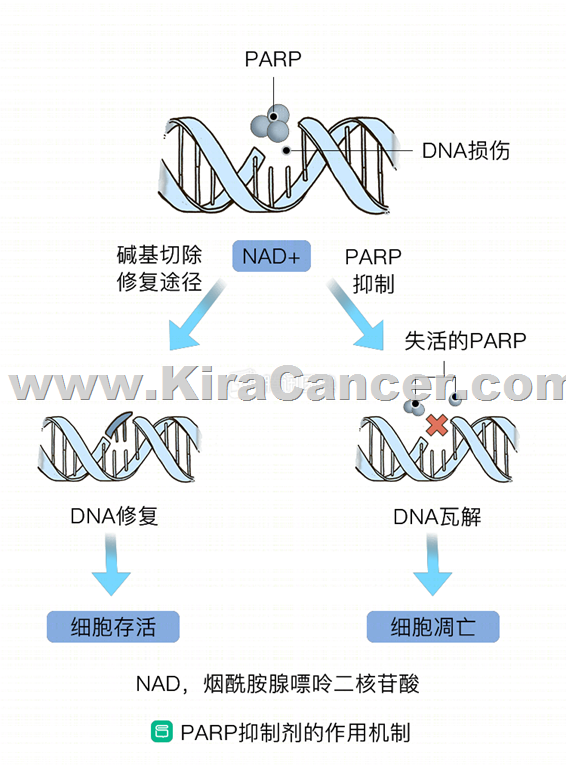
The reason why PARP inhibitors are a nightmare for BRCA mutant cancers is that, in addition to PARP inhibitors interrupting DNA repair, cancers caused by BRCA mutations are inherently defective in DNA repair and, therefore, are extremely sensitive to PARP inhibitors. Therefore, cancers with BRCA mutations will have a much harder time trying to perform DNA repair in the presence of PARP inhibitors!
So the advent of olaparib could be a great boon for patients with BRCA-mutated ovarian cancer. Here’s a look at the clinical studies to see if olaparib works as well as it does!
Highlight study solidifies olaparib’s therapeutic status
The Lancet Oncology, a leading medical journal, recently published an international, multicenter, double-blind, randomized, controlled, phase III clinical trial study to investigate the maintenance effects of olaparib in patients with recurrent ovarian cancer with platinum-sensitive, BRCA1 or 2 mutations. strong>.
The study included 295 patients with ovarian, fallopian tube, or primary peritoneal cancer who were randomly assigned to maintenance treatment in the trial (olaparib group) and control (placebo group) groups (196 in the trial group and 99 in the control group). Patients in the trial group received olaparib tablets (300 mg: 150 mg × 2) orally twice daily, while the control group received the same amount of placebo. The study evaluation metric was an estimate of progression-free survival (PFS).
The results of the study showed that:
1.
1. median PFS in the olaparib-treated group was more than 3 times that of the placebo group, as assessed by the investigators! The median PFS in the olaparib group was 19.1 months, compared with 5.5 months in the control group. Olaparib reduced the risk of progression in cancer patients by 70% compared to placebo.
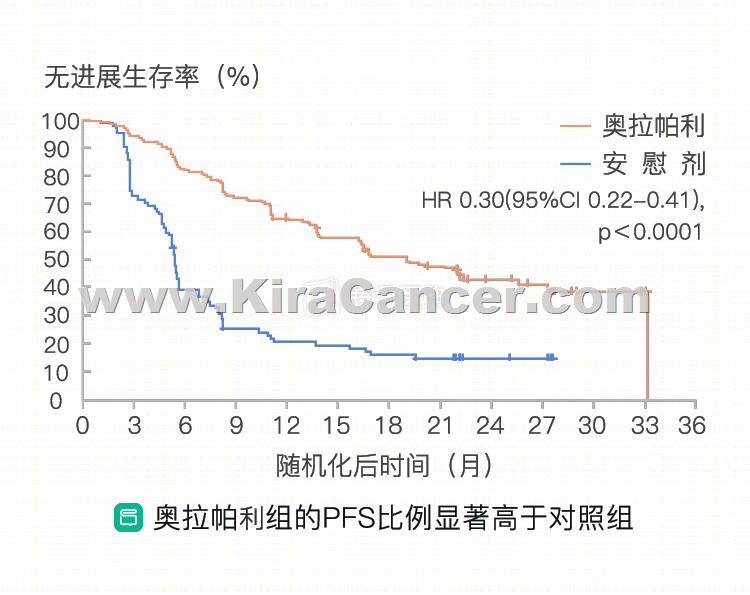
2. The 1-year disease-progression-free survival rates were 65% versus 21% in the olaparib group and 43% versus 15% in the 2-year disease-progression-free survival rate in the control group. This suggests that the Olaparib group had approximately 3 times the progression-free survival rate of the control group!
3.
3. For participants who had received bevacizumab in the past, the median PFS was 17.0 months in the olaparib group, which was significantly higher than the 5.1 months in the control group. Therefore, past treatment with bevacizumab (bevacizumab) did not affect patient outcomes with olaparib.
.
4. Of all participants, 97% (286) had BRCA mutations, with 190 in the olaparib group and 96 in the control group. Likewise, the median PFS was significantly higher in the olaparib group than in the control group (19.3 months vs. 5.5 months).
The study showed that olaparib did improve treatment outcomes in patients with platinum-sensitive, BRCA1/2-mutated recurrent ovarian cancer, significantly and effectively extending progression-free survival.
Since olaparib is so effective, what is its safety profile?
Relax! Olaparib has a good safety profile
From the study mentioned above, the most common grade 1-2 adverse reactions in the olaparib and control groups were nausea, fatigue or weakness, vomiting, abdominal pain, and diarrhea. However, the rate of grade 3-5 adverse reactions was low in both groups.
The most common Grade 3 or higher adverse reaction in the olaparib group was anemia. Eighteen percent (35) of patients in the olaparib group required blood transfusions compared with 1% (1) in the control group. In addition, grade 3 or higher adverse reactions in the two groups included neutropenia and thrombocytopenia, the rates of which did not differ significantly between the two groups. The rate of serious adverse reactions was 18% (35) in the olaparib group compared with 8% (8) in the control group.
In summary, this study is the first phase III study to examine the effect of olaparib on maintenance therapy in patients with platinum-sensitive, BRCA-mutated recurrent refractory ovarian cancer. The study found that oraparib significantly improved progression-free survival compared with placebo and had no significant adverse impact on patients’ quality of life.
However, the overall data from this study are not yet mature, and it is unclear whether the prolonged PFS in the olaparib group translates directly into a survival benefit. Let’s continue to hope that the test of time will prove that olaparib is an effective, low-toxicity anticancer drug for the maintenance treatment of ovarian cancer patients!