Some patients with lung cancer have been diagnosed and are awaiting surgery or other treatment, but their doctors say they can’t rush it and need a mediastinoscopy. Why is this? Is mediastinoscopy a routine test to diagnose lung cancer? Which patients need it? Which patients do not need it? This article will tell you more about it.
Mediastinoscopy is not routinely required to confirm a diagnosis of lung cancer, and there has been some debate among physicians as to whether or not all patients with a diagnosis of lung cancer should undergo mediastinoscopy, as we discuss below.
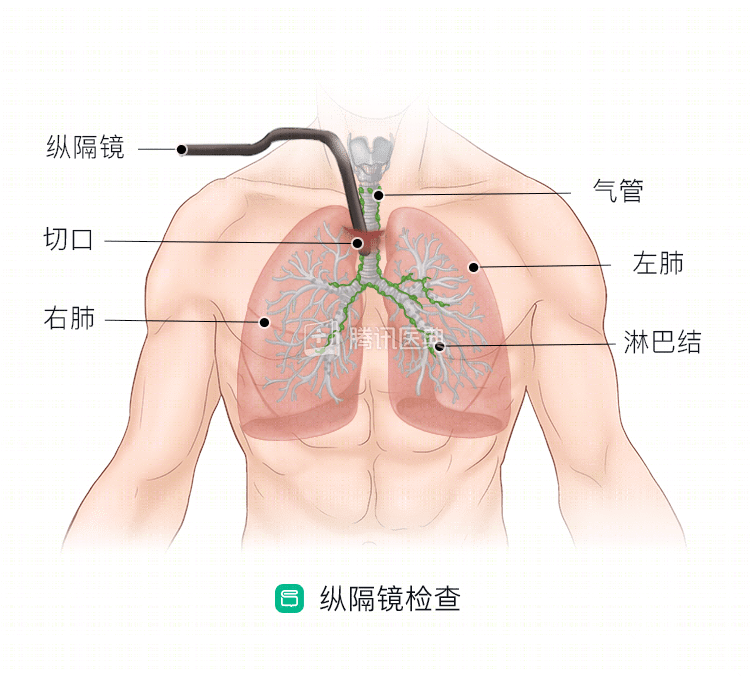
Which patients need a mediastinoscopy?
For patients with non-small cell lung cancer (NSCLC) who are likely to have surgery, it is important to identify any mediastinal lymph node metastases before surgery. This is because it depends on whether surgery can be performed, whether surgery followed by chemotherapy or targeted therapy, or chemotherapy or targeted therapy followed by surgery.
Traditional imaging methods such as CT and magnetic resonance imaging (MRI) are less accurate and have higher false-positive and false-negative rates; PET-CT has better accuracy and specificity than CT for lung cancer staging, but still has some false-positive and false-negative rates, and is expensive.
Mediastinoscopy is currently the most accurate way to determine whether there are mediastinal lymph node metastases in lung cancer. Of course, with advances in medical technology, endobronchial ultrasound (EBUS) lymph node aspiration biopsy has also become an option.
This being said, you may understand that mediastinoscopy should be considered to further clarify the diagnosis in patients with lung cancer whose imaging (CT, MRI, PET-CT) suggests lymph node enlargement or who are suspected of having lymph node metastases.
Which patients do not need/are not candidates for mediastinoscopy?
Many patients who have a CT on physical examination and have a “ground glass nodule” in the lung usually do not need a mediastinoscopy at this time. As mentioned earlier, it is not a routine test to establish a diagnosis of lung cancer.
Some patients are not good candidates for this test, such as those with aortic aneurysms, cardiopulmonary insufficiency, severe anemia, or a high risk of bleeding; those with superior vena cava obstruction, severe tracheal deviation, mediastinal fibrosis, and severe cervical spondylosis should also be cautious and should be discussed fully with their physician.
What are the limitations of mediastinoscopy?
Mediastinoscopy has many advantages, such as being accurate and effective, less invasive, shorter, repeatable, and less expensive, but it requires general anesthesia, which may be difficult for you to accept. In addition, it is, after all, an invasive test, and there is a risk of complications.
Also, it cannot reach the posterior and inferior mediastinum. If imaging reveals enlarged lymph nodes or other masses in these areas, your doctor may consider performing a thoracoscopy.
Co-reviewed by Dr. Liao Rijiang, Deputy Chief Physician, Guangdong Provincial People’s Hospital Guangdong Lung Cancer Institute Dr. Jing-Hua Chen