The pathogenesis of lung cancer is still not fully understood, but scientists have been able to find some “clues” associated with lung cancer through long-term observations.
Age
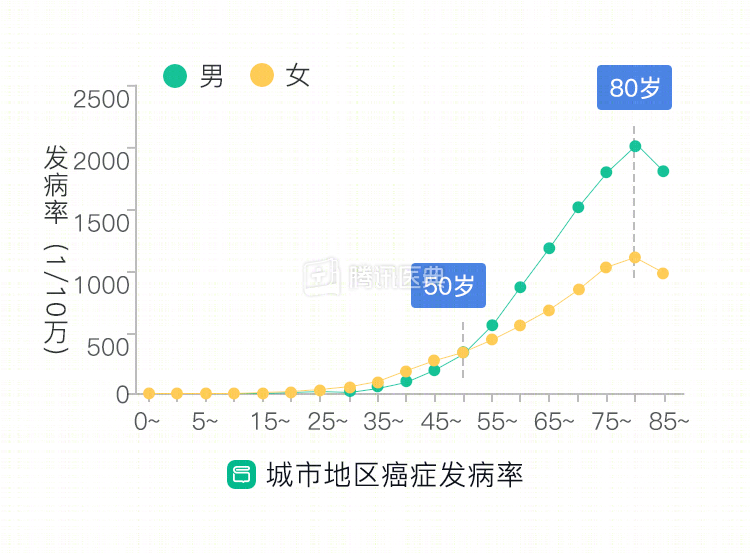
Why are there so few records of our ancestors getting cancer? Why don’t dogs and cats get cancer? Maybe he or she didn’t live to be old enough to get cancer. Cancer is an age-related disease, as is lung cancer. The latest cancer data from the National Cancer Center in China show that the incidence of cancer rises gradually with age, with a faster increase after age 40 and a peak at age 80.
Heredity
We carry a lot of genetic information in our bodies that we inherited from our parents, like labels that precisely distinguish each person’s traits. Lung cancer is not a genetic disease, but there is a certain “genetic susceptibility,” a genetically determined predisposition to the disease, and the environment has a strong influence on its occurrence.
Oncogenes that are closely related to lung cancer include the ras and myc gene families, cerbB-2, Bcl-2, c-fos, and c-jun genes; related oncogenes include p53, Rb, CDKN2, and FHIT genes; molecular alterations associated with lung cancer development include mismatch repair genes such as hMSH2 and hPMS1 abnormalities, and telomerase expression. The expression of telomerase.
Smoking
It is often said that “a cigarette after a meal is better than a cigarette after a meal”. In fact, long-term smoking can really lead to early death. The fact is that the benzopyrene, nicotine, nitrosamines and a small amount of radioactive elements such as polonium in the smoke are carcinogenic. A puff of smoke has several or dozens or even hundreds of carcinogens. All kinds of cigarettes, cigars and pipes are carcinogenic.
Compared to nonsmokers, the risk of lung cancer is on average 4 to 10 times higher in smokers, and up to 10 to 25 times higher in heavy smokers.
There is a clear quantitative relationship between the amount of smoking and lung cancer, with the younger the age of initiation, the longer the duration, and the greater the amount, the higher the incidence of lung cancer. The risk of lung cancer in a household where the husband smokes and the wife does not smoke is twice as high for the wife as for the wife in a household where both spouses do not smoke, and the risk increases with the husband’s smoking.
The incidence of lung cancer in men in the United States increased dramatically in the 1950s as a result of the increase in smoking in the early part of the 20th century. In contrast, over the past two decades, lung cancer mortality in the United States decreased by 43% in men from 1990 to 2014 and by 17% in women from 2002 to 2014 due to the widespread perception of the health risks of smoking, the implementation of comprehensive tobacco control, and early diagnosis and treatment.
Air pollution
PM2.5 is a topic of concern, and some studies have shown that PM2.5 can enter the alveoli and not only affect lung gas exchange, but can even penetrate the lungs and sneak into the bloodstream, causing health problems. The proportion of people who are exposed to PM2.5 for a long time and end up with lung cancer, especially lung adenocarcinoma, is very high. And indoor coal use, exposure to soot or its incomplete combustion products, and oil fumes released from heating during cooking are also risk factors for lung cancer.
Occupational carcinogens
Occupational factors that have been identified as causing lung cancer include asbestos, arsenic, chromium, nickel, beryllium, coal tar, mustard gas, trichloromethyl ether, chloromethyl ether, heating products from tobacco, and radon gas from the decay of radioactive materials such as uranium and radium, ionizing radiation, and microwave radiation. These factors can increase the risk of lung cancer by 3~30 times. Among them, asbestos is a recognized carcinogen, and the lung cancer mortality rate of smokers exposed to asbestos is 8 times higher than that of non-exposed smokers.
Diet and nutrition
Some studies have shown that lower consumption of beta-carotene-containing vegetables and fruits increases the risk of lung cancer, while higher consumption of beta-carotene-containing green, yellow, and orange vegetables and fruits and vitamin A-containing foods reduces the risk of lung cancer, a protective effect that is particularly pronounced in current or former smokers. Some studies, however, have come to the opposite conclusion, suggesting that high long-term supplementation of beta-carotene and vitamin A in smokers can instead increase the incidence of lung cancer. This area is still controversial.
Lung cancer is often complex, and there is nothing we can do about it for now in the face of genetics, age, and other factors. However, measures such as tobacco control and cessation, avoidance of high-risk occupational exposure, and good protection on hazy days can reduce the relative risk. Regular medical checkups and regular lung cancer screenings for high-risk groups are conducive to early diagnosis and treatment and a relatively good prognosis.
Co-reviewed by: Guangdong Provincial People’s Hospital Guangdong Lung Cancer Institute Dr. Zhiyong Chen Dr. Jiatao Zhang
Co-authors: Dr. Ma Yue, Department of Oncology, Renji Hospital, Shanghai Jiao Tong University