Overall, bronchoscopy is a relatively safe test, but there can be some risks. What you need to know is that serious complications are unlikely, and that if you pay attention to your condition, notice abnormalities and tell your doctor in a timely manner, and cooperate with him or her, you can complete the test successfully.
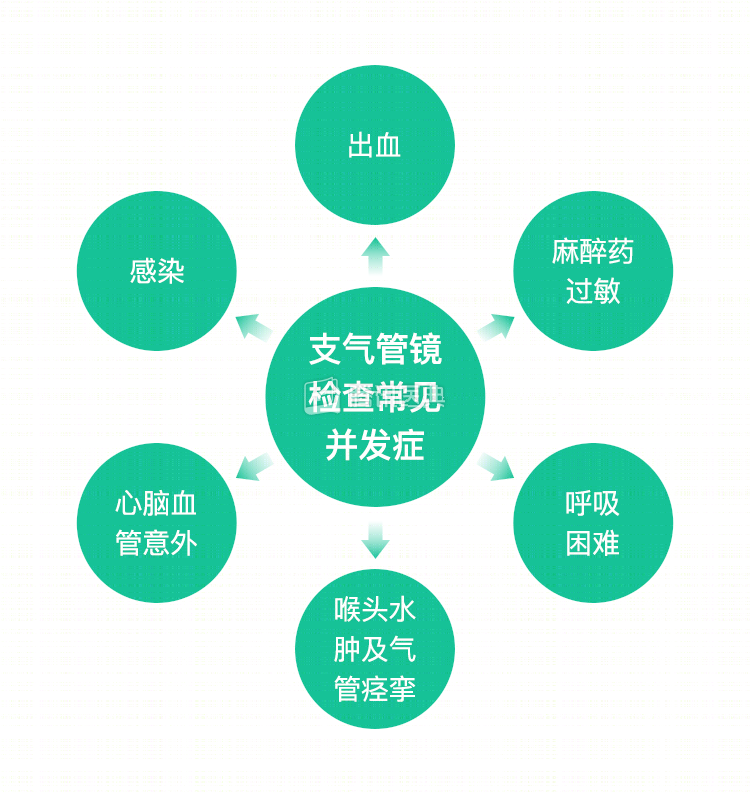
Bleeding
This is the most common complication of bronchoscopy and the most common cause of death. However, the fact is that the incidence of hemorrhage is only about 0.7%. In general, a small amount of bleeding (a dozen or so mouthfuls of “blood in sputum” or a small amount of coughing up blood) within 2 to 3 days after surgery is normal and does not require special treatment, and the physician may use some hemostatic medications; if this range is exceeded, such as dozens of mouthfuls of bloody sputum per day, or a whole mouthful of fresh blood, or a large amount of coughing up blood more than 3 to 5 days after surgery, the physician will be alert. The doctor will be alert and may do intravenous hemostatic treatment, and if necessary, emergency surgery to stop the bleeding.
Patients at higher risk for bleeding are usually evaluated by physicians before surgery and preventive measures are taken in advance.
Anesthetic allergy
There may be sudden onset of chest tightness, shortness of breath, palpitations, pallor, laryngeal edema, deficiency, drop in blood pressure, cardiac arrhythmia, and in severe cases, respiratory depression and even cardiac arrest.
Once it occurs, doctors usually immediately discontinue medications that may cause allergies and administer resuscitation, including oxygen, keeping the airway open, and applying anti-allergy and anti-shock medications.
Before using medications, you should always tell your doctor in detail what foods and medications you have been allergic to.
Hypopnea
You may experience some degree of dyspnea during the bronchoscopy, but there is no need to be overly anxious; being nervous can make it worse.
It is generally accepted that if your arterial partial pressure of oxygen falls below 60 mm Hg before the test, the test is risky. The doctor will take measures such as administering oxygen (high-frequency ventilation if necessary), monitoring oxygen saturation, minimizing the duration of the test, and also closely monitoring respiration and pulse rate.
Laryngeal edema and tracheal spasm
Often caused by inadequate anesthesia or unsuccessful insertion of the scope. Common triggers are poor subglottic and bronchial anesthesia, and if you have a history of bronchial asthma, you may be more likely to develop tracheospasm. You should always inform your doctor in advance, and your doctor will usually choose to do the exam during asthma remission.
During the procedure, the doctor will enhance the anesthesia of the voice and bronchi, operate gently, and minimize irritation. If laryngeal edema and bronchospasm occur, the doctor will stop the procedure immediately and give emergency treatment.
Cardiac and cerebrovascular accidents
A small number of patients may have a cardiovascular accident, most commonly cardiac arrest, due to irritation of the airway during the examination resulting in dyspnea, violent coughing, or elevated blood pressure. This is most often seen in patients who are elderly, have inadequate coronary artery supply, or have other underlying cardiac disease.
To try to avoid this, the doctor will do an electrocardiogram before the procedure to “know” what to expect. The doctor will monitor the patient closely during the examination, along with the ECG monitoring, so that problems can be detected early and resuscitated immediately.
Infection
Bacteria growing in the respiratory tract can enter the bloodstream through the post-biopsy wound and cause a local, or even systemic, infection. For this reason, your doctor will monitor you closely after the test. If you develop fever and sputum, the cause will be sought immediately and anti-infective treatment will be targeted.
Postoperative fever
Postoperative fever
Temporary fever is common after bronchoscopy and usually does not require special management. If the fever persists, or if the chest radiograph suggests inflammation in the lungs, the physician may treat with antibiotics.
In addition to these complications, there are some rare adverse reactions and accidents, such as pneumothorax, mediastinal emphysema, and broken inspection forceps and brushes. If they occur, experienced physicians will treat them according to the appropriate symptoms. It is most important that you do not panic and cooperate closely with your doctor.
In conclusion, the risk of serious complications from bronchoscopy is very low as long as the operating physician is experienced and uses the appropriate equipment, so do not choke on it and delay treatment.
Co-reviewed by: Guangdong Provincial People’s Hospital Guangdong Lung Cancer Institute Dr. Qing Zhou, Chief Physician Dr. Xiaoyan Bai Dr. Mei-Mei Zheng