Lung cancer may not have obvious symptoms in its early stages; when some symptoms appear, they may be easily mistaken for other diseases, delaying the best time for diagnosis and treatment. The following warning signs suggest that you should seek medical attention as soon as possible.
Call emergency services immediately if you experience any of the following:
- New onset, or sudden onset, of pressure or crushing chest pain that gets progressively worse; or other symptoms of a heart attack, such as shortness of breath and nausea, occurring at the same time.
- New onset, or sudden onset, of dyspnea.
- Large amounts of hemoptysis, to a degree that exceeds bloody sputum or blood in the sputum.
- Vomiting so much that you feel like you are going to faint when you sit up or stand up.
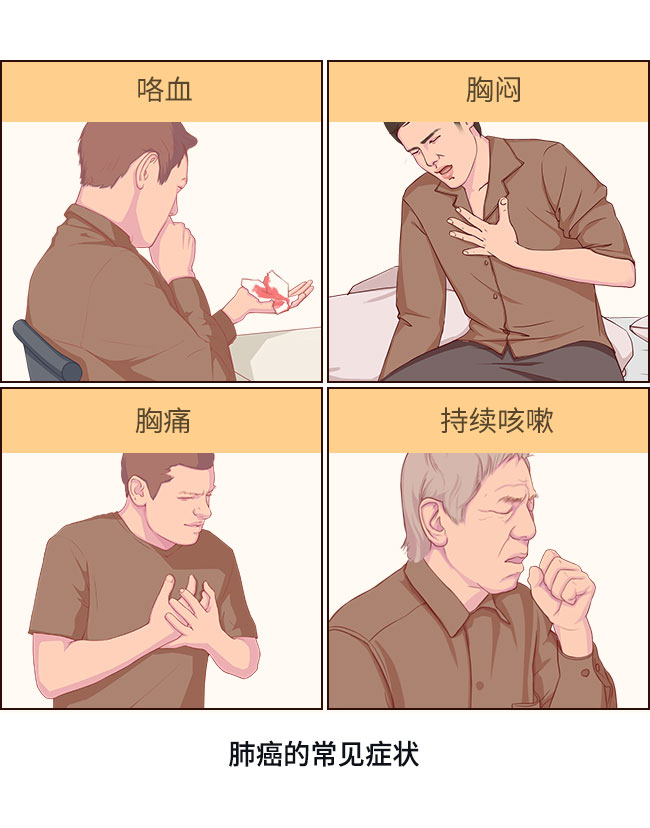
See a doctor immediately if you experience:
- Struggling, shallow, rapid breathing with shortness of breath or wheezing, also at rest.
- Swelling of the neck and face.
The presence of the following suggests the need to have the condition evaluated by a physician:
- New onset of persistent chest pain that is worse than the usual discomfort from coughing and that worsens with deep breathing.
- Symptoms of pneumonia, such as shortness of breath, cough, and fever, are present.
- Cough with a small amount of bright red or rust-colored blood in the sputum.
- Coughing up frequent yellow-green mucus from the lungs (rather than the “nasal drip” that flows down the back of the nose into the throat) for more than 2 days.
- The cough often causes vomiting.
- Cough that lasts more than 4 weeks.
- Normal breathing at rest, with severe shortness of breath after any physical activity.
- Unexplained fatigue that gets progressively worse.
- Unexplained fatigue that gets progressively worse.
- Unexplained weight loss.
Symptoms of lung cancer are usually caused by obstruction of the airways, or by cancer that has metastasized to the appropriate organ. Any suspected symptoms should not be ignored, especially persistent cough, blood in the sputum, wheezing, hoarseness, or recurrent lung infections, and require a thorough examination (e.g., chest X-ray) in the hospital.
Which departments to visit?
Pulmonology, thoracic surgery, medical oncology, and radiation oncology are available.
Co-reviewed by: Guangdong Provincial People’s Hospital Guangdong Lung Cancer Institute Dr. Yue-Li Sun Dr. Xiaoxiao Peng