The latest release of Cancer Statistics 2018 in the United States shows a gradual decline in the incidence of cancer in the US population. The overall incidence of lung cancer continues to decline, and the decline is about twice as large in men as in women.
At the same time, cancer death rates have also declined, with the largest declines in lung cancer deaths, down 45% (1990 to 2015) and 19% (2002 to 2015) for men and women, respectively.
We all know that lung cancer is the most prevalent tumor in China and also the leading cause of cancer deaths. Is the incidence of lung cancer increasing in our country? Is it possible that we will see a decline in lung cancer incidence and mortality rates like the United States?
Now, with questions in mind, let’s look at the changing trends in lung cancer in our country.
Lung cancer incidence in China: on the rise, or on the decline?
The incidence of lung cancer in China is rising, or is it falling?
The age-standardized incidence of lung cancer, adjusted for population proportions, is on the decline in the Chinese population in the 2015 release of Global Cancer Data, 2012 (GLOBOCAN 2012) by the World Health Organization (WHO).
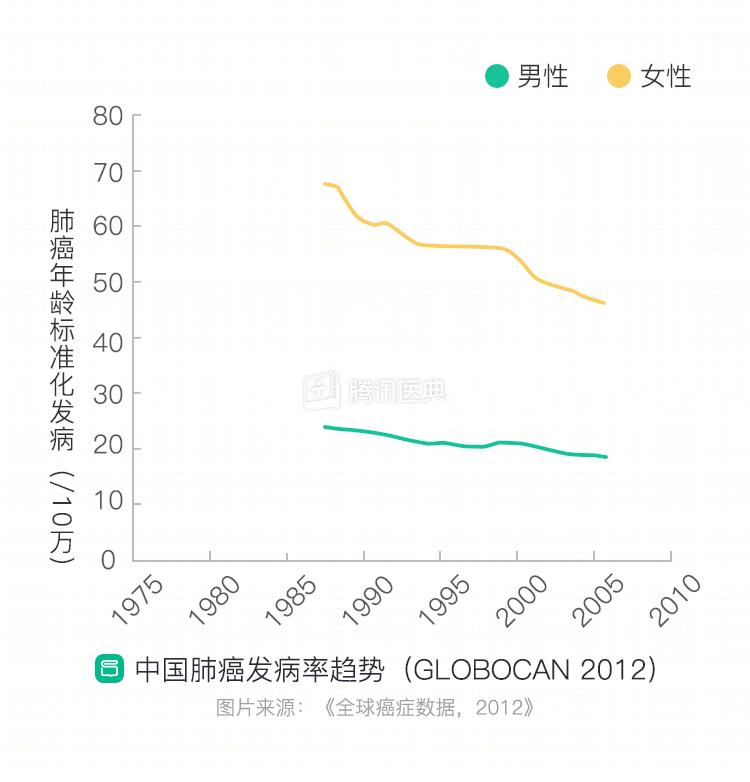
But no downward trend in lung cancer incidence was observed in the 2015 China Cancer Statistics, published in 2016 by China’s National Cancer Center and National Tumor Registry.
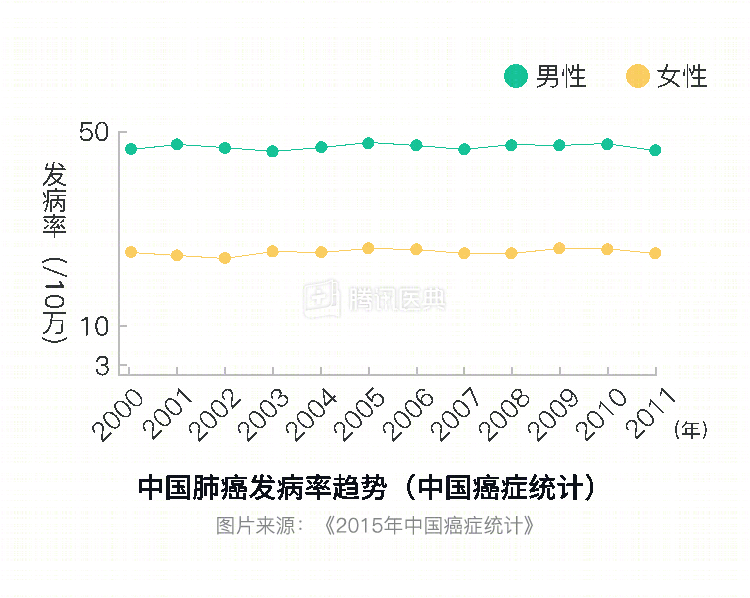
Chen Wanqing, one of the lead authors of China Cancer Statistics 2015 and director of the National Cancer Registry, analyzed that although GLOBOCAN 2012 and China Cancer Statistics take different statistical approaches, the two are close in terms of mortality, so presumably, the difference in cancer incidence between the two mainly stems from the coverage and quality of China’s cancer registries at the time of data collection. The difference in cancer incidence is presumably due to the coverage and quality of Chinese cancer registries at the time of data collection.
In summary, the incidence of lung cancer in China has not declined.
What groups are experiencing increased lung cancer incidence?
The Chinese Lung Cancer Epidemiological Survey analyzed lung cancer incidence data from 2000 to 2010 in different populations in China and found that the increase was more pronounced in rural than in urban populations, and more pronounced in women than in men.
In urban areas, there was only a slight and slow increase in incidence in men in the 50-59 age group; in women, the increase was more pronounced in those over 80 years of age.
In rural areas, there was a trend toward increased incidence of lung cancer in people older than 70 years in both men and women, with a slight increase observed in the remaining age groups.
The reason for the increase may be mainly related to smoking.
What are the trends in lung cancer mortality in China?
In terms of lung cancer deaths, the data from GLOBOCAN 2012 and China Cancer Statistics 2015 are relatively close.
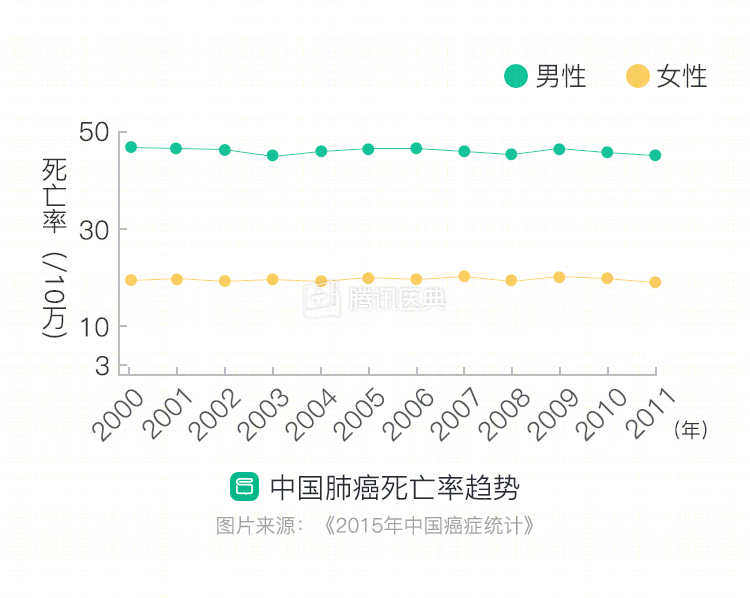
The graph shows that lung cancer, the number one cause of death due to cancer, did not see a significant increase or decrease between 2000 and 2011, remaining at a steady high level.
The results of another survey of cancer death trends in China (2002 to 2010) show similar trends.
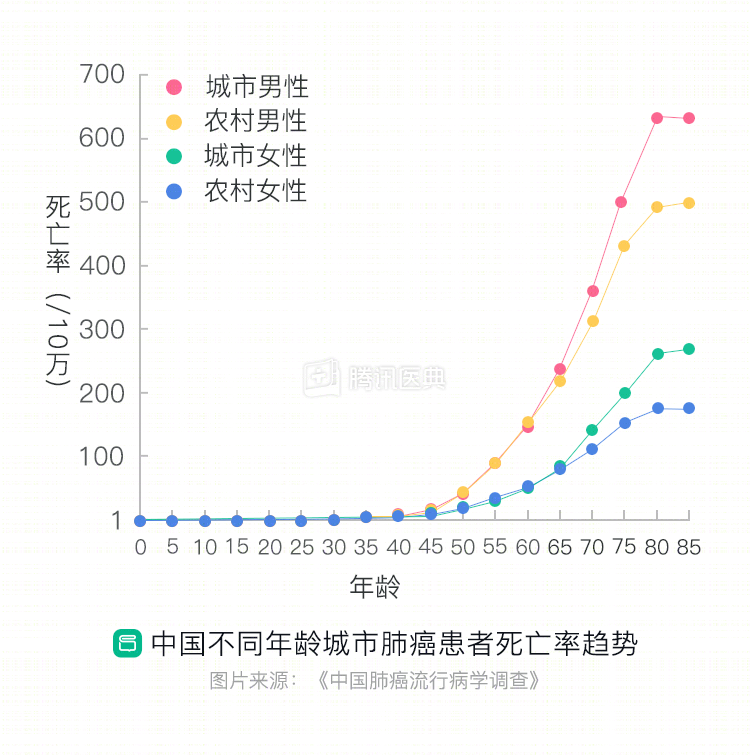
Lung cancer mortality was significantly higher in men than in women when looking at different populations. The lung cancer mortality rate was once highest in urban men but showed a downward trend; at the same time, it was significantly higher in rural men. On the other hand, lung cancer mortality rates for women are increasing in both urban and rural areas.
Analysis of lung cancer deaths in China in 2010 in the Chinese Lung Cancer Epidemiological Survey showed that lung cancer mortality began to increase significantly after age 50 in both urban and rural areas, in both men and women, and peaked around age 80.
What are the likely trends in the incidence of lung cancer in China?
The incidence of lung cancer is mainly associated with smoking, environmental (air) pollution, indoor pollution, occupational exposure, genetic mutations, and chronic obstructive pulmonary disease (COPD), with smoking being the most important cause of lung cancer.
There are about 320 million smokers in China, consuming more than 40% of the world’s tobacco, and the number of smokers is increasing. About 28.1% of adult men and 2.5% of women smoke, and about 52.7% of smokers are between the ages of 20 and 34. At this rate, the incidence of lung cancer in China is hardly decreasing.
The increase in the incidence of lung cancer is not only due to the fact that more people are getting lung cancer, but it may also be related to the increased “detection rate” due to widespread screening and advances in detection technology. The rate of detection of lung cancer in China is likely to increase as the economy grows, as living standards and medical care improve, and as policies become more supportive.
Based on the above data, we can predict that the incidence of lung cancer in China is likely to continue to rise.
On the other hand, mortality from lung cancer is related not only to incidence but also to the stage of disease at the time of detection, level of treatment, and medical resources (medical facilities, accessible drugs, etc.) In this regard, 30% of the population in urban areas in China currently receives 70% of the medical resources, but this inequality is changing.
We can perhaps be more optimistic that lung cancer mortality will decline as our healthcare improves.
Co-reviewed by: Guangdong Provincial People’s Hospital Guangdong Lung Cancer Research Institute Dr. Liao Rijiang, deputy chief physician Dr. Zhang Chao