What are “radioactive particles”?
.
“Radioactive particles”, commonly known as “particle knives”.
Professionals seal radioactive nuclides in a metal shell and make “particles” that are less than a millimeter thick and half a centimeter long. The doctor, guided by ultrasound, CT and other imaging techniques, puts the particles inside or next to the tumor at regular intervals through an endoscope or surgery such as a thoracoscope, like a “mine”. The particles that are “inside” the tumor will emit radiation over a certain period of time to kill the tumor.
Radioactive particles are the most direct way to kill tumors up close and personal than other treatments. Iodine 125 (I-125) particles are the most widely used in clinical practice.
When I-125 is implanted in a lung cancer lesion, this tiny radioactive source emits continuous, short-range radiation that kills tumor tissue; as the distance increases, the radioactivity decays rapidly, thus protecting normal tissue around the tumor from damage or minimal damage. The best efficacy of the particles requires precise implantation, as well as stability in spatial distribution and position of the particles.
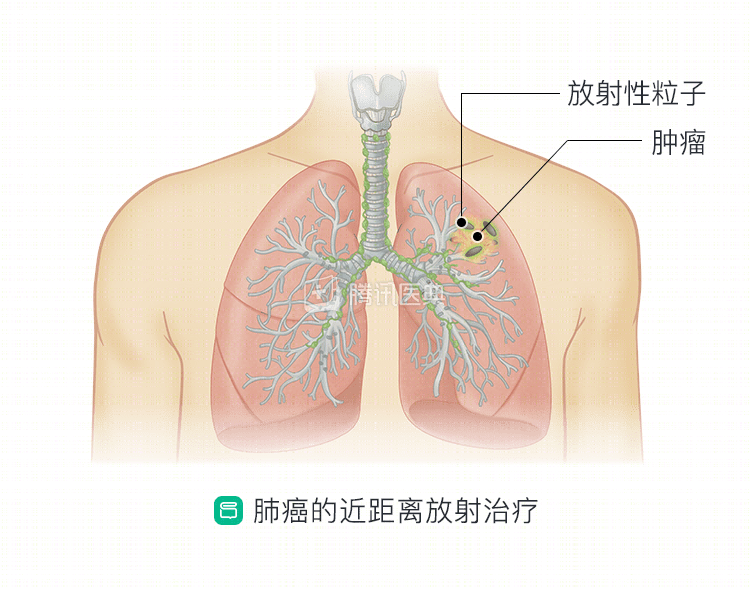
Which lung cancer patients should be considered for Particle Knife?
Radioactive particles are not currently a good option for patients with lung cancer.
Radiation is not currently a routine treatment for lung cancer, and its clinical use is limited to palliative or adjuvant treatment after failure of other standard treatments such as radiotherapy and targeted therapy, such as local tumor progression after failure of standard treatments such as surgery and radiotherapy for locally advanced lung cancer, or palliative treatment for patients with advanced disease. In addition, like common radiotherapy, it is a local treatment that produces only local effects and cannot treat advanced patients with multiple systemic metastases alone.
What to look for in radioactive particle therapy?
For physicians, the key to treatment is the technicality of particle implantation. The physician can place the particles into the tumor area under CT image guidance and through the bronchoscope, with the right placement and distribution of the particles.
After implantation, you are a “walking radioactive source” and it is recommended that you wear lead protective clothing after surgery to protect your healthcare provider, family and others around you from radiation exposure. For 90 days after implantation, if you are not wearing a lead suit, you need to keep a “cautionary distance” (about 1.5 meters) from people around you.
After implantation, the particles need to be monitored periodically to see if they fall out. Particles implanted in the lungs may be coughed up, so you should be extra careful when you cough. If you ever find that the particles have fallen out, they should be put into a closed lead container and sent to the hospital for recycling.
What are the possible adverse effects of Particle Knife treatment?
What are the possible adverse effects of particle knife therapy?
The main possible adverse effects of particle therapy are caused by puncture, such as bleeding, infection, pneumothorax, and, in a rare but critical situation, air embolism (air in the lungs entering a blood vessel and causing an embolism).
However, please be confident that your doctor will do a good job of preventing and responding to the common complications that can be avoided with active cooperation and timely management.
Co-reviewed by: Guangdong Provincial People’s Hospital Guangdong Provincial Institute of Lung Cancer Dr. Pan Yao, Chief Physician Dr. Chen Zhiyong Dr. Zhang Jiatao