Who doesn’t hate needles?
But there is a group of people around us who have to endure the pain of needles every day.
They are some people with type 2 diabetes.
So is there an “ultimate” solution that can keep your blood sugar in check for days with just one injection?
Up to 100 million people with type 2 diabetes
In our country, there are 100 million people with type 2 diabetes. When they hear their doctor recommend insulin, their first reaction is often fear and worry, and so they try to delay or refuse it in any way they can.
Surveys show that only 25% of patients who take oral hypoglycemic drugs and have poor outcomes will initiate insulin injections within 2 years; even after 5 years, about 50% of patients do not receive insulin therapy.
The reasons why patients refuse or delay insulin injections are easy to understand: Will it hurt to get the needle every day? Will the treatment dose get higher? Will the insulin make me gain weight? What will I do if I have hypoglycemia?
But if insulin therapy is not started in time, blood sugar may not be controlled at the desired level; then, many complications can ensue, leading to a reduced quality of life and even a shorter life span.
Make insulin longer-lasting, with one injection for a week
In fact, in the century since insulin was discovered, scientists have been working to make insulin injection protocols easier.
From animal insulin, to human insulin, to insulin analogs, it has become easier and easier to preserve and its effects last longer and longer.
Long-acting insulins are now commonly used, and only one injection a day is needed to achieve the desired glucose-lowering effect.
Even so, many patients are still resistant.
So, is it possible to manage your blood sugar for days with just one injection?
Recently, the New England Journal of Medicine, a top international medical journal, published the results of a phase 2 clinical trial of insulin icodec, the “big boss” of insulin, which was able to control blood sugar for a whole week with just one injection. The study was conducted in a phase 2 clinical trial in the journal
What’s the mechanism behind a single injection that works for a week?
Why is insulin icodec the same as insulin?
Why do some insulins control blood sugar for a few hours and others for a few days?
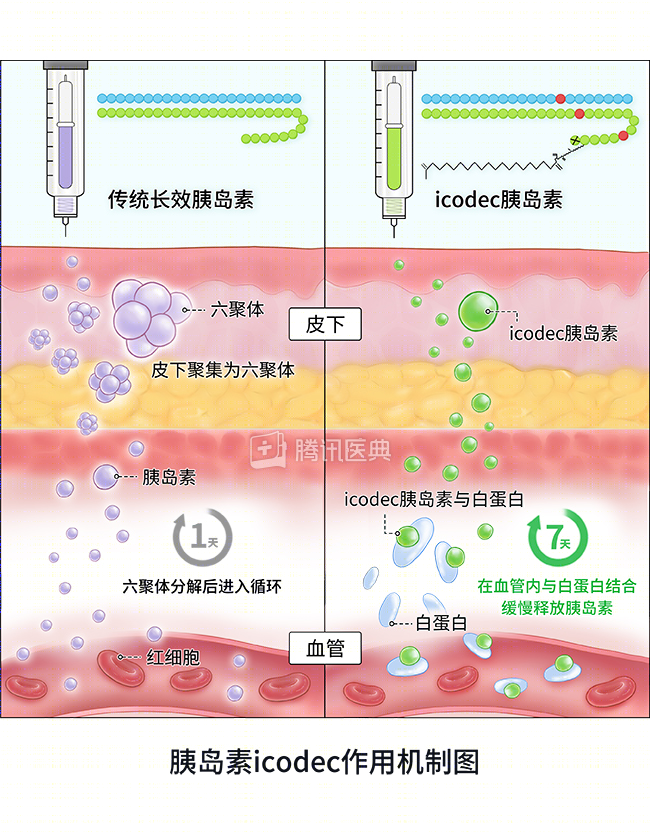
Actually, it has to do with the half-life of the drug.
In short, the half-life is how quickly the drug is cleared in the body.
A drug with a long half-life means that it is slow to be eliminated in the body and takes a long time to work.
The half-life of “big boss” insulin icodec is about 1 week, so patients don’t need to take it as often.
The secret behind this is that scientists have given its structure a little “disguise” to prevent it from being identified and removed by the body’s “cleaners” and also to give it a 24-hour bodyguard. “It also has a 24-hour bodyguard to achieve the goal of slow release of insulin. In this way, the ability to control blood sugar more permanently is achieved.
Excellent efficacy and few adverse effects in phase 2 trial
So how well does insulin icodec control blood glucose compared to long-acting insulin?
Now, let’s take a look at how this study was conducted!
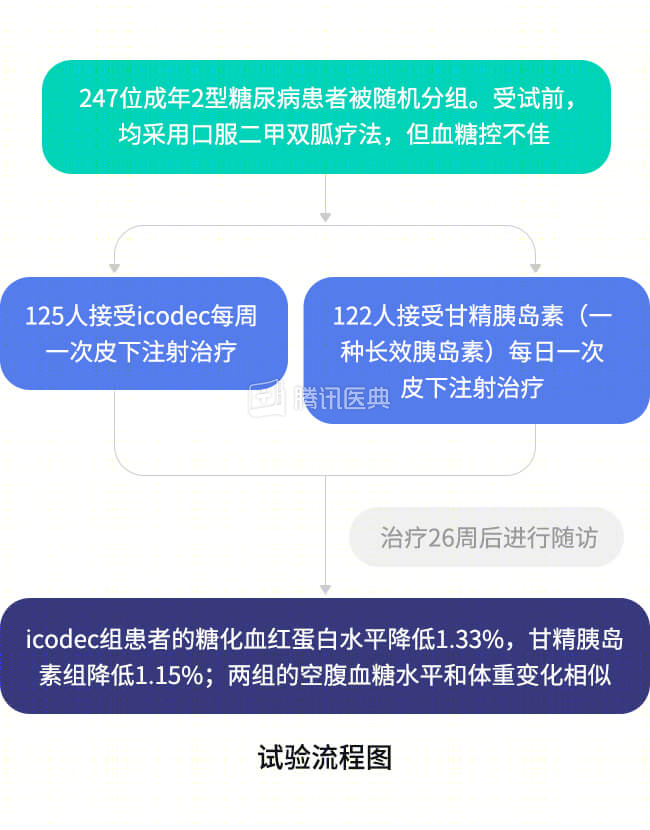
The results of the study showed that once-weekly insulin icodec injections were about as effective at lowering glucose as daily glargine insulin injections; and in terms of adverse events, there was essentially no difference between the two groups and lower rates of both hypersensitivity and injection site reactions.
However, the incidence of hypoglycemia was higher in the icodec group than in the glargine insulin group (54% vs. 38%). The difference between the two groups was not statistically significant, but this trend should still be taken into account.
Researcher Harpreet Bajaj of the LMC Diabetes and Endocrine Centre in Ontario, Canada, who participated in the study, said, “We know that many people with type 2 diabetes prefer regimens with fewer and more convenient injections. This phase 2 clinical trial demonstrates that icodec can help these patients escape the tedious and complicated daily regimens they currently use and even achieve longer periods of glycemic control.”
Will insulin icodec succeed in stepping up to the plate of the insulin family and shine in clinical care?
We are looking forward to the results of the clinical phase 3 trial.