Breast biopsy, a method often used to diagnose breast disease, is simply the process of removing a sample of tissue from a suspicious area of the breast by various methods and examining it under a microscope for the presence of breast cancer.
Why do you need a breast biopsy?
The purpose of a breast biopsy is to confirm whether a lump felt in the breast or a suspicious area found on an X-ray is cancerous, that is, malignant or benign. Pathologic examination of a breast sample obtained by biopsy is the only reliable way to confirm the presence of cancer cells.
What should I do to prepare for a biopsy?
Tell your doctor if you have any of the following.
- Are taking any medications or dietary supplements (e.g., vitamins, etc.).
- Are allergic to medications, including anesthetics.
- Allergic to rubber.
- Taking blood thinners, or have had bleeding problems.
- Pregnancy or possible pregnancy.
The doctor will first explain why the test is needed, the risks of the test, how it will be performed, and what the results mean. The person will then be asked to sign an informed consent form indicating that he or she understands the risks of the test and agrees to it.
People who are taking blood thinners may need to stop taking them 1 week before the biopsy.
Tests such as blood tests may be needed before the biopsy is performed. If general anesthesia is required (no consciousness or pain during anesthesia), a strict water fast is required, which means that no food or drink is allowed for a period of time before the procedure, or the procedure may be cancelled. If you need to take medication on the day of surgery, please take it with a small sip of water. IV access will be established in the arm prior to general anesthesia, and sedative medication will be given approximately 1 hour prior to the biopsy.
How is the biopsy performed?
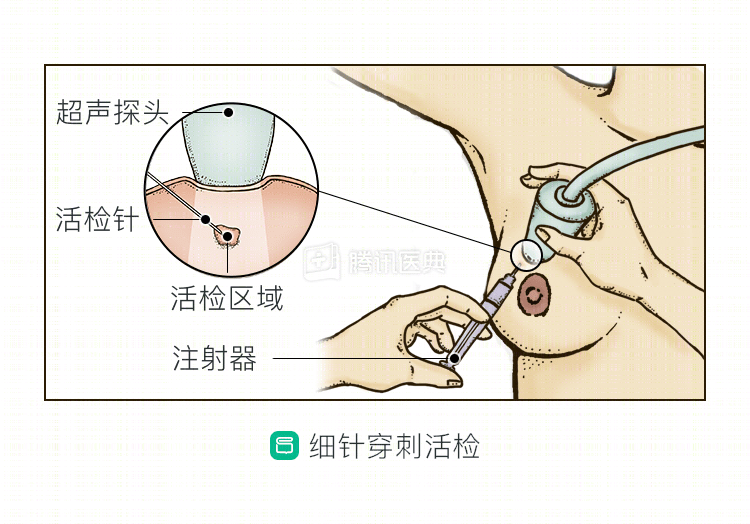
Fine needle aspiration biopsy
The person is asked to remove clothing from the waist up and sit or lie on the exam table with hands at the sides of the body or above the head (depending on what position is easiest to feel the mass). Depending on the size and location of the lump, the doctor will decide whether or not to inject anesthetic medication into the area to be biopsied, then insert a puncture needle into the breast tissue, aspirate the tissue sample and send it to the lab. The biopsy procedure usually takes 5 to 15 minutes, during which the patient must remain still. After the biopsy needle is removed, pressure is applied to the puncture site for a few moments to prevent bleeding.
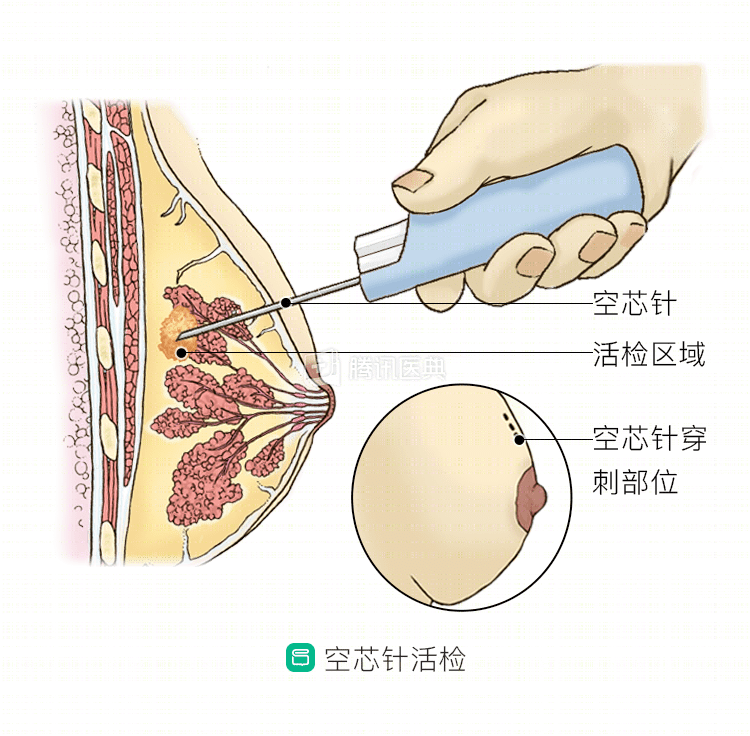
Hollow-core needle biopsy
The position is the same as for a fine needle aspiration biopsy. After the doctor injects anesthetic, a small incision is made in the skin and a biopsy needle with a special tip is inserted into the breast tissue to remove several samples for examination. After the needle is removed, firm pressure is also applied to the puncture site. The entire procedure takes about 15 minutes and may be repeated to ensure that enough tissue samples have been collected.
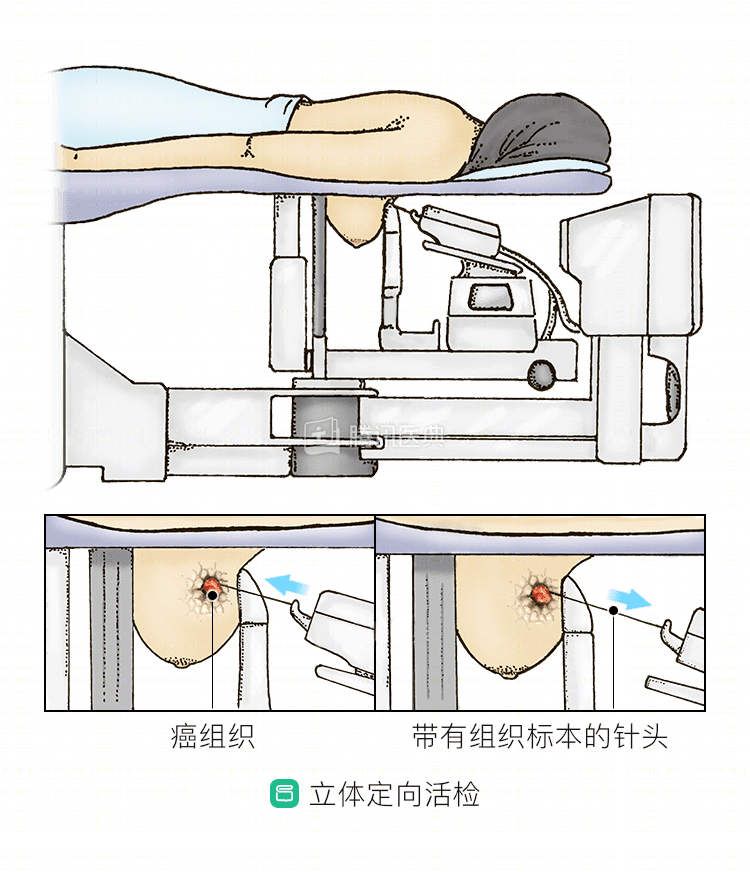
Stereotactic biopsy
It is performed by an imaging physician in the imaging department. The subject will lie on a special examination table with the breast hanging down through a hole in the table after removing clothing above the waist, and a mammogram is taken to pinpoint the location of the mass.
A small incision is made in the skin after the doctor injects anesthesia, and a puncture needle is inserted under special x-ray guidance into the area to be biopsied, usually removing several samples. The entire procedure takes about 60 minutes, but most of the time is spent locating the biopsy area. The subject must remain stationary during the biopsy.
Small skin incisions do not require sutures, and firm pressure on the puncture site is sufficient to prevent bleeding. A small metal marker is usually placed in the breast where the biopsy sample is removed to locate the lesion if surgery or an x-ray is needed. Even without surgery, the metal marker does not have any effect on the body if it is left in.
Excisional biopsy
Usually this needs to be done in the operating room. After removing all or most of the clothing above the waist, the subject sits or lies on the examination table with his or her hands at the sides of the body or raised above the head. The procedure can be performed under local or general anesthesia, which may also be sedated for local anesthesia and administered through an arm infusion for general anesthesia, without awakening during the procedure.
After anesthesia, the surgeon finds the mass through a skin incision and removes it, and then sends the removed tissue for examination. The skin incision needs to be sutured. The surgical biopsy takes about 60 minutes.
What will the biopsy feel like?
What will you feel during a biopsy?
With local anesthesia, you will only feel pain when the anesthetic needle is inserted and the drug is injected, and there is no pain but may be pressure when the biopsy needle is inserted. For 2 to 3 days after a fine-needle aspiration biopsy, hollow-core needle biopsy, or stereotactic biopsy, there may be pressure, bruising, swelling, or slight bleeding at the biopsy site, which can be relieved with an ice pack or some over-the-counter pain medication (other than aspirin) that does not require a physician’s prescription. Do not lift heavy objects or perform other activities that strain the chest muscles for 24 hours after the biopsy.
People who have had a biopsy and have received general anesthesia may wake up with numbness at the biopsy site and may feel drowsy for a few hours. Fatigue may be experienced 1 to 2 days after the biopsy. If a tracheal tube was used during anesthesia to help with breathing, there may also be a slight sore throat, which may be relieved by using throat lozenges and warm saline gargles. After excisional biopsy, the breast may be tender, firm, swollen, and bruised, and ice or pain medication as described above may also be indicated. The pressure pain will disappear within about 1 week and the bruising will subside within 2 weeks, but the firmness and swelling may persist for 6 to 8 weeks. A bra or sports bra should be worn for 2 to 3 days after the biopsy to provide support and not to lift heavy objects or perform other activities that strain the chest muscles.
What are the possible risks of a biopsy?
- An infection at the biopsy site can be treated with antibiotics.
- Bleeding at the biopsy site.
- No abnormal tissue samples were taken.
- Vertigo and syncope.
If any of the following occur, seek immediate medical attention.
- Pain lasting more than 1 week.
- Redness, severe swelling, bleeding, or pus from the biopsy site.
- Fever.
- Fever.
Methods other than fine-needle aspiration biopsy may leave a small scar on the surface of the breast, which usually becomes less visible over time.
How do I take care of myself after a biopsy?
The biopsy site may require a special bra and dressing for a few days after the biopsy. Small tapes or sutures will remain at the incision site. Do not attempt to remove them yourself. It can be removed at a follow-up visit or you can wait for it to come off on its own.
It may be necessary to apply medication to the biopsy area, apply ice, or change your own bandages at home. The healthcare provider will present information on showering, soaking, and wound care.
If needed, pain medication may be ordered. To reduce the risk of bleeding, do not take aspirin or products containing aspirin for the first 3 days after surgery, unless otherwise prescribed by your doctor.
The biopsy area may also become dark and purple for a few days afterwards.