Mr. Wang’s Story: Lung Cancer Missed by Chest X-ray
Mr. Wang, 50, had a cold for nearly 2 weeks, and his main symptom was a cough, with no significant abnormalities found on a chest X-ray. Because he was a 30-year old smoker, his doctor recommended a low-dose computed tomography (LDCT) scan of his chest, which revealed a 12-mm diameter “glassy” nodule in the upper left lung. “nodule in the left upper lung, 12 mm in diameter. The doctor told him that the nodule was close to the periphery and would not cause a cough and could be reviewed in 3 months. While waiting for his review, Mr. Wang was very anxious, so his doctor recommended that he undergo minimally invasive thoracoscopic surgery to remove it. He accepted the doctor’s suggestion and the postoperative pathology confirmed that it was an adenocarcinoma in situ.
Mr. Wang remembered that he had just had a physical examination at his workplace a month ago and all the results were normal, so why was he found to have lung cancer in such a short time?
Of course, lung cancer did not occur within this 1 month, but because LDCT has a higher diagnostic rate for lung cancer than the chest X-ray done during the physical exam.
Why screen for lung cancer with LDCT
LDCT is a CT that allows the examiner to “eat” less radiation because the lungs are different from other tissues and organs in structure, containing more air and lower density, so a very low dose of X-rays can form a satisfactory image. The radiation dose of one LDCT is equivalent to 15 conventional X-ray chest examinations, or the natural radiation (naturally occurring radon radiation) received by human body for 6 months. Since it is a computed tomography scan followed by re-imaging, LDCT also overcomes the shortcomings of X-ray chest film which is insensitive to small non-calcified nodules and can detect tiny lesions less than 5 mm in diameter, and the cost of examination is lower than that of ordinary CT.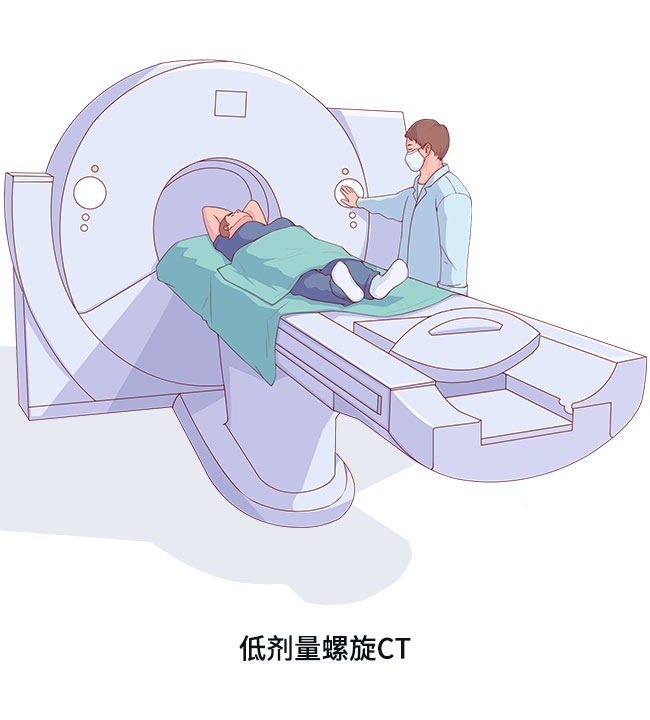
Large-scale clinical trials have shown that screening scans of the chest with LDCT can detect more early resectable lung cancers and are particularly useful for lung cancer screening in high-risk groups.
LDCT is 4 to 10 times more sensitive than conventional chest radiography in detecting early stage peripheral lung cancer. Data from the International Early Lung Cancer Action Plan show that annual LDCT screening detects 85% of stage I peripheral lung cancers, with an expected survival rate of 92% at 10 years after surgery. The U.S. National Lung Cancer Screening Trial demonstrated that LDCT screening reduces lung cancer mortality by 20%, making it the most effective lung cancer screening tool available.
The National Comprehensive Cancer Network (NCCN) guidelines suggest risk assessment factors for lung cancer screening, including history of smoking (current and past), radon exposure, occupational history, history of cancer, family history of lung cancer, history of disease (chronic obstructive pulmonary disease or tuberculosis), and history of smoke exposure (passive smoking exposure). Risk status was divided into 3 groups.
- High-risk group: age 55 to 74 years, history of smoking no less than 30 pack-years, history of cessation less than 15 years; or age no less than 50 years, history of smoking no less than 20 pack-years, and one additional risk factor other than passive smoking.
- Intermediate risk group: age less than 50 years, history of smoking or passive smoking exposure less than 20 pack-years, and no other risk factors.
- Low-risk group: age less than 50 years, history of smoking less than 20 pack-years.
- Combined with at least one of the following risk factors:
- Smoking for no less than 20 pack years, including former smokers who have quit for less than 15 years;
- Passive smokers;
- Passive smokers;
- History of occupational exposure (to asbestos, beryllium, uranium, radon, etc.);
- History of malignancy or family history of lung cancer;
- History of COPD or diffuse pulmonary fibrosis.
NCCN guidelines recommend lung cancer screening for the high-risk group.
The “Expert Consensus on Low-Dose Spiral CT Lung Cancer Screening” published by the Cardiothoracic Group of the Chinese Medical Association Radiology Section in 2015 recommends lung cancer screening in high-risk groups. The high-risk group is defined as.
- Age 50 to 75 years;
LDCT is recommended for lung cancer screening in high-risk groups in the pilot technical guidelines for cancer screening and early diagnosis and treatment currently being conducted in a few regions in China.
Therefore, LDCT is an important measure for early lung cancer diagnosis, and it is necessary for high-risk groups to receive LDCT screening.
For more information about LDCT screening, please read the related articles at
Co-Author: Guangdong Provincial People’s Hospital Guangdong Lung Cancer Institute Dr. Yue-Li Sun Dr. Wen-Feng Lai