
Mammillary mesenchymal sarcoma, a relatively unfamiliar-sounding term, is actually a malignant lesion that occurs in the breast. Is mesenchymal sarcoma of the breast part of breast cancer?
What is the difference between mesenchymal sarcoma of the breast and breast cancer?
Mammillary mesenchymal sarcoma, or breast sarcoma, although a tumor that occurs in the breast, is not a tumor of the breast gland, but occurs in the mesenchymal tissue of the breast in addition to the gland. Breast sarcomas can also be subdivided into various types depending on the tissue of origin. Mesenchymal sarcoma of the breast is less common, with an incidence of 0.5% to 3%, and is similar in nature to mesenchymal sarcomas that occur elsewhere in the body.
Although mesenchymal sarcoma of the breast is also a malignant tumor of the breast, there are differences compared to breast cancer as follows.
- Tissue origin. The tissue source of breast cancer is the epithelial tissue of the breast, whereas the tissue source of breast mesenchymal sarcoma is the mesenchymal tissue outside the breast.
- Incidence. Breast cancer is more common, whereas mesenchymal sarcoma is relatively uncommon.
- Mass characteristics. Breast cancer has a hard texture, whereas mesenchymal sarcoma of the breast is usually soft.
- Pathologic histologic features. Under the microscope, the surgeon will see a “nest-like” structure in the breast cancer, while the mesenchymal sarcoma cells are diffuse and the boundaries between the various structures are unclear.
- Immunohistochemistry. Breast cancer cells and mesenchymal sarcoma cells express different markers.
How is mesenchymal sarcoma of the breast diagnosed?
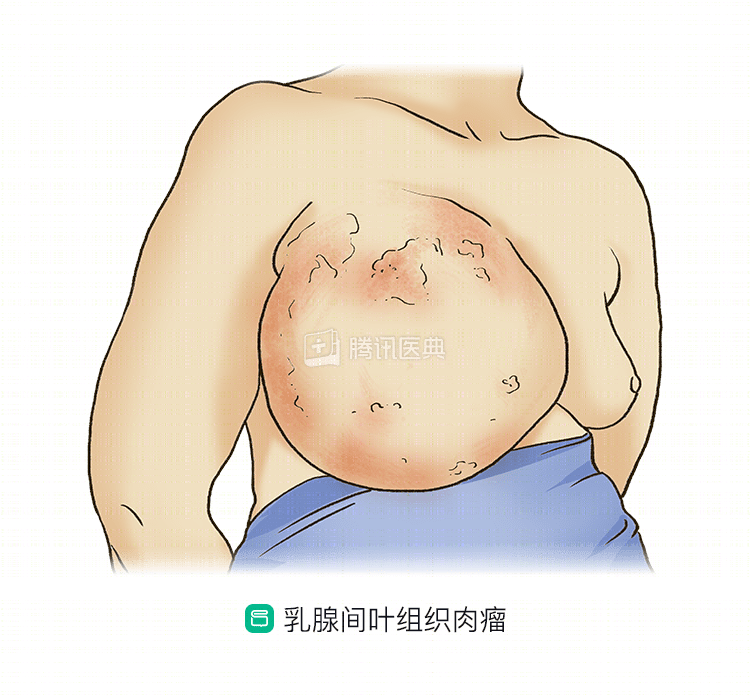
Mammillary mesenchymal sarcoma is often a solitary mass, occasionally multiple, without pain. The lump is round or oval in shape with clear, hard borders and no adhesions to the skin, and the nipple is not invaginated. In a few cases with large masses, the breast skin is often thin, with obvious venous dilatation, and the skin occasionally has an uneven, orange peel-like appearance. In advanced stages, the tumor may be relatively fixed if it invades the pectoral muscle. The main metastasis of this type of breast sarcoma is through the bloodstream to the lungs, liver, brain and other organs, and rarely to the lymph nodes.
Based on the clinical presentation, if mesenchymal sarcoma is suspected, your doctor will consider the following tests:
- Mammography is an important tool for diagnosing mesenchymal sarcoma, which often appears as a round, burr-free, coarse-density mass on x-ray;
- Ultrasound can determine whether the tumor is solid or cystic;
- angiography will reveal a tumor with a significant blood supply;
- Pathology, on the other hand, is a means of confirming the type and nature of the tumor, which usually includes lobulated cystic sarcoma (most are less malignant), mesenchymal sarcoma (usually larger in size than breast cancer), liposarcoma (rare), and angiosarcoma (rare).
How is mesenchymal sarcoma of the breast treated?
Surgery is the primary treatment, and the surgeon may remove only the complete lesion or perform a mastectomy, and some patients may still have a better outcome with extensive resection after a local recurrence.
In those with lung metastases, a partial or complete lung may be removed; this approach improves survival but does not slow disease progression.
Radiotherapy is not usually considered to be significantly effective for mesenchymal sarcoma of the breast. Doctors generally do not use postoperative adjuvant chemotherapy, and often use palliative chemotherapy for those who metastasize through the bloodstream.
The overall outcome of mesenchymal sarcoma of the breast is poor, depending primarily on the type of sarcoma and the degree of differentiation of the tumor cells. Most lobulated cystic sarcomas are low malignancy and thus have a better 5-year survival rate of about 85%, compared with only 45% for nonlobulated cystic sarcomas. Angiosarcoma has the worst outcome, with approximately 90% of patients dying within 2 years. Recurrent recurrence is an unfavorable factor in breast sarcoma outcomes, with a lower recurrence rate in those with low malignancy who have undergone more adequate extended resection and a higher risk of recurrence in those with high malignancy and inadequate extent of resection. Recurrent recurrence also increases malignancy and increases the risk of metastasis and death.
Thus, malignant tumors that occur in the breast are not always breast cancer. However, in either case, you should seek immediate medical attention as soon as you notice a breast abnormality, and please follow your doctor’s treatment recommendations.