The female breast is structured like an orange, with soft fatty tissue like pulpy granules and dense fibrous and glandular tissue like those transparent fascia. When there is more of the latter than fat, we call it “dense breast”.
In the United States, 40% to 50% of middle-aged and older women (40 to 74 years old) have dense breasts. They are four or five times more likely to develop breast cancer than women with low breast density. To make matters worse, dense breasts can also “shield” tumors from doctors during an X-ray. This is because a dense breast appears as a white mass on an X-ray, and the image of a breast lump or tumor happens to be white. Therefore, some tiny tumors can be masked, making it difficult for doctors to distinguish them even if they have a good eye.
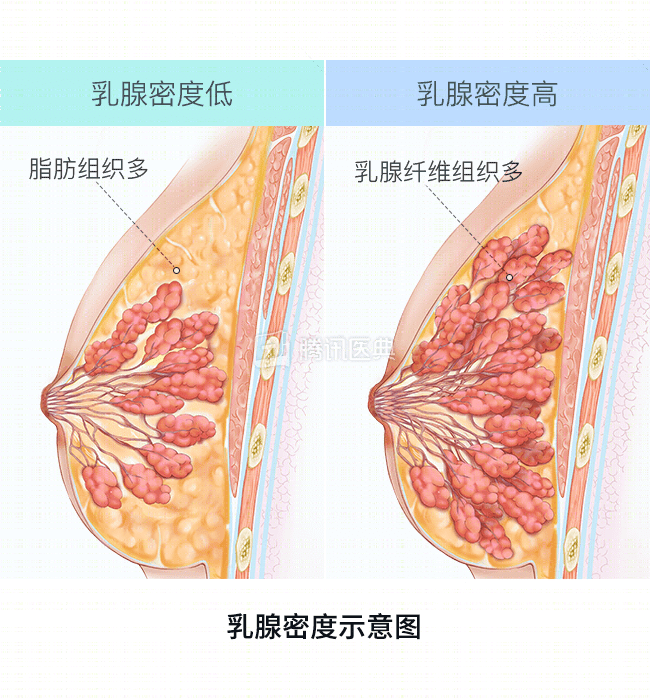
Considering the high risk of dense breast cancer and the “overwhelming” nature of x-ray screening, experts around the world have been discussing whether additional imaging methods should be added to x-ray. Magnetic resonance imaging (MRI) is one of these options. But how practical is MRI? Can it benefit women with dense breasts, and does it lead to overdiagnosis?
Recently, the New England Journal of Medicine, a top medical journal, published new research on MRI screening for breast cancer that provides the strongest evidence to date to answer these questions. The study concluded that for women with dense breast tissue, pairing a mammogram with an MRI can be more effective than an X-ray alone. Here’s a look at how the study was done:

This study is the world’s first large-scale MRI screening trial of dense breasts. The results showed that women who had additional MRI screening had a 4.2 per 1,000 lower incidence of “interval breast cancer” compared to women who had only x-rays. The term “interval breast cancer” refers to breast cancer that is diagnosed in the interval between regular medical exams. The team believes that the decline in this type of breast cancer likely means that MRI screening is more sensitive and can “catch” tumor tissue in its infancy earlier.
If the new study proves that MRI screening is beneficial, shouldn’t we expand it to all women with dense breasts?
Don’t worry, it’s hard to say for sure given the current situation. In its 2016 guidelines, the US Preventive Services Task Force clearly states, “There is insufficient evidence at this time to recommend additional screening (other than x-ray) for women with dense breasts.”
While MRI does not have a “name” right now, could it be included in the guidelines so that it can be rightfully extended to every woman with dense breasts? The study also found that the guidelines, as the medical authority, could not be changed at will. To change the guidelines, the current study is not convincing enough; scientists need to know whether MRI screening will help improve women’s health and, ultimately, their survival rates. In this regard, Dan Longo, associate editor of the New England Journal of Medicine, wrote in an editorial, “The ultimate test of MRI screening will be whether it improves patient survival, but we won’t find out for a long time to come, I’m afraid.”
In addition, the false-positive rate of MRI is a difficult issue. In this study, a number of women were “detected with breast cancer” by MRI, but subsequent biopsies revealed that 73.7% of them did not have cancer. It is clear that MRI increases the detection rate of breast cancer, but it also has a higher probability of “misrepresentation,” leading to more people undergoing unnecessary biopsies.
In response, Dan Longo said, “The results of this trial may reinforce the notion that MRI is important for women with dense breast tissue. But are we thereby putting these women at increased risk for surgery without improving their ultimate survival?”
So far, we don’t have a perfect screening protocol for dense breast, but this study has taken a critical first step.