Knowing the stage of cancer can help doctors choose the most appropriate treatment plan. Non-small cell lung cancer (NSCLC) can be divided into the following stages according to the extent of tumor metastasis:
Invisible stage
Cancer is not found on imaging or bronchoscopy, but is found in sputum or bronchial lavage, and although “insidious,” the cancer may have metastasized to other parts of the body.
Stage 0 (carcinoma in situ)
Abnormal cells can be found in the bronchial lining, but they do not break through the basement membrane, so metastasis is not usually possible.
Stage I
In stage I, the cancer has already formed, and stage I is divided into stages IA and IB:
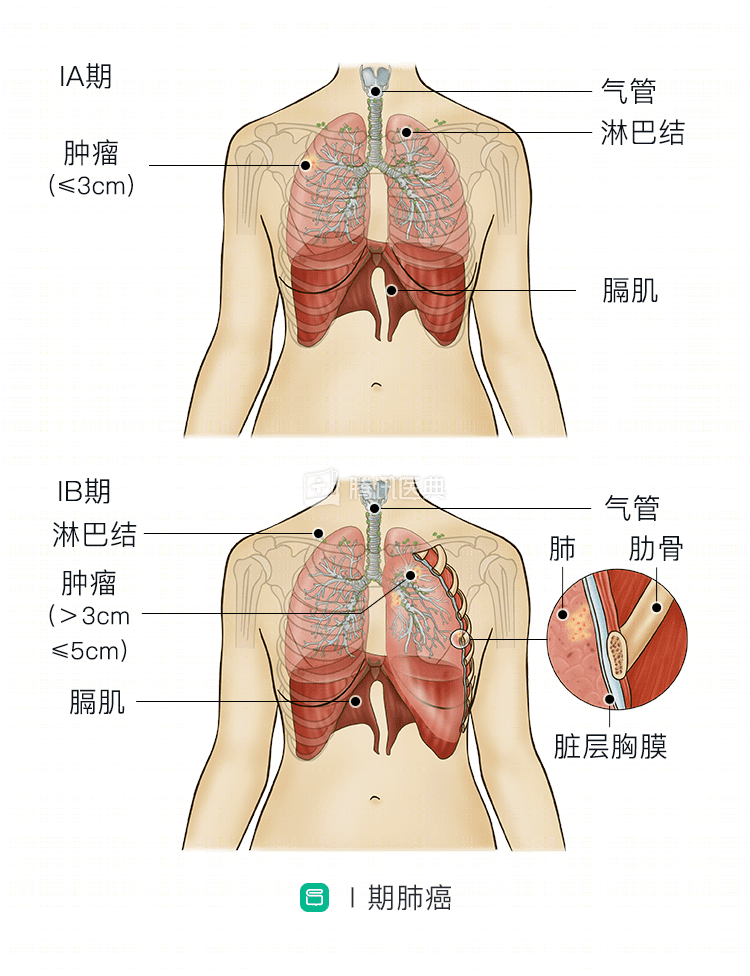
- Stage IA: The tumor is confined to the lung and there is no pleural invasion.
- Stage IB: No metastasis to lymph nodes yet and one or more of the following are present.
- Tumor larger than 3 cm but not more than 5 cm.
- The cancer has damaged the bronchial wall.
- The cancer has metastasized to the mucosa.
- The cancer has metastasized to the lining of the pleura that adheres to the surface of the lung (called the dirty pleura).
- The lung tissue at the junction of the trachea and bronchi has collapsed or developed pneumonia.
Stage IIA
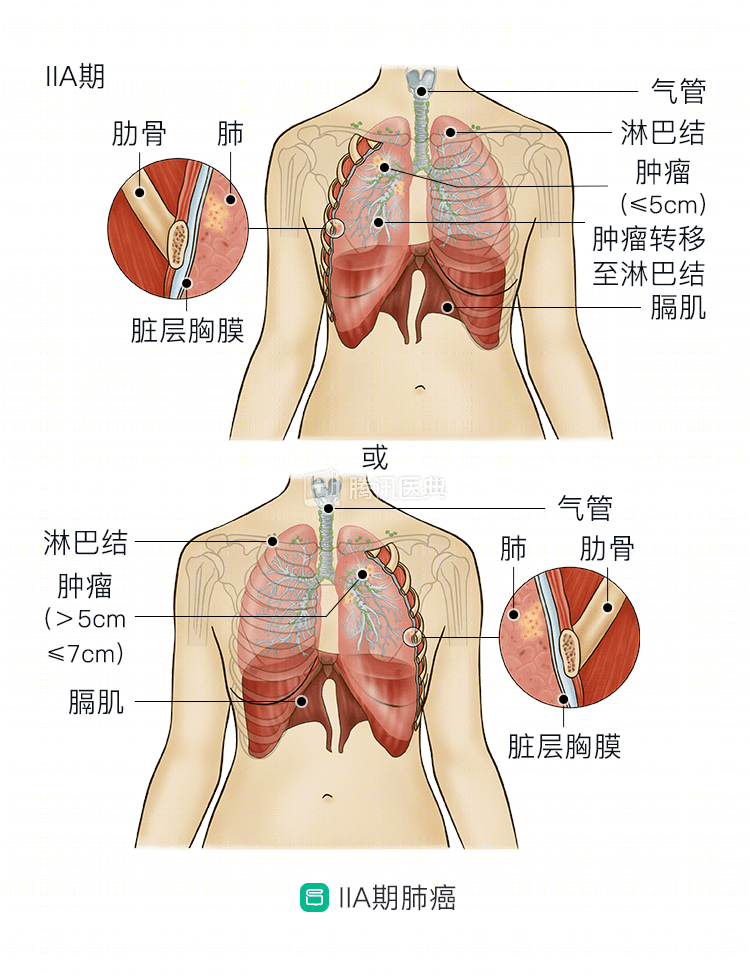
The cancer may have metastasized to lymph nodes in the chest cavity ipsilateral to the tumor, and the involved lymph nodes are located in the lung or near the bronchi, in addition to one or more of the following:
- Tumor does not exceed 5 cm.
- The cancer has metastasized to the main bronchus and is located at least 2 cm below the tracheal-bronchial junction.
- Cancer has metastasized to the dirty pleura.
- The lung tissue at the tracheobronchial junction has collapsed or developed pneumonia.
Or, the cancer has not metastasized to the lymph nodes and one or more of the following conditions are present:
- Tumor is larger than 5 cm but not more than 7 cm.
- Cancer has metastasized to the main bronchus and is located at least 2 cm below the trachea-bronchus junction.
- Cancer has metastasized to the dirty pleura.
- The lung tissue at the tracheobronchial junction has collapsed or developed pneumonia.
Stage IIB
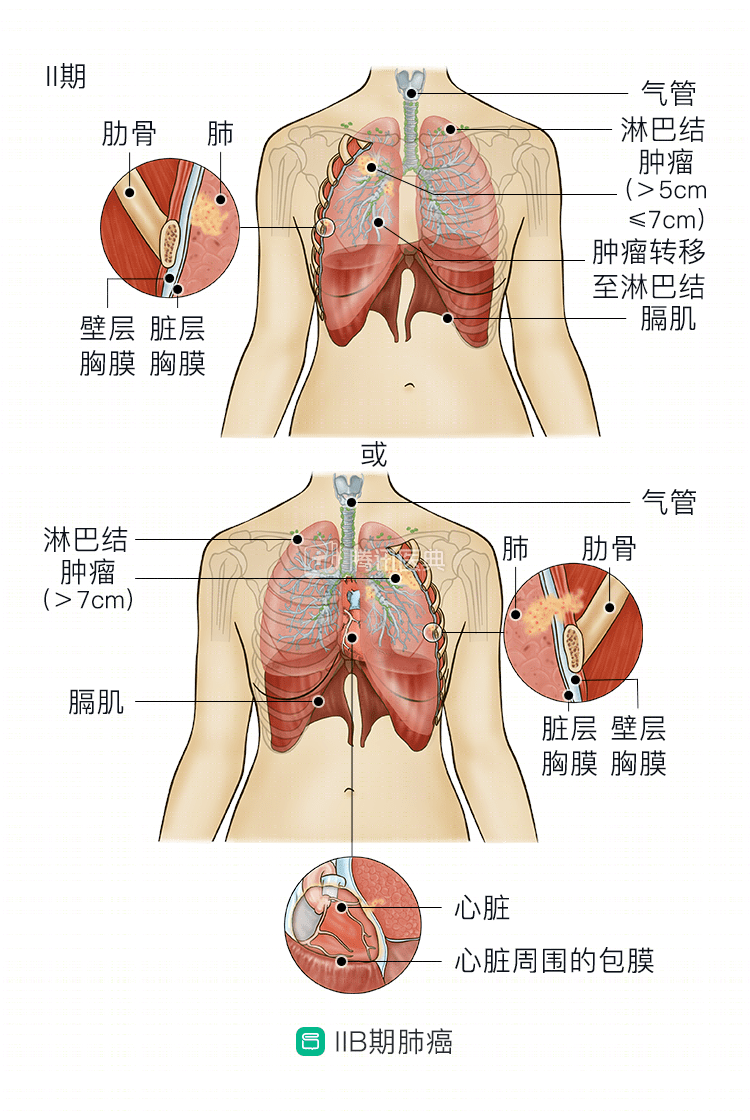
Cancer has metastasized to lymph nodes in the chest cavity ipsilateral to the tumor, and the involved lymph nodes are located in the lung or near the bronchi, in addition to one or more of the following:
- Tumor is greater than 5 cm but not more than 7 cm.
- The cancer has metastasized to the main bronchus and is located at least 2 cm below the trachea-bronchus junction.
- Cancer has metastasized to the dirty pleura.
- The lung tissue at the tracheobronchial junction has collapsed or developed pneumonia.
Or, the cancer has not metastasized to the lymph nodes and one or more of the following conditions are present:
- Tumor is larger than 7 cm.
- The cancer has metastasized to the main bronchus (and is located less than 2 cm below the trachea-bronchus junction), the chest wall, the diaphragm, or its nerves.
- The cancer has metastasized to the heart.
- Cancer has metastasized to the pericardium or mural pleura.
- The whole lung has collapsed or developed pneumonia.
- One or more separate tumors in the same lung lobe.
Stage IIIA (part 1)
Stage IIIA is divided into 3 parts based on tumor size, site of detection, and involved lymph nodes.
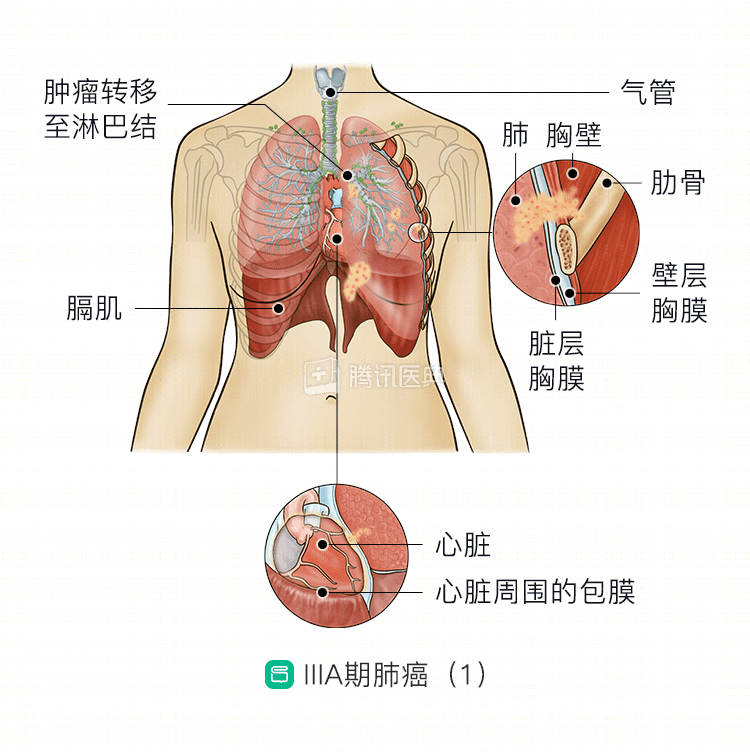
Mediastinal lymph nodes whose cancer has metastasized to the thoracic cavity ipsilateral to the tumor, with involved lymph nodes near the sternum or bronchial connection to the lung, along with:
- The tumor can be of any size.
- Part of the lung tissue (where the trachea joins the bronchus) or the whole lung may have collapsed or developed pneumonia.
- One or more separate tumors may be present in the same lung lobe.
Stage IIIA (part 2)
The cancer may have metastasized to any of the main bronchus (not the trachea-bronchus junction), the chest wall, the diaphragm and its nerves, the dirty or mural pleura, or the pericardium.
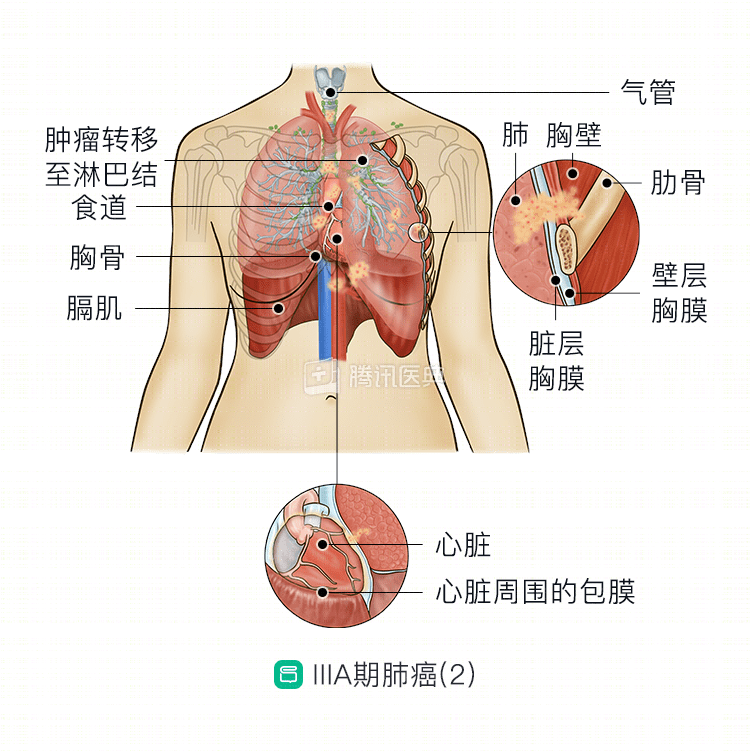
The cancer has metastasized to mediastinal lymph nodes in the thorax ipsilateral to the tumor, and the involved lymph nodes are located in the lung or near the bronchi. Also:
- The tumor can be of any size.
- The whole lung may have collapsed or developed pneumonia.
- One or more separate tumors may be present in any lobe of the affected lung.
Stage IIIA (part 3)
The cancer may have metastasized to any of the main bronchi (not the tracheobronchial junction), the chest wall, the diaphragm and its nerves, the dirty or mural pleura, the heart or pericardium, the major blood vessels flowing into or out of the heart, the trachea, the esophagus, the laryngeal nerves, the sternum or spine, or the tracheobronchial junction.
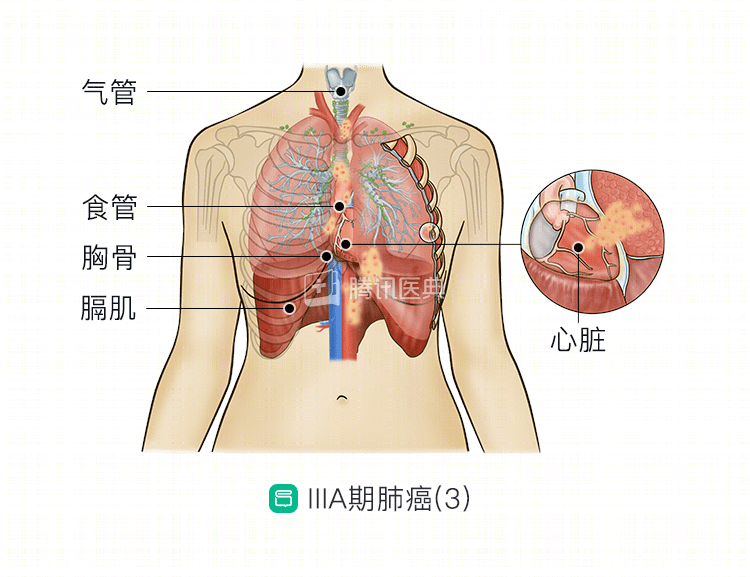
The cancer has not metastasized to the lymph nodes, the tumor can be any size, and the cancer has metastasized to any part of the heart, major blood vessels flowing into or out of the heart, trachea, esophagus, laryngeal nerves, sternum or spine, or tracheal-bronchial junction.
Stage IIIB
Stage IIIB can be divided into two parts depending on the size of the tumor, the site of detection, and the involved lymph nodes.
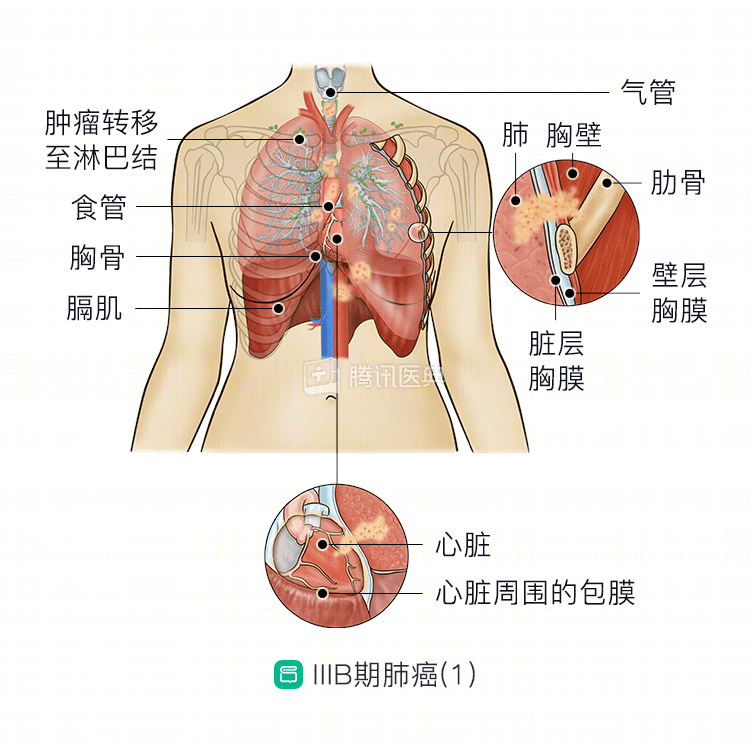
- The cancer has metastasized to the lymph nodes above the clavicle or in the chest opposite the primary tumor. Also.
- The tumor can be of any size.
- Part of the lung tissue (where the trachea joins the bronchi) or the whole lung may have collapsed or developed pneumonia.
- One or more separate tumors may be present in any lobe of the affected lung.
- The cancer may have metastasized to any of the main bronchi, chest wall, diaphragm and its nerves, dirty or mural pleura, heart or pericardium, major blood vessels flowing into or out of the heart, trachea, esophagus, laryngeal nerves, sternum or spine, or tracheal-bronchial junction.
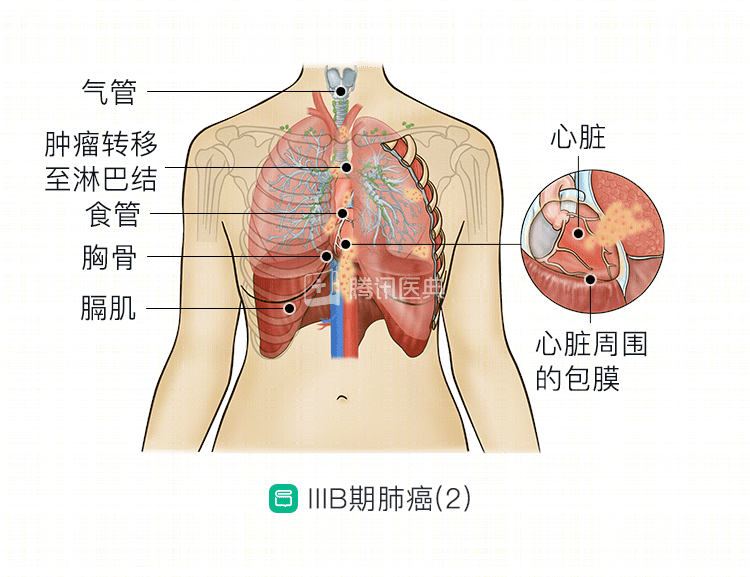
- The cancer has metastasized to the thoracic lymph nodes ipsilateral to the tumor, and the involved lymph nodes are near the sternum or where the bronchus connects to the lung. Also.
- The tumor can be of any size.
- More than one independent tumor is present in different lobes of the ipsilateral lung.
- The cancer may have metastasized to any part of the heart, major blood vessels flowing into or out of the heart, trachea, esophagus, nerves in the larynx, sternum or spine, or tracheal-bronchial junction.
Stage IV
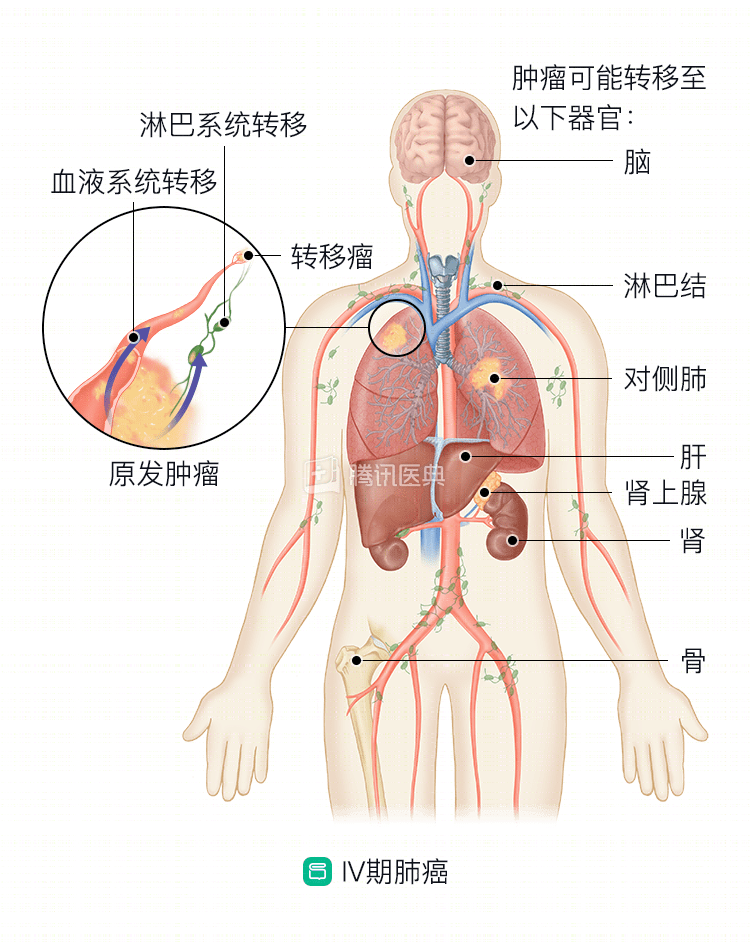
The tumor can be any size, the cancer may have metastasized to the lymph nodes, and one or more of the following conditions are present:
- One or more tumors in both lungs.
- Cancer is found in the fluid around the lungs or heart, or metastatic nodes in the pleura.
- Cancer has metastasized to other parts of the body, such as the brain, liver, adrenal glands, kidneys, or bone.
Co-reviewed by Dr. Dong Song and Dr. Zhang Chao of Guangdong Provincial People’s Hospital and Guangdong Lung Cancer Institute.