
Currently, breast reconstruction using implants is the least invasive form of breast reconstruction, with shorter surgery times and more common applications.
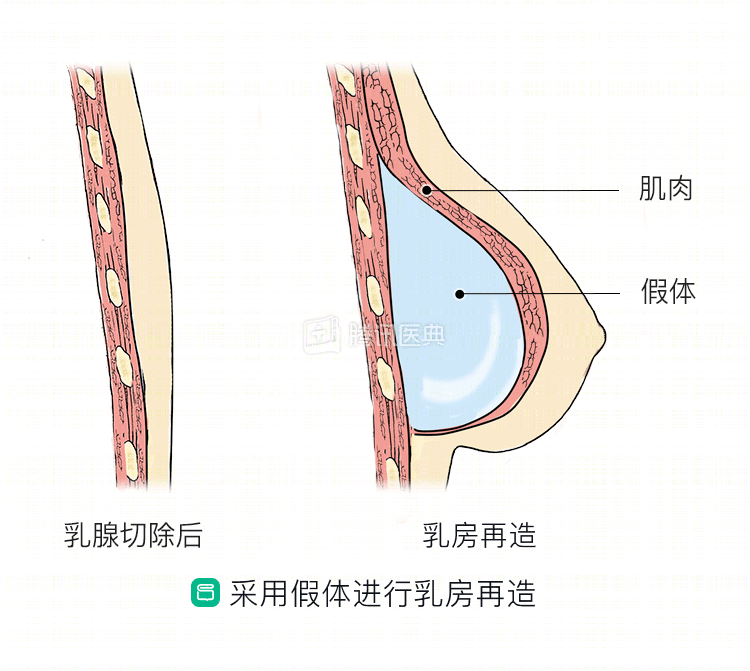
Which patients can undergo breast reconstruction with implants?
For patients with simple mastectomy, modified radical breast cancer, or congenital breast dysplasia, if the healthy side of the breast is not large, the muscle of the side of the breast to be reconstructed is relatively intact (with the pectoralis major muscle preserved), and there is a certain thickness of subcutaneous tissue and a sufficient amount of skin without significant defects, the surgeon will consider breast reconstruction using simple implants. In other words, when using this method, the skin and subcutaneous tissue must not be too much defective, and it is important to ensure that there is enough area of skin and enough thickness of subcutaneous tissue to cover the implant after implantation so that the implant does not protrude too much into the subcutaneous contour. This method cannot be used for people with many skin defects and too thin subcutaneous tissues.
If postoperative radiation therapy is determined to be necessary, the prosthesis should also not be used because radiation can cause damage to the prosthesis and increase the likelihood of scar contracture.
People with localized defects in breast tissue are also not candidates for implants because the implants are regular in shape and do not accommodate localized defects.
What is the general procedure?
There are two types of breast reconstruction with implants. One is direct implantation, which is suitable for those with adequate skin volume and no significant defects. The other is post-expansion implantation, for those with less than adequate skin and some deficits. An expandable hydrocolloid (tissue expander) is first implanted in the breast, which is expanded over time to increase the skin area, and then surgically removed and replaced with an implant. Of course, doctors sometimes use back tissue (latissimus dorsi muscle flap) to repair the skin defect and increase the thickness of the tissue covering the prosthesis, but this will undoubtedly increase the damage to the back.
What are the advantages and disadvantages of breast reconstruction with prosthesis?
If implants alone are used, there is no “damage to the donor area that provides the autologous tissue” and it is the least invasive and fastest recovery method of breast reconstruction. Because there are many different types of implants, this also provides a wide range of options for breast reconstruction. Breast reconstruction with implants is a shorter procedure, especially when performed immediately in conjunction with breast cancer surgery, and avoids the need for a missing breast. Usually the shape of the breast reconstructed with implants is more desirable, with better protrusion of the implant, and the shape of the breast can be achieved immediately, sometimes even better than the shape of the contralateral breast, which may then need to be adjusted to make both sides aesthetically pleasing and symmetrical.
Breast reconstruction with implants can also have some problems. First, the implant does not feel as soft as its own tissue, especially if the tissue covering the surface of the implant is thin, making it easy to feel the contours of the implant. Second, the implants do not sag with age, and after several years there may be a situation where the opposite breast naturally loosens and sags while the reconstructed breast remains firm.
Adding to this, some patients may have concerns about the safety of the implant. The fact is that there is no need to worry. It is now well established that all surgical breast implants are medical-grade silicone gel, which is extremely stable and has no impact on the development and outcome of breast cancer.
What to look for after surgery?
After implantation of the prosthesis, there is no significant impact on daily life. Two to four weeks after surgery, the wound is healed and the prosthesis is fixed in place, so you can play any sport, including strenuous sports such as ball games and swimming. However, in the postoperative 2 to 4 weeks, upper extremity activities need to be limited and the chest needs to be fixed with pressure to prevent displacement of the prosthesis by pulling and compression.
Most prostheses do not have a fixed life span and do not need to be replaced regularly in the absence of abnormalities, but after several years of implantation, annual MRI examinations are recommended to observe the prosthesis and avoid abnormalities.
In general, breast reconstruction with implants is less invasive, quicker to recover, and has a desirable breast shape. Of course, breast implants have their disadvantages, and patients can choose the most suitable reconstruction method for themselves after full communication with their doctors, taking into account their physical condition and economic conditions.