Did you know? 1 in 10 adults (ages 20-79) worldwide have diabetes.
In 2021, the number of adults with diabetes reaches 537 million worldwide; compared to 2019, there are 74 million more people with diabetes, an increase of 16%. Diabetes is one of the leading causes of blindness, amputations, heart disease, kidney failure, and premature death, and has been called the “sweet killer.
More than 90% of all diabetes is type 2. Although drugs are available to control blood glucose and complications associated with hyperglycemia, they become less effective after a period of time. So there is an urgent need to develop new drugs to better control the progression of type 2 diabetes.
How can we apply “double insurance” to better control blood glucose?
How do you apply “double insurance” to better control your blood sugar?
According to the International Diabetes Federation (IDF) Global Diabetes Map (10th edition), published in 2021, the number of people with diabetes in China has increased from 90 million to 140 million in the last 10 years (2011-2021), an increase of 56%. And this proportion will be even higher in people over 65 years old.
The “three lows” of diabetes are even more worrisome – low awareness rate (36.5%), low treatment rate (32.2%), and low control rate (49.2%). This means that there are more untreated “invisible patients” in the population, and those who are receiving treatment are not as well-controlled as they should be.
Type 2 diabetes is a progressive disease, and one of the biggest headaches at this stage is that it gets worse over time, regardless of the medications used to control it. Authorities recommend that type 2 diabetes requires a series of progressive and intensive treatments, meaning that as patients’ blood glucose levels gradually increase, the intensity of treatment should also increase.
So usually, for type 2 diabetes, doctors start with a single medication; if the single medication doesn’t work, other medications are added. When oral hypoglycemic drugs or non-insulin injectable drugs don’t work, insulin therapy is the last resort. As the disease progresses, the dose of insulin required will increase.
In response to the lack of drug response, researchers have developed a new drug: a compound that works synergistically with two targets to add up the effects of blood glucose control and weight loss. This “double-safe” drug mechanism may produce better glycemic effects and fewer side effects than a single target.
Tirzepatide beats semaglutide in lowering glucose, lowering weight
Tirzepatide is a new drug for type 2 diabetes that is still in development. It has a dual target, activating both the glucose-dependent glucagon peptide receptor and the GLP-1 receptor, which means it acts as a “double insurance policy” to control blood glucose levels and weight.
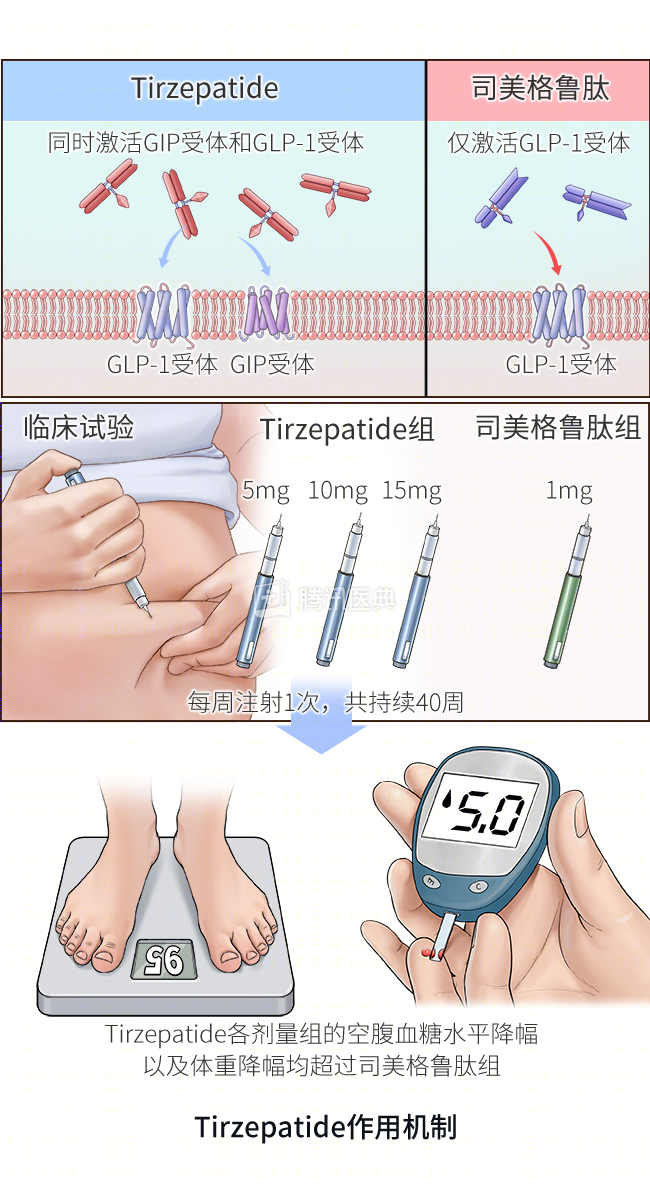
The results of a phase 3 clinical trial of this new drug, Tirzepatide, for type 2 diabetes were recently published in the New England Journal of Medicine, one of the world’s top medical journals, and found that it outperformed semaglutide in the clinical trial.
In the trial, the team compared the efficacy and safety of Tirzepatide to that of semaglutide, a glucose-lowering drug that acts on only one receptor. Let’s take a look at how the study was conducted:
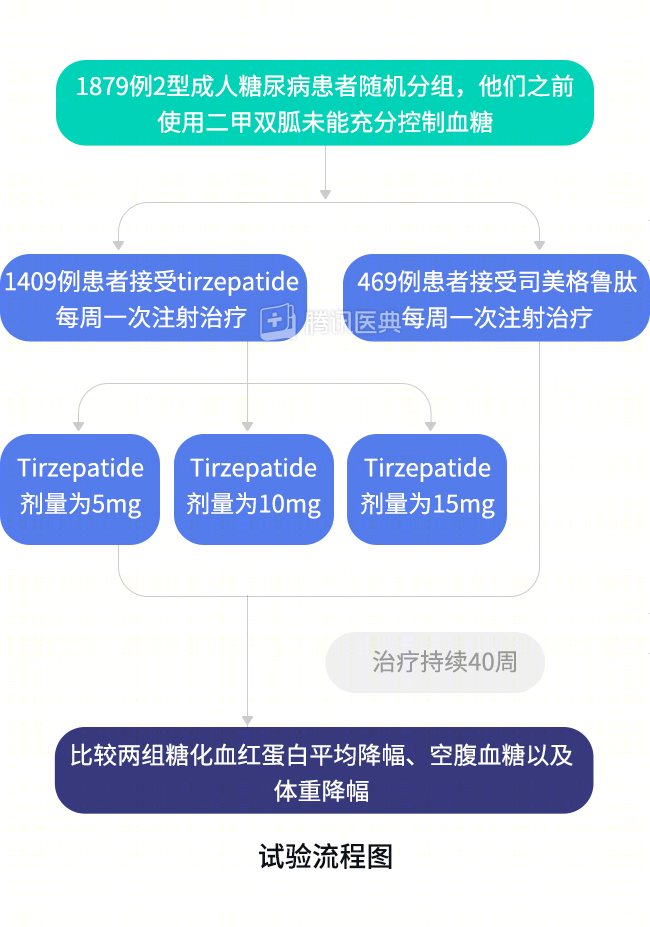
In the 5 mg, 10 mg, and 15 mg Tirzepatide groups, glycated hemoglobin levels (reflecting average blood glucose levels over the past three months) were reduced by an average of 2.01 %, 2.24 %, and 2.30 % relative to the pre-test, and 1.86 % in the 1 mg semaglutide group.
The results of the trial showed that all doses of Tirzepatide were no worse than, or even better than, stiglutide, and that all doses of Tirzepatide had greater reductions in fasting blood glucose levels than the stiglutide group, as well as greater reductions in body weight.
In terms of safety profile, the most common adverse events in the Tirzepatide and semaglutide groups were gastrointestinal events, mainly mild to moderate (eg, nausea, diarrhea, vomiting), with a higher incidence in the 10 mg and 15 mg Tirzepatide groups than in the 5 mg Tirzepatide and semaglutide groups.
In addition to exploring efficacy in type 2 diabetes, scientists are also investigating the potential efficacy of Tirzepatide in diseases such as chronic weight management, nonalcoholic steatohepatitis, and heart failure. If we want to win this battle against disease, we can’t afford to let up on the development of new drugs.