Surfing around and self-medicating should not be allowed
After being diagnosed with prostate cancer, many patients and families ask around, search the Internet, ask friends and relatives, visit prostate cancer patients in their neighborhoods, or look up relevant literature in English and Chinese in databases to see how prostate cancer is treated and what the prognosis is.
The result is often a lot of information, but a lot of confusion.
As the saying goes, “A man’s profession is like a mountain,” and this is especially true in the medical field, where even many doctors don’t know much about prostate cancer, let alone the average patient.
What should be done after a diagnosis of prostate cancer?
Don’t panic if you have prostate cancer
In recent years, as the overall level of medical care and medical conditions improve, more and more patients are diagnosed with various types of malignant tumors, and people not only “fear cancer” but also consistently believe that if you have a malignant tumor, it is incurable, and it is only a matter of time before the tumor spreads, metastasizes, or even dies.
In fact, this is a complete misunderstanding of malignant tumors, and the ultimate outcome of tumors in different parts of the body and different degrees of the same part of the body can be very different. The most important thing is that you should not be so worried about prostate cancer, and you should be in the right frame of mind.
It is important to note that the increasing incidence of tumors is partly related to lifestyle changes, but more so to improvements in diagnostic techniques that have improved the detection rate of all types of tumors.
Cancer can be “good” or “bad,” but prostate cancer is generally “good”
.
Is having prostate cancer a death sentence?
Of course not.
Of course not.
Unlike other malignancies, prostate cancer is one of the “friendliest” of all malignancies, with a 5-year survival rate of 98% in the United States and the best prognosis of any malignancy.
Prostate cancer usually progresses relatively slowly and generally does not affect the life expectancy of patients. Most prostate cancer patients do not die from prostate cancer, but from other diseases, such as other types of tumors, cardiovascular disease, and diabetes.
There are even some prostate cancers that can hibernate in the body for a long time without affecting the body, and this type of latent prostate cancer does not require excessive treatment or panic.
Prostate cancer has a good prognosis, but still needs to be treated aggressively
.
Of course, this is not to say that all prostate cancers can rest on their laurels. For many prostate cancer patients, aggressive treatment is still needed to slow the progression of the disease and improve the overall prognosis.
The prognosis of patients with prostate cancer is closely related to the stage of the tumor and its malignancy, and directly related to the treatment used.
After a diagnosis of prostate cancer, patients and families should actively seek the help of a trusted specialist who will determine an individualized treatment plan based on a combination of factors, including life expectancy, the degree of tumor cell differentiation, and the presence of distant metastases.
It’s good to have surgery
For early stage prostate cancer, if radical prostate cancer surgery is performed to remove as many tumor cells as possible, the patient’s prognosis will be relatively good.
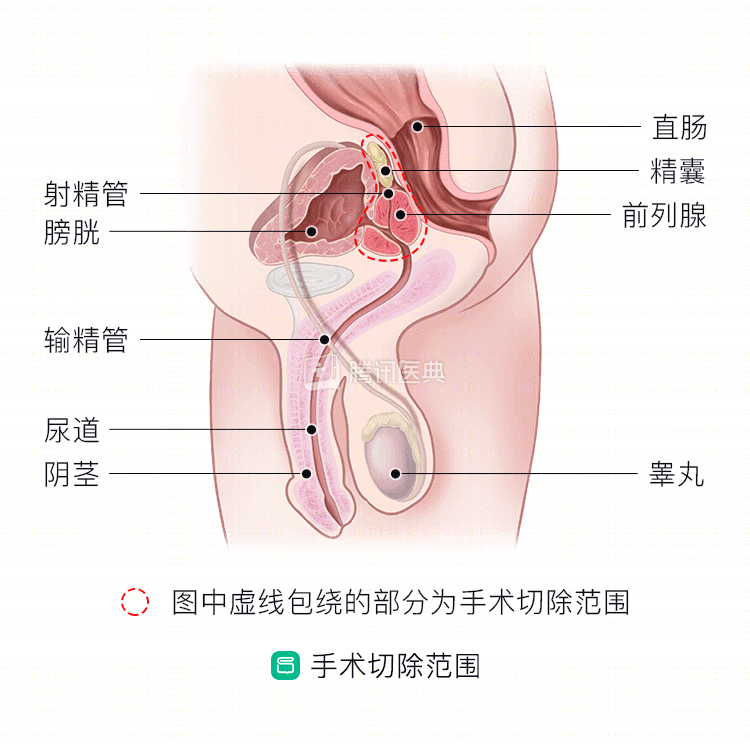
It has been reported that if the area of tumor invasion is still confined to the prostate at the time of diagnosis and there are no distant metastases, also known as limited prostate cancer, patients have a 5-year survival rate of almost 100% and a 10-year survival rate of 90% after surgery. In other words, early stage prostate cancer can be treated surgically to achieve radical cure without posing a threat to the patient’s health for a limited period of time.
We have a patient who was diagnosed with prostate cancer at age 84, was in good general condition, and was strongly urged to undergo surgery. He has been followed up for 3 years without recurrence, and this year, at age 87, he is still coming to the clinic alone for follow-up.
Impossible to operate, but radiotherapy works well
For patients with early-stage prostate cancer who cannot have surgery for various reasons, radical radiation therapy can also be effective. If the lesion is still confined to the prostate, the 5-year and 10-year survival rates after radiation therapy can be 80% and 65%, respectively.
So for patients who are too old or too frail to tolerate surgery, radiation therapy is the appropriate choice.
In addition, the rapid advances in cryoablation and in vivo radiation therapy allow for individualized treatment based on the disease and the patient’s wishes.
Without aggressive treatment, the prognosis is often poor
Conversely, the prognosis for diagnosed early-stage prostate cancer can be poor if not treated aggressively and effectively. One survey found that the vast majority of patients with untreated early-stage limited prostate cancer will die from prostate cancer within 10 years.
Some people say that patients with mid- to late-stage prostate cancer have lost the value of treatment and should give up continuing treatment. Clearly, this thinking is not true.
Because prostate cancer is an androgen-dependent disease that develops, even patients with mid- to late-stage disease can still control its progression with endocrine therapy in an aggressive anti-androgen fashion. Endocrine therapy can improve the prognosis to a large extent, with studies showing 5-year survival rates of up to 60% for patients with intermediate to advanced disease treated with endocrine therapy. If not treated aggressively, however, the 5-year survival rate will unfortunately be less than 15%.
So, for patients with mid- to late-stage prostate cancer, combination therapy can still help slow progression and extend life expectancy.
Summary
In conclusion, patients with either early or mid- to late-stage prostate cancer must be in the right frame of mind and actively cooperate with their doctors to draw up an individualized treatment plan to fight the disease, not to mention giving up lightly or even thinking about living lightly.