Which is the only organ in the male body that maintains lifelong growth?
The answer is, the prostate.
It grows quickly and slowly, growing rapidly during adolescence and then having a “second life” in middle age. The actual fact is that a little bit of “excessive” prostate is not life threatening.
Prostate cancer: 6th most common malignancy in men
By contrast, prostate cancer is a malignant cell growth that tops the list of malignant tumors in men in Europe and the United States year after year.
The incidence of prostate cancer in China is lower than in Europe and the United States, but it is becoming more common due to an aging population, increased diagnosis rates, and lifestyle changes in recent years. 2015 China Oncology Annual Report data show that prostate cancer ranks 6th in the incidence of malignant tumors in men.
Current treatments for prostate cancer, which focus on suppressing androgen production in patients, are not very sustainable, and tumors tend to develop into “destructive prostate cancer,” which means they are resistant to hormone therapy. Researchers have developed a new therapy that deactivates cancer cell signaling by controlling androgen receptors. Recently, the New England Journal of Medicine, a top international journal, published results from a phase 3 clinical trial of enzalutamide.
As one of the representative drugs of the new therapy, how clinically effective is it?
Buffett, Murdoch are beneficiaries: Androgen suppression, stopping the ‘fuel’ supply
While the pathogenesis of prostate cancer is not yet clear, androgens seem to be involved.
In 1941, American surgeon Charles Brenton Huggins and others found that surgical removal of the testicles to suppress androgen production, or supplementation with estrogen to block androgen receptors, was extremely effective in controlling prostate cancer. And if these patients who had gotten better were injected with androgens again, the cancer cells would become active again.
It seems that androgens are like “fuel” for the cancer cells – as soon as the fuel is stopped, the prostate cancer can’t move forward.
For this important discovery, Charles Brenton Huggins was awarded the 1966 Nobel Prize in Physiology or Medicine, and this hormone therapy became known as androgen deprive therapy (ADT) and has long been the first choice for prostate cancer treatment. It has long been the treatment of choice for prostate cancer. It has helped most patients actually “live with” or “live with” their tumors, and has benefited Warren Buffett, the stock market god, and Murdoch, the media mogul.
Unfortunately, in some cancer patients, androgen deprivation therapy only keeps prostate cancer in remission for 2 to 3 years. This is because the wily cancer cells gradually find a way to respond and can still thrive without “fuel”. The disease inevitably progresses to “depot-resistant prostate cancer,” which means it becomes resistant to hormone therapy.
It is estimated that 1 in 3 patients with resistant prostate cancer without metastases will develop bone metastases within 2 years. Once the tumor metastasizes, the prognosis is very poor and the patient will not survive beyond 2 years.
A new drug, enzalutamide, that “loves” the androgen receptor at first sight
While scientists still don’t know how cancer cells continue to grow in the absence of “fuel,” they have found that the androgen receptor is critical in this process.
Under normal circumstances, the androgen receptor releases signals that control the growth and function of the prostate. And in patients, the androgen receptor can also send signals and instructions to cancer cells to grow. Therefore, if this signaling process can be cut off, there is hope that cancer development can be inhibited, and enzalutamide plays such a role.
Enzalutamide is an androgen receptor antagonist that blocks the transmission of growth signals to cancer cells by “loving” the androgen receptor at first sight and hugging it tightly when it sees it, preventing molecules like androgens from getting any closer to the receptor.
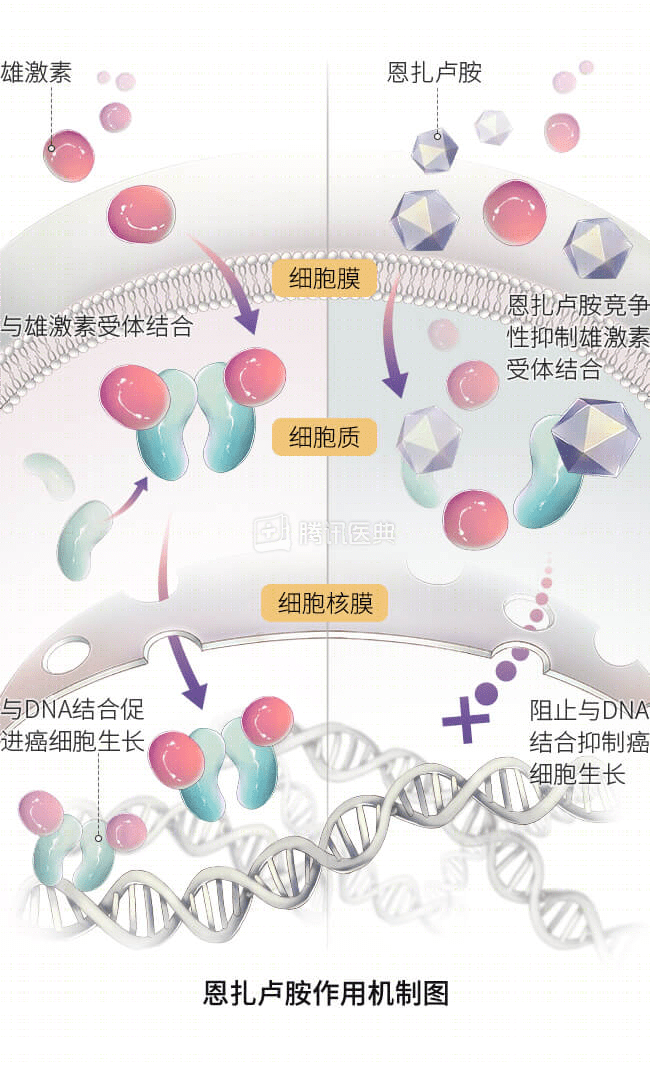
So, how does enzalutamide work in the real world? Let’s take a look at the results of the phase 3 clinical trial.
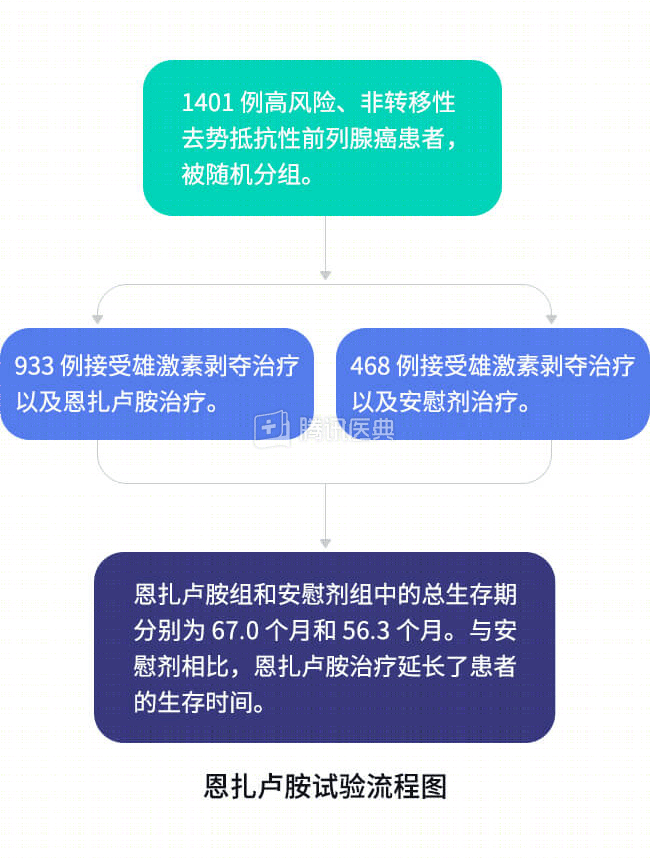
The trial of more than 1,400 prostate cancer patients showed that the enzalutamide regimen significantly prolonged the survival time of patients.
Not only that, but enzalutamide had a similar rate of adverse events to placebo.
The most common adverse effects of enzalutamide were fatigue and musculoskeletal events; however, the rate of adverse events leading to death was higher in the enzalutamide group than in the placebo group. The investigators concluded that it is important to consider that the duration of treatment in the enzalutamide group was significantly longer than in the placebo group (33.9 months vs. 14.2 months).
In the enzalutamide group, the adverse events leading to death were primarily cardiovascular events and occurred at a higher rate than in the placebo group.
Because most of the patients who died from cardiovascular events had a history of cardiovascular disease, the investigators concluded that such deaths should not be related to enzalutamide. However, Gao Xu and Li Jing, urologists at Shanghai Changhai Hospital, believe that the relationship between enzalutamide and cardiovascular-related complications still requires attention and further observation by urologists in the clinic.
Enzalutamide is available in China
Enzalutamide is currently approved in the United States for the treatment of patients with non-metastatic desmoid-resistant prostate cancer. It has also been successfully marketed and approved for the treatment of advanced prostate cancer in China.
The American Urological Association notes that while innovative drugs for prostate cancer are emerging, the impact of each drug on the survival of patients with nonmetastatic desmoid-resistant prostate cancer has, to date, remained negligible.
To further improve treatment outcomes, research at this stage must focus on the molecular mechanisms underlying the pathogenesis of desmoresistant prostate cancer and explore mechanisms of drug resistance in order to discover and identify new, more effective drug candidates.