The inability to eat is sometimes not due to a poor mood, but is a classic sign of esophageal cancer.
The initial symptoms of esophageal cancer are easy to ignore; when patients show obvious symptoms, such as difficulty in swallowing, and then go to the hospital for examination, they have often developed into advanced stages.
Thus, esophageal cancer is an insidious “killer”. In most countries, less than 30% of patients have a hope of surviving more than 5 years. The cure rate for surgery alone is low, and surgery with radiotherapy may increase the difficulty, toxicity, and postoperative complications of surgery.
So what are the better options for patients?
People are pinning their hopes on new immunotherapies. One representative drug is navulizumab.
As a fully humanized IgG4 monoclonal antibody, it can prompt immune cells to recognize and clear tumors.
Recently, the New England Journal of Medicine, the world’s top medical journal, published the results of the latest clinical phase 3 trial of nabumab, showing that the drug gave patients a longer disease-free survival.
Immunotherapy to restore T-cell desire to fight
Globally, esophageal cancer ranks eighth in incidence and sixth in mortality among malignancies.
The highest-risk area starts in Iran and extends to China, often referred to as the “esophageal cancer belt.
According to the latest epidemiological analysis of malignant tumors, esophageal cancer is the sixth most common tumor in China, with 250,000 cases per year, and the fourth most deadly tumor in China, killing about 190,000 people each year.
Clinically, 2/3 of patients with esophageal cancer are in the “locally advanced” stage. This means that the tumor is large and locally infiltrating, but has not metastasized distantly.
For them, surgery alone has a 35% cure rate, and radiotherapy poses many risks.
Navulizumab, an immunotherapy drug, is more likely to avoid these disadvantages.
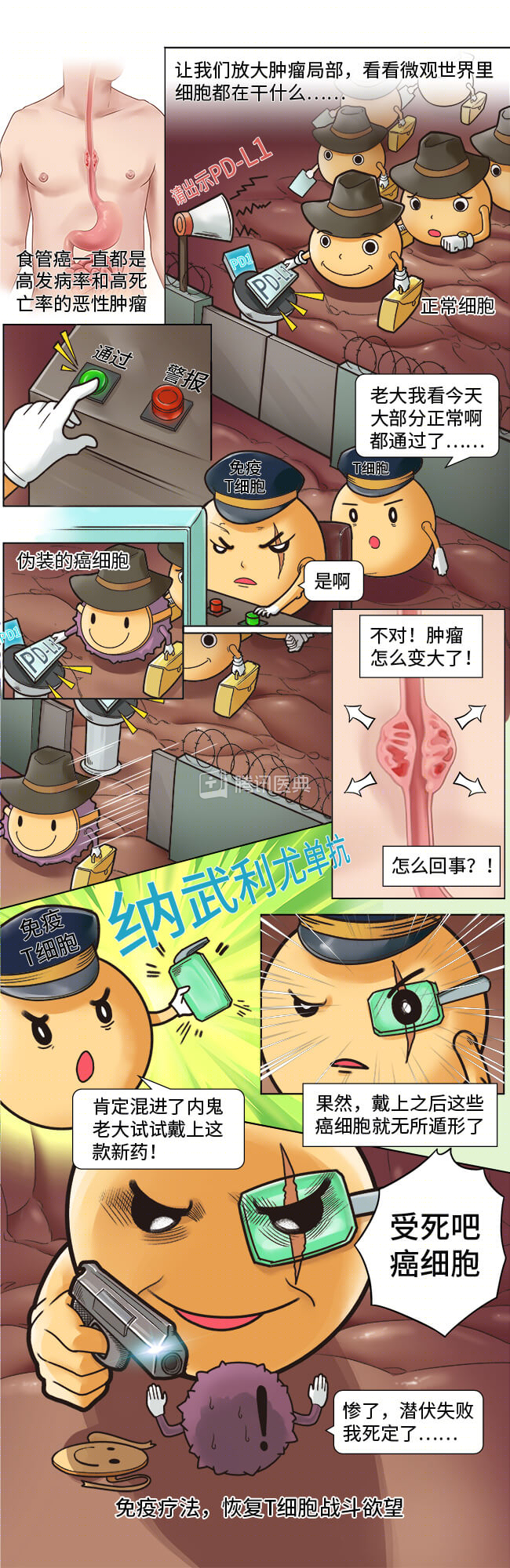
Immunotherapy works by restoring the “desire to fight” of immune T cells.
In a physiological state, the body uses PD-1 molecules on the surface of T cells to send a “truce” signal to T cells to prevent an excessive immune response, and wily tumor cells mimic normal cells and send a truce signal to T cells to avoid the immune cell attack.
Navulizumab recognizes and binds to PD-1 molecules on the surface of T cells, making it impossible for tumor cells to escape T cell surveillance, restoring the anti-tumor activity of T cells, and ultimately removing tumor cells.
Effects unimaginable in the era of traditional chemotherapy
Next, let’s take a look at how well the nabumab trial actually did.
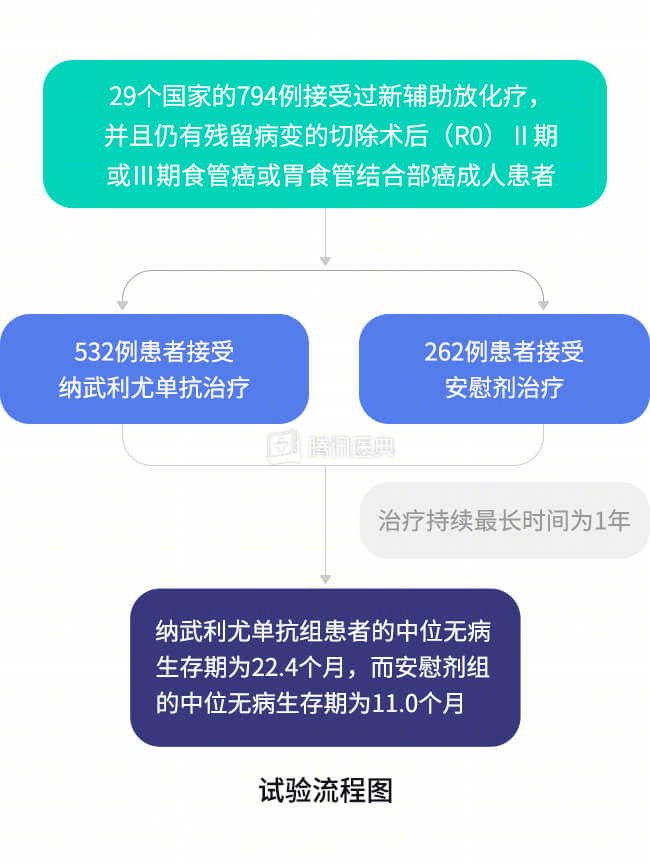
In patients who had received neoadjuvant radiotherapy, disease-free survival was significantly better in the nabugliumab group than in the placebo group. The former had a median of 22.4 months compared with 11 months in the latter.
In the nabumab and placebo groups, 13% and 6% of patients had a grade 3 or 4 adverse event, respectively, and 9% and 3% of patients each discontinued the trial because of an adverse event. The most common adverse events in the nabumetab group were pneumonia and rash.
In terms of safety, the safety of nabumetumab in the treatment of esophageal cancer was not significantly different from its use in the treatment of other cancers.
In the meantime, another clinical phase 3 trial of nabumetinumab has shown significant results.
This trial used nabumetumab in combination with chemotherapy to treat unresectable advanced or metastatic gastric cancer.
Professor Liu Tianshu, director of the Department of Medical Oncology at Zhongshan Hospital of Fudan University, who participated in the trial, said, “After a period of treatment, the tumors shrank significantly or even disappeared completely, which would have been unimaginable in the previous era when chemotherapy alone was used.”
In the future, immunotherapy paired with traditional radiotherapy may become one of the most reliable options for patients with advanced esophageal and gastric cancers.