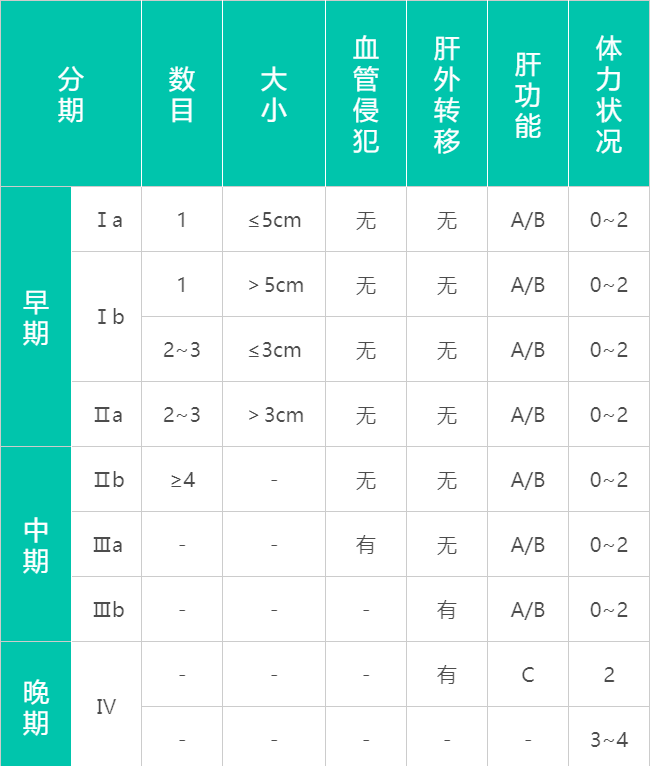
According to the specific situation and practice accumulation in China, scholars of hepatocellular carcinoma in China determine the tumor stage based on 6 factors: number, size, vascular invasion, extrahepatic metastasis, liver function Child-Pugh score, and physical status PS score, which can be divided into 7 stages: stage Ia, stage Ib, stage IIa, stage IIb, stage IIIa, stage IIIb, and stage IV.
Early to mid-stage diagnostic staging of tumors
We usually consider stages Ia, Ib, and IIa to be early, stages IIb, IIIa, and IIIb to be intermediate, and stage IV to be late.
- Stage Ia is a single tumor ≤5 cm in maximum diameter without vascular invasion or extrahepatic metastasis; liver function Child-Pugh A/B; PS0-2.
- Stage Ib is
- Single tumor maximum diameter >5cm, no vascular invasion, extrahepatic metastasis; liver function Child-Pugh A/B; PS0-2.
- Tumor number 2~3 , single tumor maximal diameter ≤3cm, no vascular invasion, extrahepatic metastasis; liver function Child-Pugh A/B; PS0-2.
.
- Stage IIa is 2 to 3 tumors with a maximum diameter of >3 cm, no vascular invasion or extrahepatic metastases; liver function Child-Pugh A/B; PS0-2.
- Stage IIb is ≥4 tumors, regardless of tumor size, no vascular invasion, extrahepatic metastases; liver function Child-Pugh A/B; PS0-2.
- Stage IIIa is tumor status regardless, with vascular invasion, no extrahepatic metastases; liver function Child-Pugh A/B; PS0-2.
- Stage IIIb is tumor status regardless, vascular invasion regardless, extrahepatic metastases; liver function Child-Pugh A/B; PS0-2.
- Stage IV is tumor status regardless, vascular invasion regardless, extrahepatic metastases.
- Stage IV is tumor status regardless, vascular invasion regardless, extrahepatic metastases; liver function Child-Pugh C; PS0-2. or tumor status regardless, vascular invasion regardless, extrahepatic metastases regardless, liver function regardless, PS3-4.
- Stage IIIb is tumor status regardless, vascular invasion regardless, extrahepatic metastases regardless, liver function Child-Pugh C; PS0-2.
For further information on the liver function Child-Pugh rating and physical activity status PS score see the link:
How can advanced liver cancer be treated?
Late stage liver cancer is treated mainly with systemic therapy. Systemic treatment can reduce tumor load, improve tumor-related symptoms, improve life quality, and prolong survival time.
-
Molecularly targeted agents: These include sorafenib and lenvatinib. Sorafenib is the first molecularly targeted drug approved for the treatment of advanced hepatocellular carcinoma. Lenvatinib was just approved in 2018. Comparing the two, lenvatinib is more advantageous for hepatocellular carcinoma with hepatitis B infection.
- Systemic chemotherapy: The oxaliplatin-containing FOLFOX4 regimen is approved in China for the treatment of locally advanced and metastatic hepatocellular carcinoma that is not amenable to surgical resection or local treatment, with the advantage that the chemotherapy drugs are all covered by health insurance.
-
Other drugs: Arsenic trioxide has some palliative effects in the treatment of intermediate to advanced primary hepatocellular carcinoma. When applied clinically, attention should be paid to monitoring hepatotoxicity and nephrotoxicity.
- Immunotherapy: The immunomodulator thymofacine is given, but novel immune checkpoint inhibitors are currently controversial in the treatment of liver cancer and need to be applied with caution.
.
Chinese medicine: Chinese herbal medicine treatment can improve symptoms, enhance the body’s resistance, reduce the adverse effects of radiotherapy and chemotherapy, and improve the quality of life. In addition to the traditional diagnosis and treatment and taking tonics, China’s drug supervision department has approved several modern Chinese medicine preparations such as Sophora granules, Kangleit, Huachansu, Eleuthero, and Hepatoflux for the treatment of liver cancer.
.
.
Usually for advanced hepatocellular carcinoma would be systemic therapy, with symptomatic supportive therapy, palliative therapy, and care for the end stage.
For further information about stage IV hepatocellular carcinoma see the link: