The esophagus is a necessary pathway for food to enter the lower GI tract, including organs such as the stomach and intestines. After cutting out the esophagus, the digestive tract must be reconnected, a process called digestive tract reconstruction.
Therefore, surgery for esophageal cancer is divided into two main steps: first, the resection of the tumor itself, mainly of the esophagus and surrounding tissues, such as lymph nodes, a step that determines the patient’s future postoperative survival; and second, the reconstruction of the digestive tract.
So, what is used to reconnect the GI tract? The stomach is used more often because it has a large volume. The steps are as follows: First, the stomach is stripped from the surrounding tissue and shaped to obtain a more extended, tube-like section of the stomach (called a “tubular stomach”). Then, the stomach is lifted upwards and immediately afterwards, the esophagus is reattached to the tubular stomach in a certain way (called “anastomosis”). The current method of attachment can be either by anastomosis or by hand suturing, depending on the patient’s condition.
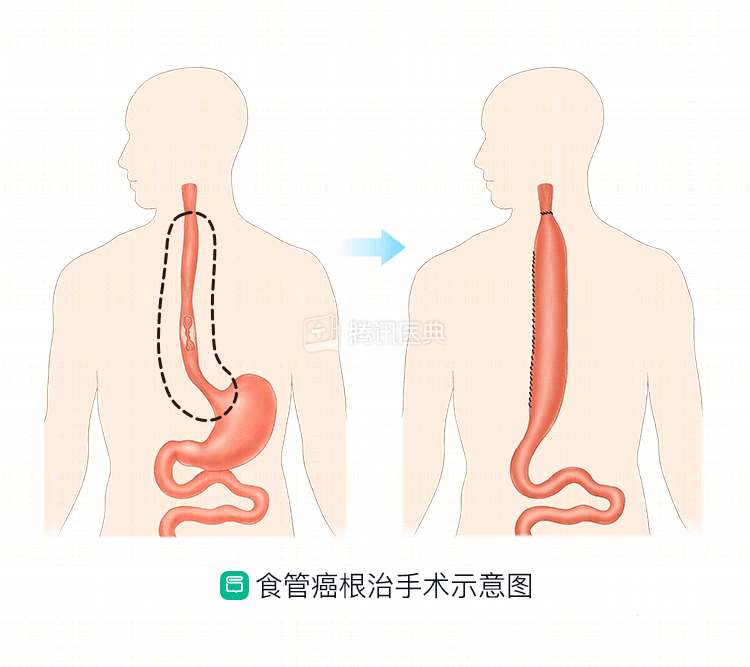
In summary, “resection” and “reconstruction” are the core components of radical esophageal cancer surgery.