Robotic surgery has become a growing trend
Radical prostatectomy is the primary treatment for limited prostate cancer, and early-stage patients can achieve a cure.
In recent years, the procedure of radical prostate cancer surgery has evolved from traditional open surgery to minimally invasive surgery, especially the development of robot-assisted laparoscopic radical prostatectomy, marking the advent of the robotic era of radical prostate cancer surgery.
Robotic-assisted laparoscopic techniques have advantages in some aspects over open surgery and laparoscopic surgery alone, and are now a major development in the surgical treatment of prostate cancer.
Da Vinci robotic surgery has its own advantages
The surgical robotic surgery system is a high-tech, intelligent, surgical platform that assists the surgeon to perform the surgery by manipulating the robotic surgery system to make appropriate movements.
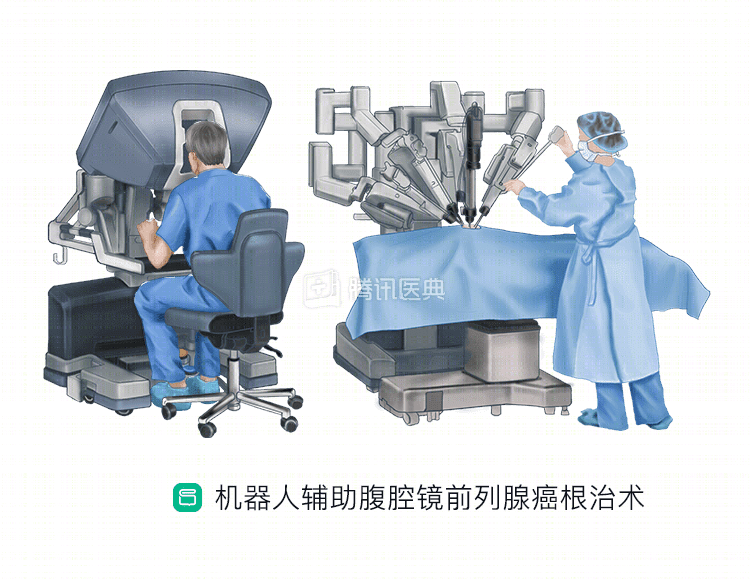
The da Vinci robotic surgery system consists of 3 main components: the surgeon’s console, the bedside robotic arm system, and the 3D high-definition imaging system.
With the following features:
- A clear image, with a 3D surgical field of view, magnified 10-15 times, allowing the surgeon to accurately localize tissue and manipulate instruments;
- Fine operation, the robot arm’s Endowrist simulation wrist provides 7 degrees of freedom and 540 degrees of rotation, recognizing and filtering hand tremor signals to provide fine separation and suturing operations;
- A shortened learning curve and a seated position for the surgeon reduces fatigue and improves surgical safety.
The da Vinci robotic surgical system enables better surgical results, shorter operative time, less bleeding, and faster postoperative recovery through the above features.
Robotic surgery has become the first choice for limited prostate cancer
The robotic surgical system has become one of the preferred modalities for the treatment of limited prostate cancer because of its dexterity and accuracy.
By clearly identifying tissue boundaries and operating with precision, tumor tissue can be completely removed while helping to preserve vital local musculo-neural tissue that is closely related to the patient’s urinary and sexual function.
Postoperative urinary incontinence and erectile dysfunction can be further improved in patients undergoing radical prostate cancer surgery based on robotic surgery, combined with pelvic floor muscle exercises and early erectile stimulant medications.
Localized high-risk prostate cancer is defined as tumor cells that have invaded the prostate envelope, seminal vesicles, bladder neck, or rectum.
The traditional view is that patients with localized high-risk prostate cancer should receive endocrine therapy and radiation therapy and are no longer candidates for surgery. With newer surgical concepts, improved techniques, and advances in equipment, localized high-risk prostate cancer can now also be considered: a combined treatment model led by robotic radical prostate cancer surgery, supplemented by endocrine therapy, chemotherapy, radiation therapy, or local cryopreservation, with more and more patients with intermediate to advanced prostate cancer benefiting as a result.
Related articles: