There are many ways to treat primary liver cancer at this stage, but the most effective method is still surgical resection of the tumor. However, only about 10-30% of patients can be surgically resected due to health status, liver function, degree of cirrhosis, tumor size, number and location of tumors, and other factors.
Other treatments (e.g., vascular interventions) are not effective in patients with large tumors or portal vein thrombosis; stenting can only temporarily relieve bile duct obstruction caused by tumor compression; and local ablation may injure normal tissues in the immediate vicinity of gastrointestinal vessels.
What is “particle knife” therapy?
What is particle knife therapy?
In recent years, advances in medical technology have led to the emergence of a new type of radiation therapy for tumors – high-precision inter-tissue radioactive particle implantation therapy, or “particle knife” for short.
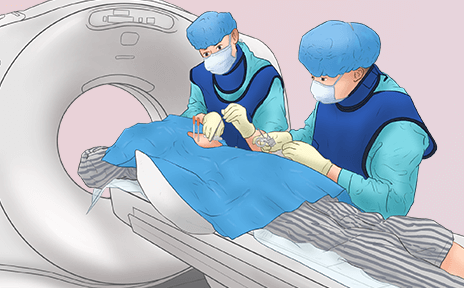
Particle Knife involves implanting radioactive particles inside the tumor and using the gamma radiation released by the particles for 180 days to kill tumor cells. Because of its low energy and small radiation range, it causes relatively little damage to the normal tissues and organs surrounding the tumor.
What are the advantages of the Particle Knife?
What are the advantages of the Particle Knife?
The Particle Knife has clear advantages for most patients with liver cancer who have lost their chance for surgery.
Precise targeting, precise efficacy
Targeting is strong, allowing the particles to be inserted precisely inside the liver tumor, allowing it to receive a significant increase in effective radiation dose, up to twice the effect of external radiation therapy. It is also a low-dose-rate radiation that lasts for 180 days and can irradiate liver tumor cells of different division cycles without interruption, so it has a high radiobiological effect.
Even in large hepatocellular carcinomas or those in more dangerous locations (e.g., giant hepatocellular carcinoma, portal emboli, etc.), complete necrosis can be achieved. These advantages are unmatched by conventional radiotherapy and vascular interventions.
Minimal trauma
The particle knife incision is just a few 2 mm pinholes, eliminating the need for surgery (resulting in a large incision of about 20 cm) and maximizing the patient’s liver function.
Maximum safety
Maximum safety
The risks of particle implantation are relatively low compared with conventional radiation therapy and surgical resection, and its complications are less frequent, less severe, and mostly easier to manage.
Ease of treatment
Surgical procedures typically require more than 2 hours of general anesthesia, whereas most imaging (ultrasound, CT, MR, etc.) guided “particle knife” procedures require only local anesthesia and can be completed in as little as 20 minutes, with the patient walking on the floor a few hours after the procedure and being discharged from the hospital in 2 to 3 days.
Better quality of life
Surgical resection often leaves long-term complications or sequelae, whereas the Particle Knife has a titanium shell that is very compatible with the body and does not cause rejection or radiation leakage, making long-term complications rare.
Repeatability of treatment
Treatment of tumors is a multiple, long-term process. Surgical procedures are the most effective but more invasive and difficult to perform multiple times; local ablation therapy is not possible multiple times in the face of liver tumors in high-risk sites; and chemotherapy is highly resistant after multiple sessions.
Particle knife is close to surgical resection, with little to no damage to normal tissue beyond 25 px from the particles, and can be repeated multiple times.
Summary
The particle knife has many advantages, including relatively mild trauma, precise efficacy, rapid recovery, and high quality of life, and is a promising alternative to surgical resection and conventional radiotherapy.
However, it is worth noting that “particle knife” is only one of many treatments for solid tumors such as liver cancer, and has its own specific scope of application and is not suitable for all patients. It is important to follow your doctor’s advice and choose the treatment plan that is most appropriate for your specific situation.