The staging of hepatocellular carcinoma is critical to the selection of treatment options and the assessment of prognosis.
Staging is generally based on tumor factors, the patient’s general condition (physical status score), and liver function (Child-Pugh grade), with a variety of staging options available nationally and internationally.
|
Physical Status (Performance Status) (ECOG scale) |
|
|---|---|
|
Level |
Strength status |
| 0 | Mobility is completely normal and does not differ in any way from pre-initiation mobility |
| 1 | Ability to walk freely and perform light physical activities, including general housework or office work, but not heavier physical activities |
| 2 | Ability to walk freely and care for themselves, but have lost the ability to work and get up and move around at least half the time during the day |
| 3 | Living only partially on their own, in bed or in a wheelchair more than half the time during the day |
| 4 | Bedridden and unable to care for themselves |
|
Liver Function Child-Pugh Classification (A: 5-6 points; B: 7-9 points; C: 10-15 points) |
|||
|---|---|---|---|
| Scoring method | 1 point | 2 points | 3 points |
| Albumin (g/L) | ≥ 35 | 25 to 35 | Not less than 25 |
| Total bilirubin (umol/L) | ≤ 25 | 25 to 40 | Not less than 40 |
| Prothrombin time (seconds, above normal) | ≤ 4 | 4~6 | Not less than 6 |
| Abdominal fluid | None | Small amount | Moderate amount |
| None | I-II | III-IV | |
Barcelona Staging
Barcelona Clinic Liver Cancer (BCLC staging), adopted and recommended by the European Society of Liver Diseases and the American College of Liver Diseases:
- Very early stage (stage 0) hepatocellular carcinoma: a single tumor no larger than 2 cm in diameter and consistent with Child-Pugh A, PS 0;
- Early stage (stage A) liver cancer: single tumor or 3 tumors no larger than 3 cm in diameter and Child-Pugh A, PS 0;
- Mid-stage (stage B) liver cancer: multiple tumors, consistent with Child-Pugh A-B, PS 0;
- Mid-stage (stage B) liver cancer: multiple tumors, consistent with Child-Pugh A-B, PS 0;
- Advanced (stage C) hepatocellular carcinoma: tumor with portal vein invasion or extrahepatic metastases and Child-Pugh A-B, PS 1-2;
- End-stage (stage D) hepatocellular carcinoma: tumor condition is not limited, as long as Child-Pugh C or PS 3~4 is met.
Staging of liver cancer in Hong Kong
The criteria for staging liver cancer in Hong Kong are:
- Early stage hepatocellular carcinoma: tumor diameter not greater than 5 cm and not greater than 3 tumors, without intrahepatic vein invasion.
- Mid-stage hepatocellular carcinoma: tumor diameter no greater than 5 cm and no less than 3 tumors or with intrahepatic vein invasion; or tumor diameter no less than 5 cm and no greater than 3 tumors or with intrahepatic vein invasion.
- Locally progressive hepatocellular carcinoma: tumor diameter no greater than 5 cm and no less than 3 tumors with concomitant intrahepatic vein invasion; tumor diameter no less than 5 cm and no less than 3 tumors or concomitant intrahepatic vein invasion; intrahepatic tumor dissemination.
Based on the above description, hepatocellular carcinoma can be classified as follows:
- Stage I: Early stage hepatocellular carcinoma with Child-Pugh A, PS 0;
- Stage IIa: Early-stage liver cancer with Child-Pugh B or PS 1;
- Stage IIb: mid-stage hepatocellular carcinoma in Child-Pugh A;
- Stage IIIa: mid-stage hepatocellular carcinoma of Child-Pugh B;
- Stage IIIb: Locally progressive hepatocellular carcinoma;
- Stage IVa: Child-Pugh A hepatocellular carcinoma with extrahepatic vascular invasion or metastasis;
- Stage IVb: Child-Pugh B hepatocellular carcinoma with extrahepatic vascular invasion or metastasis;
- Stage Va: Early-stage hepatocellular carcinoma with PS 2-4 or Child-Pugh C and no extrahepatic vascular invasion or metastasis;
- Stage Vb: non-early stage hepatocellular carcinoma with PS 2-4 or Child-Pugh C and combined extrahepatic vascular invasion or metastasis;
Korean Liver Cancer Collaborative Group and Korean National Cancer Center Staging
Hepatocellular carcinoma was classified into stages I, II, III, IVA, IVB based on primary tumor (T), regional lymph nodes (N), and presence of distant metastases (M):
| Staging | T |
N |
M |
| I |
T1 |
N0 |
M0 |
| II | T2 |
N0 |
M0 |
|
III |
T3 |
N0 |
M0 |
|
IVA |
T4 |
N0 |
M0 |
|
T1,T2,T3,T4 |
N1 | M0 | |
| IVB |
T1,T2,T3,T4 |
N0,N1 |
M1 |
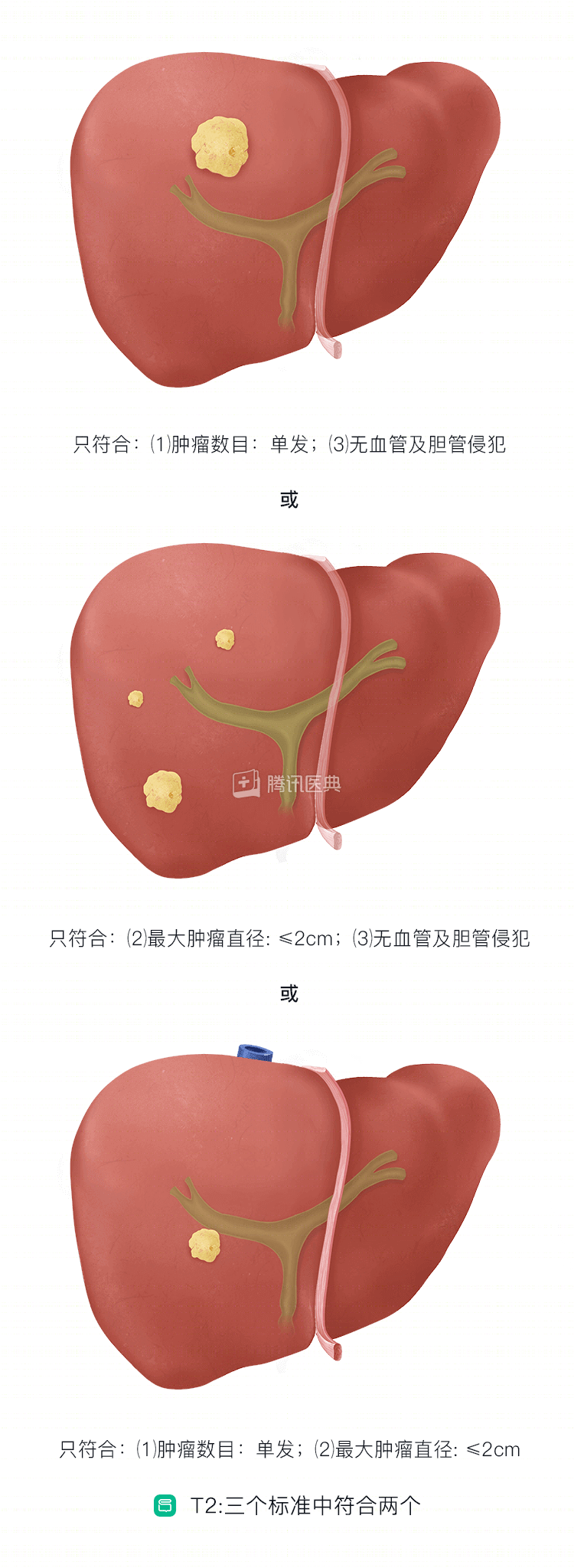
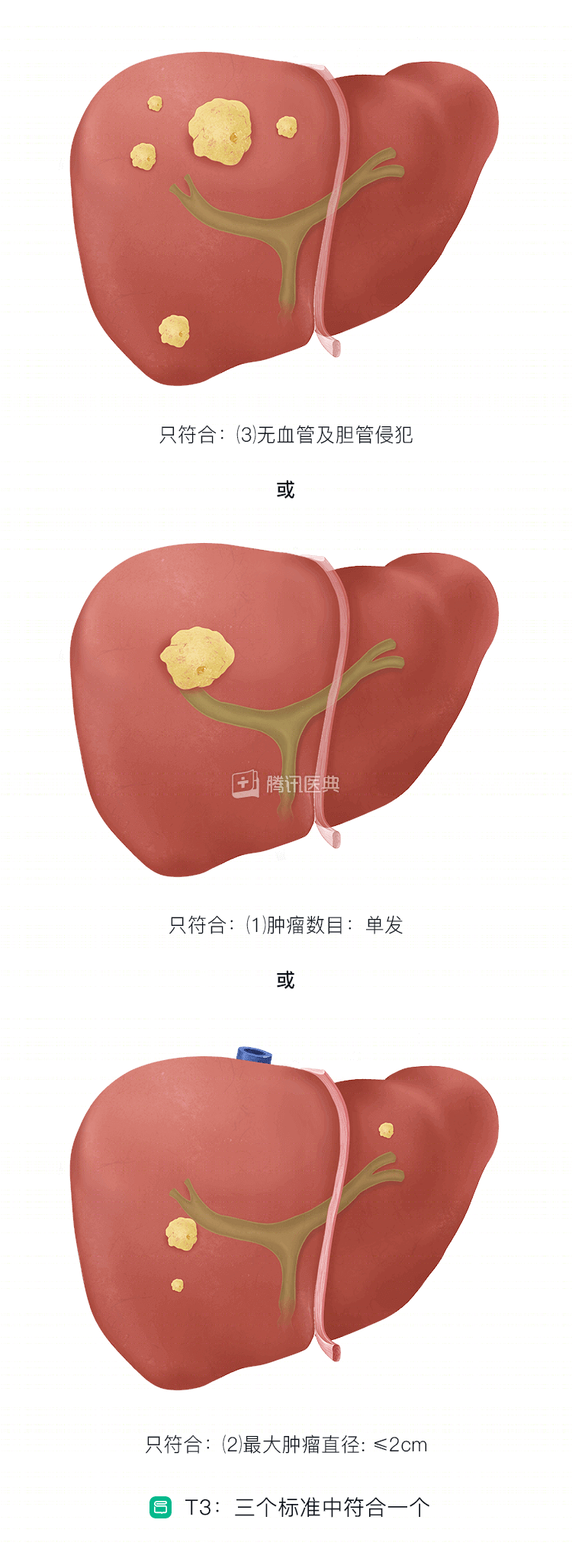
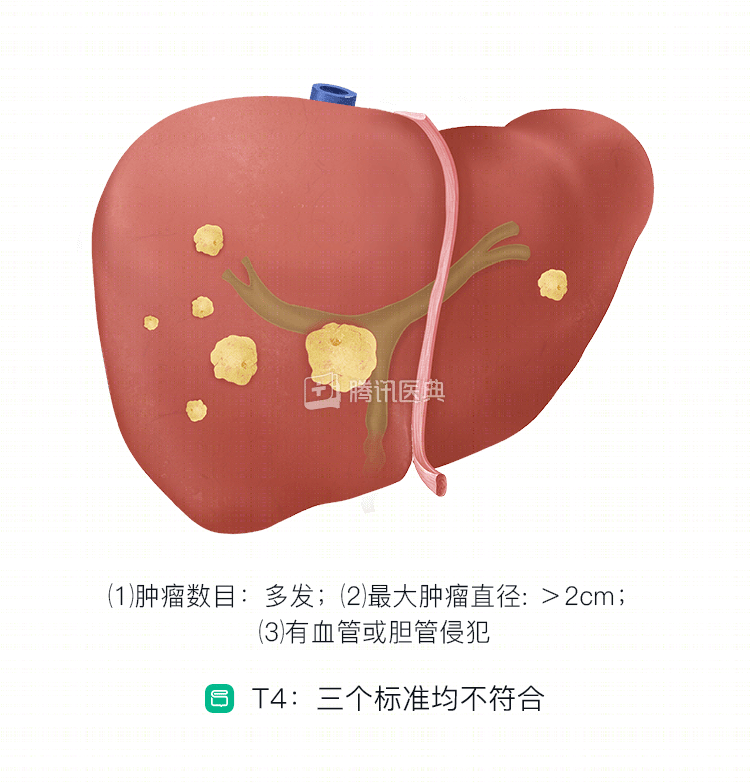
The primary tumor grading (T1, T2, T3, T4) in the above staging is described specifically in the table below and in the figure below:
| T Staging Criteria | |||
|---|---|---|---|
|
(1) Number of tumors: solitary; (2) Maximum tumor diameter: no greater than 2 cm; (3) no vascular or biliary invasion |
|||
| T1 | T2 | T3 | T4 |
| All three criteria met | Meets two of three criteria | Meets one of the three criteria | Not meeting all three criteria |