How high is the risk of esophageal cancer in teenagers and young adults in their 20s? Before answering this question, let’s look at what is the age of high incidence of esophageal cancer.
Esophageal cancer
Esophageal cancer is more common after age 40
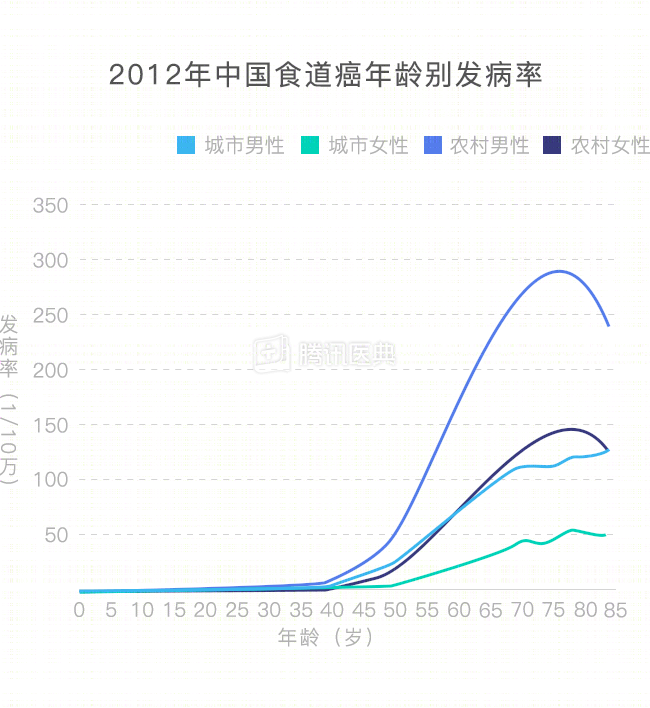
Studies show that the incidence of esophageal cancer is low until age 40; it begins to increase rapidly after age 40. In addition to rural men, the incidence of esophageal cancer peaks in the 80-year-old age group in both rural women and urban populations and declines after 85 years of age (Figure below).
Esophageal cancer rare in adolescents
According to the literature, esophageal cancer is very rare in patients under 30 years of age, and it is the age group of 60 to 75 years that has the highest incidence of esophageal cancer, accounting for more than 50% of overall esophageal cancer; followed by 45 to 60 years of age.
What about people in their 20s who have trouble swallowing?
While the risk of esophageal cancer in adolescents is extremely low, that doesn’t mean it’s absolutely impossible to get it.
Esophageal cancer is insidious at the onset, and delayed access to care is common, followed by visits for symptoms such as choking sensation, pain and discomfort behind the sternum, burning sensation, and weight loss. These symptoms are also common in pharyngitis, tonsillitis, esophagitis, gastritis, gastric ulcer and other diseases, so it is difficult for people to distinguish them. And when progressive dysphagia, a typical symptom of esophageal cancer, appears, the disease has often progressed. The pathological differentiation of adolescent esophageal cancer is low, invasive, with a high rate of lymph node metastasis and a short survival period, and the rate of radical resection is often low.
Therefore, if adolescents develop these symptoms, it is important to seek prompt medical attention to identify the cause and treat it aggressively. For adolescents suspected of esophageal cancer, doctors will confirm the diagnosis through upper gastrointestinal imaging and gastroscopy. If the doctor diagnoses that it is not esophageal cancer, after relevant medication for 1~2 weeks does not work, you should also tell your doctor in time to make up for the gastroscopy.