Patients with similar symptoms and pathology who use the same drug end up with very different outcomes. This may seem like an “odd phenomenon” in terms of common sense, but it is not uncommon in the treatment of gastric cancer.
Same disease, same drug, different outcomes
There is growing evidence that gastric cancer is a complex and variable disease. Some tumors that appear to be of the same type actually have completely different roots of disease.
More specifically, they have different genetic profiles behind them, and mutations, deletions, and other changes in these genes are strongly associated with cancer onset, progression, and metastasis. Because many targeted anti-cancer drugs are effective only for certain genetic changes, other patients do not get good results despite having similar disease, which leads to “same disease, same drug, different results”.
Recently, the New England Journal of Medicine, a top international journal, published a phase 2 clinical study conducted jointly by Japan and South Korea. They found that the trastuzumab-deruxtecan treatment regimen was effective in refractory gastric cancer. However, not all patients with gastric cancer benefit, and this regimen is currently only available for patients who are HER2-positive.
Gene helps put a motor on cancer cell growth
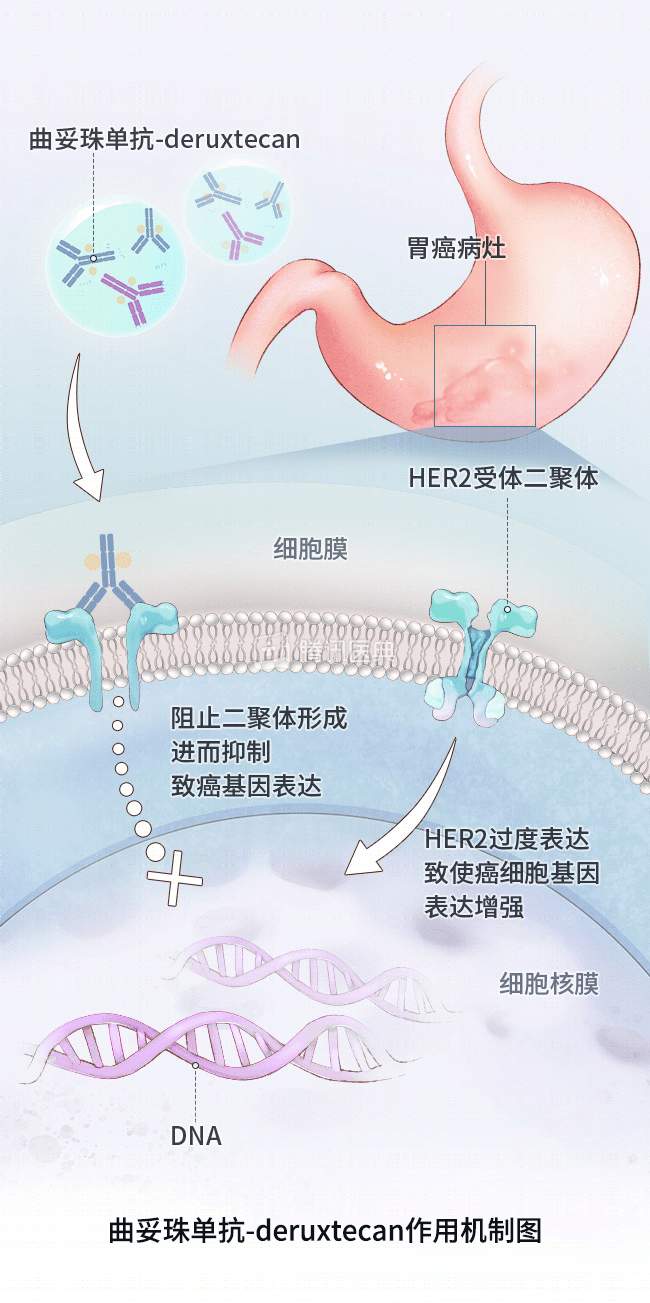
The Chinese name for the HER2 gene is “human epidermal growth factor receptor 2,” and its product, the HER2 protein, if present on the surface of cancer cells, is like putting a “motor” on the cancer cells. “This makes cancer cells grow faster, become more aggressive, and deteriorate more easily. If more of these genes are detected in a patient’s cancer cells, it is called HER2 positive.
In China, stomach cancer is the third most common cancer, and about 16.6% of patients are HER2-positive, which is equivalent to 1 in 6 patients with stomach cancer.
Not only that, but the prevention and control of gastric cancer in China is quite serious, with a 5-year survival rate of only 36%, compared to more than 60% in neighboring Japan and South Korea. Especially for patients with advanced gastric cancer who have failed other drug treatments, they have very limited treatment options available to them.
Gene also creates treatment opportunity
But HER2 positivity also creates an unexpected therapeutic opportunity. It’s like a “GPS coordinate” for cancer cells, and the targeted drug trastuzumab is a GPS-enabled missile that finds the “coordinates” and hits them right on the spot.
Trastuzumab is the world’s first approved large-molecule targeted anti-cancer drug, and it’s a grandfather of sorts. Now, a new version, trastuzumab-deruxtecan, is ready to make its mark in gastric cancer treatment. The principle of the drug is actually what we call GPS missiles, but it is upgraded from a “single warhead” to a “dual warhead”, with an additional warhead loaded with “biochemical weapons” to destroy cancer cells more effectively. It’s more effective at destroying cancer cells.
So how did this new treatment perform in patients with HER2-positive gastric cancer?
Trastuzumab-deruxtecan, can it offer hope for patients with gastric cancer?
“New life for an old drug”, can it bring hope to patients with gastric cancer?
What about trastuzumab?
Trastuzumab-deruxtecan, can it bring hope to patients with gastric cancer?
The investigators recruited more than 180 patients with advanced gastric or gastroesophageal junction cancer for the trial, all of whom were HER2-positive and had failed at least two previous treatments (see flowchart for details).
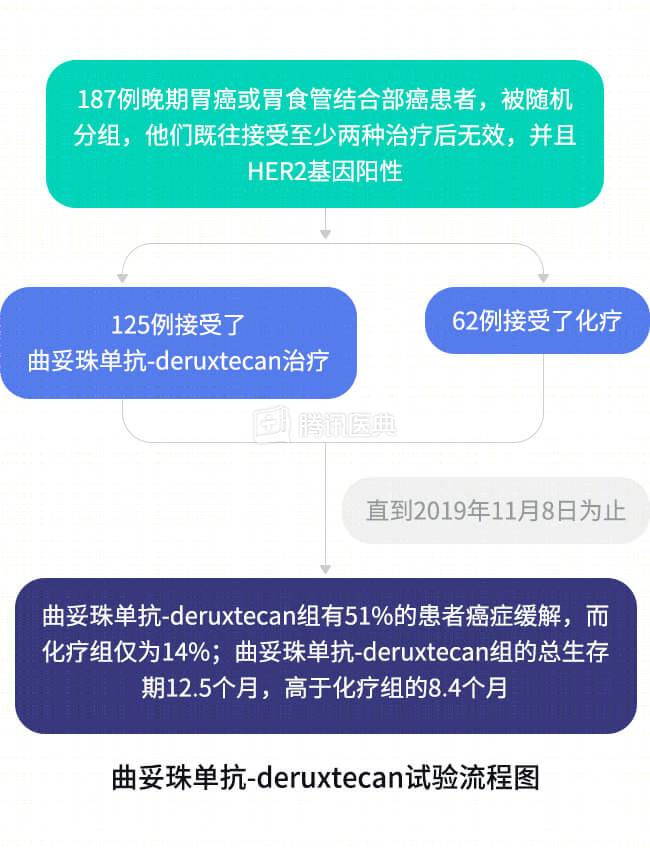
The results showed that 51% of patients in the trastuzumab-deruxtecan group had cancer remission compared with 14% in the chemotherapy group. In terms of overall survival, the trastuzumab-deruxtecan group achieved 12.5 months, compared with 8.4 months in the chemotherapy group.
While the results offer new hope for the treatment of HER2-positive advanced gastric cancer, we need to be concerned about the adverse effects of trastuzumab-deruxtecan, as Professor Aiping Zhou of the Department of Internal Medicine at the National Cancer Center/Chinese Academy of Medical Sciences Cancer Hospital pointed out.
51% of patients in the trastuzumab-deruxtecan group had more serious adverse events, such as neutropenia. In addition, interstitial lung disease occurred in about 10% of patients in this group. Although mild in most patients, close monitoring for associated symptoms and regular monitoring of chest CT is required in clinical practice.
An increasing number of HER2-positive patients will benefit
More patients with HER2-positive cancers will benefit as trastuzumab is added to the Chinese health insurance list and more anti-HER2-targeted drugs enter the clinic.
But as mentioned at the beginning, targeted drugs don’t work for everyone. Patients who are not screened by genetic testing are very ineffective when treated with targeted drugs. If you try targeted drugs “blindly,” it means that many patients may be delayed by the wrong drug, and it can lead to a huge waste of medical resources and an unjustified use of health insurance funds.
At present, the cost of genetic testing is out-of-pocket in most provinces and cities across China, and the cost of testing is high. For example, in Jiangsu, the cost of a single mutation test for the EGFR gene is about 3000 RMB.
However, as more and more cities include cancer genetic testing in their health insurance, it is believed that in the near future, this practice will also be implemented nationwide, allowing more cancer patients to benefit.