This is the first time I’ve ever seen a company like this, and I’m sure it’s a good idea. The company’s main goal is to provide a comprehensive range of products and services to the public.
“How can you have kidney cancer without any signs at all?”
“What should we do if we are so young and have kidney cancer? Do you have to wait to die?”
“Are there many people who have kidney cancer like me?”
……
With these doubts, Xiao Zhang looked around, gathered information, and consulted many urologists to slowly unravel the mystery of kidney cancer.
The incidence of kidney cancer in China – about 5 out of every 100,000 people get kidney cancer
Compared to some common types of cancer, such as lung, stomach, colorectal, and liver cancer, kidney cancer is not very prevalent and never squeezes into the top 10 cancer incidence rankings. Even in the male population, the incidence of kidney cancer is lower than other urologic tumors, such as prostate and bladder cancers.
The latest survey shows that in 2014, there were 68,300 new cases of kidney cancer nationwide, accounting for 1.8% of all malignant tumor incidences and ranking 15th in all malignant tumor incidences. In contrast, there were 780,000 new cases of lung cancer in 2014, more than 10 times the number of kidney cancer cases.
Worldwide, the incidence of kidney cancer is about 4.4 per 100,000. Among them, North America, Australia/New Zealand, and Europe have the highest incidence of kidney cancer, while regions such as Africa have the lowest incidence of kidney cancer.
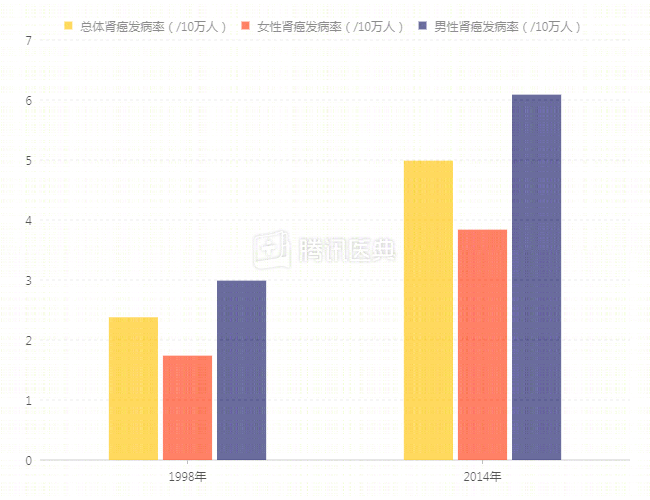
The incidence of kidney cancer in China is lower than the global and developed country averages, but in recent years, the incidence of kidney cancer has been on the rise in both men and women, in urban and rural areas. 2014 surveys show that the incidence of kidney cancer in China is 4.99 per 100,000, meaning that nearly 5 out of every 100,000 people have kidney cancer.
While the current incidence of kidney cancer is not high, it has approximately doubled compared to 20 years ago and is increasing in both men and women, but the overall incidence is significantly higher in men than in women (Figure 1).
Figure 1. Comparison of the incidence of kidney cancer in China in 1998 and 2014
Most patients with first diagnosis of kidney cancer have no obvious symptoms
The tumor grew to several centimeters in size when Xiao Zhang was diagnosed, indicating that the tumor had been in the body for a long time, yet there had been no symptoms, exactly like a normal person, so it would never have occurred to him that he would have kidney cancer. In fact, this situation is very common in the clinic, many kidney cancer patients do not have special symptoms, and many of them are only found to have tumors in their kidneys during medical examinations.
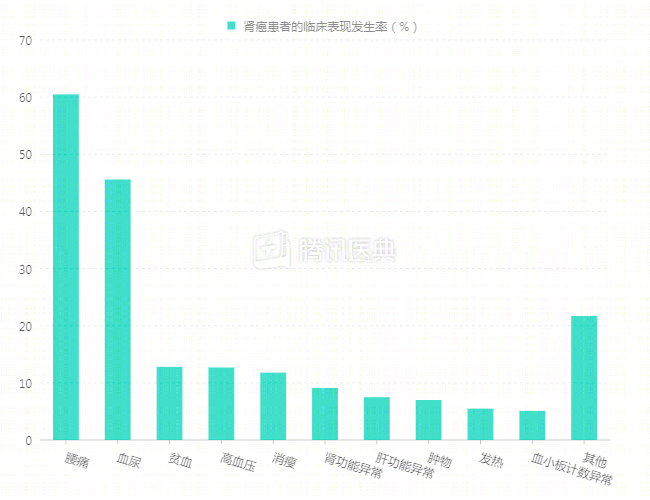
An analysis of data from several hospitals in China shows that asymptomatic kidney cancer accounts for 62.7% of patients initially diagnosed with kidney cancer. The most common symptoms for patients were, in order, back pain, hematuria, hypertension, and anemia (Figure 2).
Figure 2. Incidence of different clinical manifestations among 1975 patients with primary kidney cancer in 23 hospitals in China (August 2007 to October 2008)
Kidney cancer occurs in older people, but younger people can get it too
Cancer usually occurs in older adults, and kidney cancer is no exception. Kidney cancer can occur at all ages, but its incidence is low from 0 to 34 years of age and begins to rise after 35 years of age, with similar trends in incidence in men and women and in urban and rural areas, peaking at 75 to 79 years of age and beginning to decline after 80 years of age.
Xiao Zhang is only 32 years old, and there are very few young kidney cancer patients like him; most kidney cancer patients in clinical practice are middle-aged and older, aged 50 to 70. But urologists report that they have even seen patients at younger ages, such as in their teens.
Who is kidney cancer likely to find? — urban men
In terms of incidence data, the odds of kidney cancer seem low, but this is the average for all regions of the country, for all genders, and for some groups, the incidence of kidney cancer is much higher than the general population and should be taken seriously.
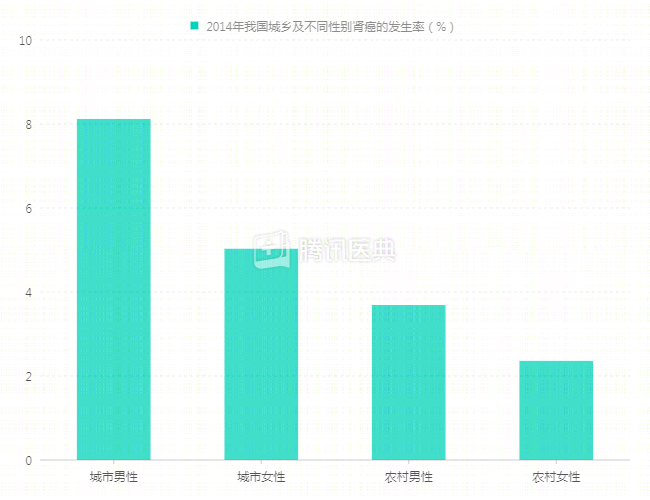
The survey found that in addition to a higher incidence of kidney cancer in men than in women, the incidence of kidney cancer was significantly higher in urban populations than in rural areas. When the population was broken down by gender and rural/urban areas, it was found that the incidence of kidney cancer was 8.12/100,000 in urban men, significantly higher than in urban women (5.03/100,000) and even higher than in rural populations (Figure 3).
Figure 3. Incidence of kidney cancer in urban and rural areas and by gender in China in 2014
Why is this?
Why is the incidence of kidney cancer increasing? — The prevalence of physical exams and the increase in risk factors
In recent years, people always feel that cancer is becoming more and more prevalent, and kidney cancer is no exception. The exact reason is hard to be fully understood, but it is certain that it has a lot to do with the popularity of medical checkups. The reason is that in the past, when medical care was not advanced, many people were not in a position to get a diagnosis even if they were ill, and they did not know what they had until they died.
Fortunately, with the popularity of imaging tests such as ultrasound, CT (computed tomography) and MRI, the level of kidney cancer diagnosis has improved greatly, and many kidney cancers are detected at an early stage. Xiao Zhang is a typical example. If it wasn’t for his unit’s physical examination, he would likely have had symptoms only after several more years, when the kidney cancer slowly progressed to metastasis throughout his body, and by then, treatment would have been tricky.
But this is only part of the reason for the rising incidence of kidney cancer, which may also have a lot to do with a number of risk factors. The three major risk factors for kidney cancer that are now recognized are:
- Smoking
- High blood pressure
- Obesity
And these three risk factors have become increasingly serious and prevalent in our country in recent years. While developed countries are trying to reduce tobacco consumption, it is still on the rise in China. while overweight and obesity were rare in the 1980s, the overweight rate in our population reached 34% and the obesity rate exceeded 10% in 2014. In addition, the prevalence of hypertension in China has been increasing year by year, and in 2002, the prevalence of hypertension among people over 15 years old was nearly 18%. These factors may have contributed to the increasing incidence of kidney cancer.
She had a history of smoking for many years and often worked late at night, was black and white, lacked exercise, and weighed nearly 200 pounds at 170 cm tall. Although it is not certain that these causes must have led to kidney cancer, even if there is no kidney cancer, these poor lifestyle habits may lead to other health problems.
The prognosis for kidney cancer is relatively good compared to other malignancies
Like all patients who have just been diagnosed with kidney cancer, Zhang’s biggest fear and concern is – how long can you live with kidney cancer?
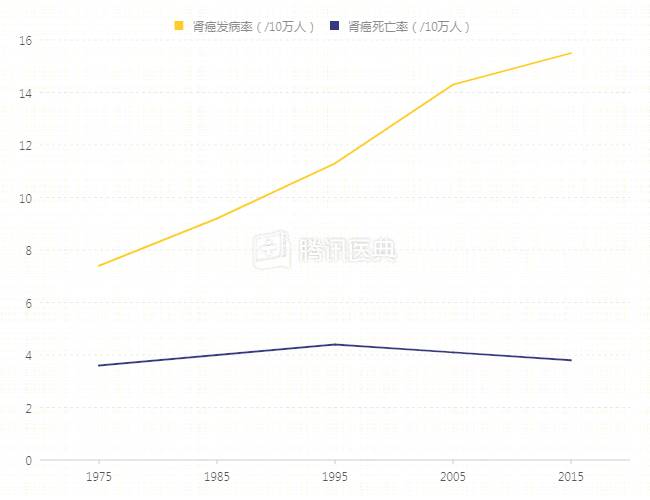
In fact, the overall survival prognosis for kidney cancer is relatively good compared to other cancer types (e.g., lung, stomach, liver, etc.). For example, the 5-year survival rate for patients with kidney cancer in the United States is 74.5%, compared with 18.6% for lung cancer. In addition, although the incidence of kidney cancer in the United States is on the rise, the mortality rate is declining (Figure 4).
Figure 4. Trends in incidence and mortality of kidney cancer in the United States between 1975 and 2015
There are no survival survey statistics for kidney cancer in China, but urologists are generally optimistic about the survival rate of kidney cancer, especially for early-stage kidney cancer patients, most of whom can achieve long-term survival and be cured after surgical treatment.
After learning this, Xiao Zhang has confidence in the treatment of kidney cancer. It seems that kidney cancer is not as scary as imagined, and he is in the early stage, the tumor has not yet spread, but only a little large, which needs to be surgically removed, and the current surgical technology is very mature, so there is no need to be overly nervous and worried. The next step is to adjust yourself well and cooperate with the doctor to receive examination and treatment.