A separate renal tumor aspiration biopsy is usually not required if surgery has been prepared. However, if the tumor is small and does not require treatment for the time being but only active surveillance, or if a definitive pathologic diagnosis is needed before ablation, targeted or radiotherapy without surgery, a renal aspiration biopsy may be needed to provide a basis for a reasonable treatment plan.
What should I do before a renal puncture?
Preparation for the procedure is an important part of reducing complications. The following preparations are needed before surgery:
- The physician will explain the necessity, safety, and possible complications of renal puncture biopsy to the patient and family, and obtain their consent. The renal puncture operation is also explained to relieve the patient’s fear. Patients are also instructed to practice breath-holding (brief breath-holding is required for renal puncture) and bed-rest urination (bed-rest is required for 24 hours after renal puncture).
- Tests for clotting time, platelet count, and prothrombin time for bleeding tendency.
- Check creatinine clearance.
- Check creatinine clearance, blood creatinine and urea nitrogen for renal function; isotope renogram for fractional renal function; and ultrasound for renal size, location and mobility.
- Check blood type, prepare blood, and clean the skin of the renal area before surgery.
- Take oral or intramuscular vitamin K 2 to 3 days before surgery.
- Empty the bladder before surgery.
What is the procedure for a kidney puncture?
The specific steps of the renal puncture biopsy are as follows:
- The patient is placed prone on the examination table after urination, with a pillow on the abdomen and the kidney pushed to the dorsal side for fixation, with the arms extended forward and the head tilted to the side.
- The physician determines the puncture site and puncture angle under CT or B-ultrasound guidance.
- The skin of the back is disinfected and a sterile towel is spread.
- Local skin and subcutaneous anesthesia with 1% to 2% lidocaine.
- The physician punctures the puncture needle vertically up to the renal capsule and observes the movement of the upper and lower poles of the kidney with breathing. When the tumor moves to the best position for puncture, the patient will be asked to hold his breath, immediately and quickly puncture the puncture needle 1~2 cm into the tumor, excite the puncture gun, and pull out the puncture needle, at which time the patient can resume normal breathing.
- To check whether the kidney tissue is taken and to measure its length, usually 2~3 strips of tissue need to be taken from different parts of the tumor for pathological examination.
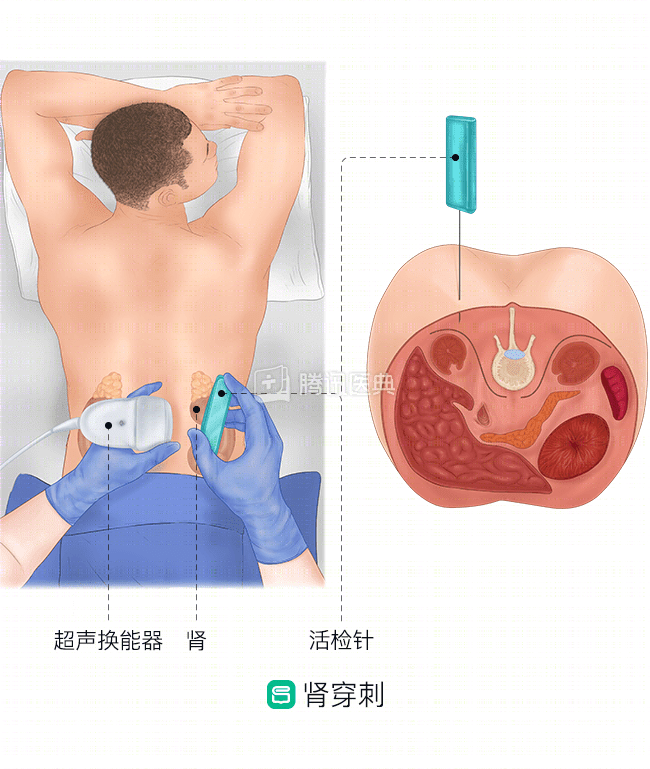
The entire puncture procedure is mildly painful during local anesthesia and puncture. The patient should lie flat for 24 hours after the procedure, drink plenty of fluids, and closely monitor blood pressure, pulse, and changes in urine color.
What are the physical effects of a kidney puncture?
Kidney puncture biopsy may cause a number of complications, including hematuria, perirenal bleeding, back pain, and infection.
- Hematuria: If there is only “microscopic hematuria” with no change in color to the naked eye, it usually disappears 1 to 5 days after the procedure and requires no special treatment. If the hematuria is visible to the naked eye, most of it disappears in 1-3 days if it is not serious. It is recommended to drink plenty of water to ensure a smooth urinary tract and to pay attention to urination. In rare patients with heavy bleeding, the doctor may perform a renal arteriogram to identify the site of the bleeding and, if necessary, embolize the small vessels that are bleeding.
- Perirenal hemorrhage: It occurs in about 60% of patients and is usually small, asymptomatic, and most often absorbed within 2 to 4 weeks.
- Lower back pain: incidence is about 40%, mainly associated with subperitoneal hemorrhage after puncture, which mostly disappears within a week.
- Infection: is rare and may be due to poor sterilization, perirenal infection, or concomitant pyelonephritis, manifested by fever, severe back pain, and elevated white blood cells, at which time the physician may recommend antibiotic treatment.