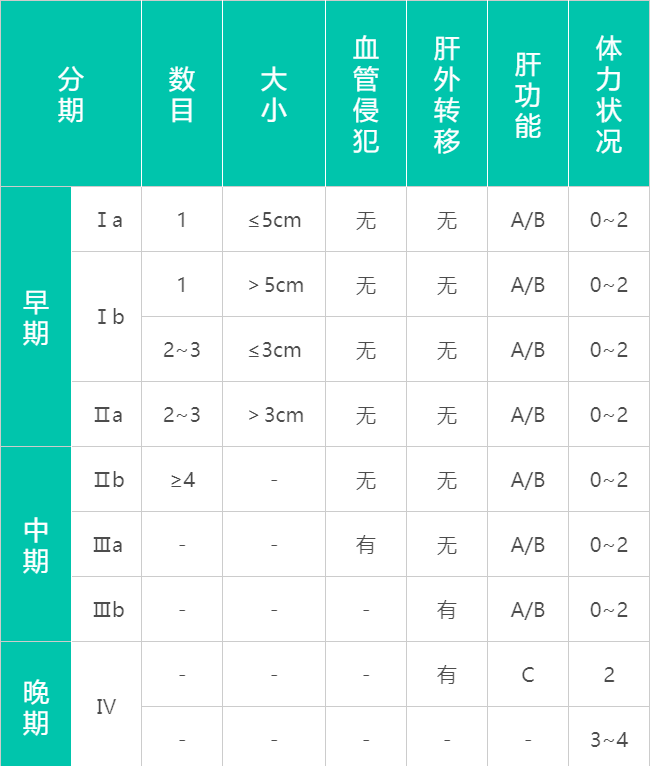
According to the specific situation and practice accumulation in China, scholars of hepatocellular carcinoma in China determine the tumor stage based on 6 factors: number, size, vascular invasion, extrahepatic metastasis, liver function Child-Pugh score, and physical status PS score, which can be divided into 7 stages: stage Ia, stage Ib, stage IIa, stage IIb, stage IIIa, stage IIIb, and stage IV.
Early to mid-stage diagnostic staging of tumors
We usually consider stages Ia, Ib, and IIa to be early, stages IIb, IIIa, and IIIb to be intermediate, and stage IV to be late.
- Stage Ia is a single tumor ≤5 cm in maximum diameter without vascular invasion or extrahepatic metastasis; liver function Child-Pugh A/B; PS0-2.
- Stage Ib is
- Single tumor maximum diameter >5cm, no vascular invasion, extrahepatic metastasis; liver function Child-Pugh A/B; PS0-2.
- Tumor number 2~3 , single tumor maximal diameter ≤3cm, no vascular invasion, extrahepatic metastasis; liver function Child-Pugh A/B; PS0-2.
.
- Stage IIa is 2 to 3 tumors with a maximum diameter of >3 cm, no vascular invasion or extrahepatic metastases; liver function Child-Pugh A/B; PS0-2.
- Stage IIb is ≥4 tumors, regardless of tumor size, no vascular invasion, extrahepatic metastases; liver function Child-Pugh A/B; PS0-2.
- Stage IIIa is tumor status regardless, with vascular invasion, no extrahepatic metastases; liver function Child-Pugh A/B; PS0-2.
- Stage IIIb is tumor status regardless, vascular invasion regardless, extrahepatic metastases; liver function Child-Pugh A/B; PS0-2.
- Stage IV is tumor status regardless, vascular invasion regardless, extrahepatic metastases.
- Stage IV is tumor status regardless, vascular invasion regardless, extrahepatic metastases; liver function Child-Pugh C; PS0-2. or tumor status regardless, vascular invasion regardless, extrahepatic metastases regardless, liver function regardless, PS3-4.
- Stage IIIb is tumor status regardless, vascular invasion regardless, extrahepatic metastases regardless, liver function Child-Pugh C; PS0-2.
For further information on the liver function Child-Pugh rating and physical activity status PS score see the link:
How is mid-stage liver cancer treated?
Interventional treatment is recommended for mid-stage hepatocellular carcinoma, provided that the portal vein trunk is not completely obstructed or is completely obstructed but compensatory collateral vessels are formed between the hepatic artery and portal vein. For stage IIIb patients, interventional therapy is recommended in combination with systemic therapy, including combination of molecularly targeted drugs, arsenic trioxide, radioimmune-targeted drugs, gene therapy, immunotherapy, and systemic chemotherapy. There is also a need to focus on local plus local treatment, including TACE combined with ablation, TACE combined with radiation therapy (mainly for treatment of portal vein trunk thrombosis, inferior vein thrombosis or limited large hepatocellular carcinoma after intervention), TACE combined with stage II surgical resection, and surgical resection is recommended for large hepatocellular carcinoma or massive hepatocellular carcinoma when it shrinks after TACE treatment and an opportunity for surgery is available.
Summary: It is mid-stage liver cancer that will be treated primarily with TACE and systemic therapy, etc.
For further information on stage II and III hepatocellular carcinoma, see the link: