Patients with leukemia, whether acute or chronic, require bone marrow aspiration for diagnosis or treatment. Bone marrow aspiration (abbreviated as bone aspiration) generally consists of two operations: bone marrow smear and bone marrow biopsy.
We humans produce all of our blood cells in the extravascular space of the bone marrow. The blood vessel wall forms a barrier between the hematopoietic “compartment” and the blood circulation, the marrow blood barrier (MBBB). Newly generated blood cells must pass through this MBBB in order to enter the peripheral blood circulation. This barrier is selective, sifting through cells, blocking immature or defective cells, while allowing mature blood cells to pass through and enter the peripheral circulation. To date, there is no technology available to overcome this barrier.
Therefore, the only way to understand the pathology of hematopoietic cells in the bone marrow can be clarified by this test, bone marrow aspiration.
In addition, patients with suspected leukemia need a bone marrow test to determine if there is a malignant hematopoietic clone in the bone marrow, and patients with leukemia who have been diagnosed and treated need a bone marrow test to determine the effect of the treatment.
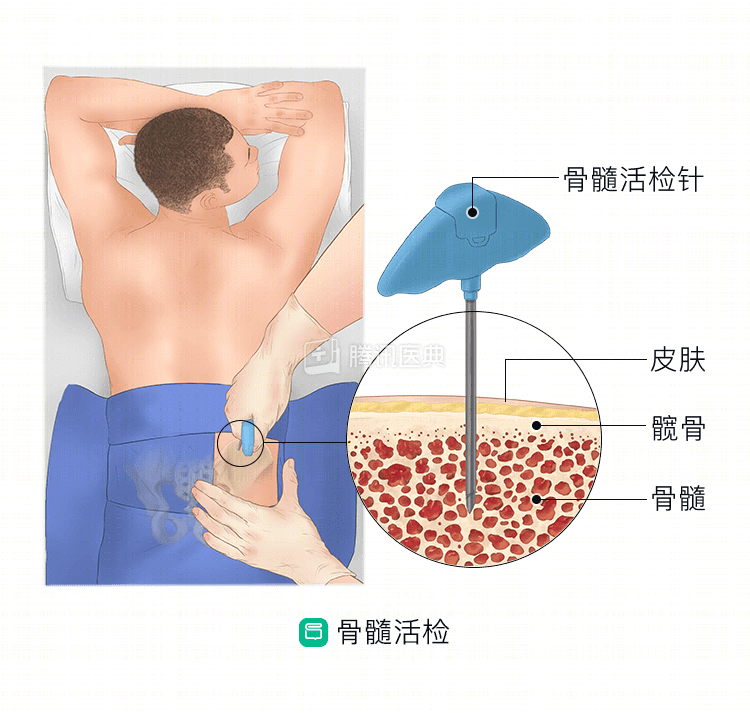
Many patients have a fear of bone marrow aspiration. In fact, a bone puncture is a very minor procedure, usually a sample is taken at the upper edge of the pelvis where blood production is strong, after a small local injection of anesthetic.
- Bone marrow smear is the extraction of 0.2 ml of bone marrow fluid, which is applied as a single cell layer on a slide, usually through an oil microscope (which can be magnified 1000 times), to observe the specific morphology and internal structure of the blood cells;
- Bone marrow biopsy is the extraction of 1 to 2 cm of bone tissue, which is processed by HE staining and immunohistochemistry and then analyzed under high magnification (magnification 200 to 400 times).
The entire procedure of bone aspiration is performed by a skilled physician in just a few minutes. After the bone marrow is extracted, the patient can get up and move around immediately. A few things to keep in mind:
- Local pressure to stop bleeding for 5 to 10 minutes after the bone marrow puncture;
- Do not touch the wound with water for 3 days to prevent infection;
- If accompanied by generalized fever or persistent bleeding from the wound, contact your doctor to stop the bleeding or use antibiotics as appropriate for your condition.
The average amount of bone marrow hematopoietic tissue in a normal person is 2,600 grams, and the amount taken by each puncture is only 0.2 to 0.3 grams, plus the bone marrow is a highly regenerative tissue that is quickly produced after aspiration, so there is no damage to the patient’s health.
There are, of course, contraindications to bone marrow aspiration:
- Bone marrow aspiration is contraindicated in hemophilia with severe bleeding.
- Bone marrow aspiration is contraindicated in those with bleeding tendency or significantly prolonged clotting time, but it can be done for definitive diagnosis of the disease, with prolonged local compression for hemostasis after a puncture.
- Bone marrow aspiration should be performed with caution in women with advanced pregnancy.