Chimeric antigen receptor (CAR) T-cell therapy is a state-of-the-art technology that uses a patient’s own immune cells for anti-tumor therapy. Doctors will collect a specific type of white blood cell from the patient and genetically modify the cells in the lab to give them greater tumor cell recognition. Hundreds of millions of genetically modified cells are then amplified and infused back into the patient to more effectively kill tumor cells.
This is a newer therapy, and clinicians do not yet have a complete picture of the extent of benefit or duration of treatment. And the cost of the treatment is extremely high, and countries have not yet included it in their health insurance coverage.
Patients need to talk to their doctors and carefully weigh the pros and cons of CAR-T cell therapy before deciding whether to receive it.
What cancers can CAR-T cell therapy be used to treat?
CAR-T cell therapy is approved in the United States to treat pediatric and adult acute lymphoblastic leukemia, as well as certain types of adult non-Hodgkin’s lymphoma. Researchers are evaluating the efficacy of this regimen for other types of hematologic tumors through clinical trials.
Chemotherapy and stem cell transplantation are the preferred treatment options for these diseases. However, if a patient has tried at least 2 options and has failed, or has a relapse after treatment has ended, then CAR-T cell therapy may be an option for follow-up treatment. For some patients, this may be the last hope for a cure.
Why can CAR-T cell therapy treat cancer?
Under normal circumstances, T cells in the body recognize and kill tumor cells. They look for mutated cells based on antigens on the surface of the cells, which are different from normal cells, and the T cells flag the mutated cells, alerting the immune system that “the culprit is here! and do their best to kill them.
But sometimes T cells may not recognize some tumor cells because they are disguised as almost identical to normal cells. After escaping recognition by the immune system, such tumor cells can gradually grow and expand because they are not attacked by T cells. This is the rationale behind the clinical development of CAR-T cell therapy. It genetically modifies the T cells, adding a special receptor to enhance the function of the T cells, so that they can more effectively recognize and target tumor cells in the body.
This therapy is also called autoimmunotherapy because it uses the patient’s own immune cells to treat the tumor and does not require volunteers to provide allogeneic cells.
How does the process of CAR-T cell therapy work?
There are 2 types of CAR-T cell therapies: Yescarta (axicabtagene ciloleucel) and Tisagenlecleucel (KMYRAH). The entire treatment process is essentially similar for patients regardless of the therapy and the type of tumor being treated.
But because the therapy can cause serious, even fatal, side effects, patients can currently only be treated at select cancer centers.
Step 1: Collecting T cells
T cells are collected from the patient’s blood through a special instrument, a process also known as leukapheresis. Two intravenous catheters are connected to a vein in the patient’s arm, one to introduce the patient’s blood into the instrument for processing and the other to return the blood back to the patient after the T cells have been collected.
This process is not damaging to the body, but it can take several hours. The patient can lie in bed or sit in a recliner for the T-cell isolation. During this time, the patient can read, listen to music, work on the computer, or do something recreational that does not require walking around to pass the time.
Step 2: T-cell genetic modification
A sample of a patient’s T cells is sent to a lab where technicians genetically modify them, introducing an exogenous new gene into the cells. This allows the T cells to form a specific protein on their surface, called a “chimeric antigen receptor” or “CAR,” which enhances the ability of the T cells to recognize antigens on the surface of tumor cells.
Laboratories then grow and amplify hundreds of millions of genetically modified T cells, or CAR-T cells, typically over several weeks. However, the length of time to dispose of T cells may vary from patient to patient.
Step 3: Low-dose chemotherapy
While patients are waiting for their T cells to be genetically modified, they may need to receive several days of low-dose chemotherapy to reduce the number of other immune cells in their body, which doctors may also call “lymphocyte-deleting chemotherapy. This reduces the level of competing cells, which is more conducive to the growth, proliferation, and therapeutic effects of the CAR-T cells that are then introduced into the patient’s body.
Step 4: CAR-T cell infusion
After expansion, a sufficient number of CAR-T cells are cryopreserved and transported to the patient’s oncology treatment center. They enter the patient’s body by intravenous infusion, similar to the usual blood transfusion process.
Then there is the prayer that the CAR-T cells will recognize the tumor cells effectively. Once they start recognizing and attacking, they initiate further proliferation so that more CAR-T cells search for, and kill, tumor cells in the body.
Step 5: The recovery process
After treatment with CAR-T cell therapy, it takes about 2 to 3 months for the patient to recover. For a few months after discharge, it is best for the patient to stay temporarily in the immediate area of the oncology treatment center to allow for monitoring of side effects from the treatment. During this time, the patient will need a full-time caregiver to take care of him or her and may need to return to the hospital for any related complications.
Even during the recovery process, patients may still feel very tired and have little appetite. A longer period of time is needed before the patient can finally return to a normal life.
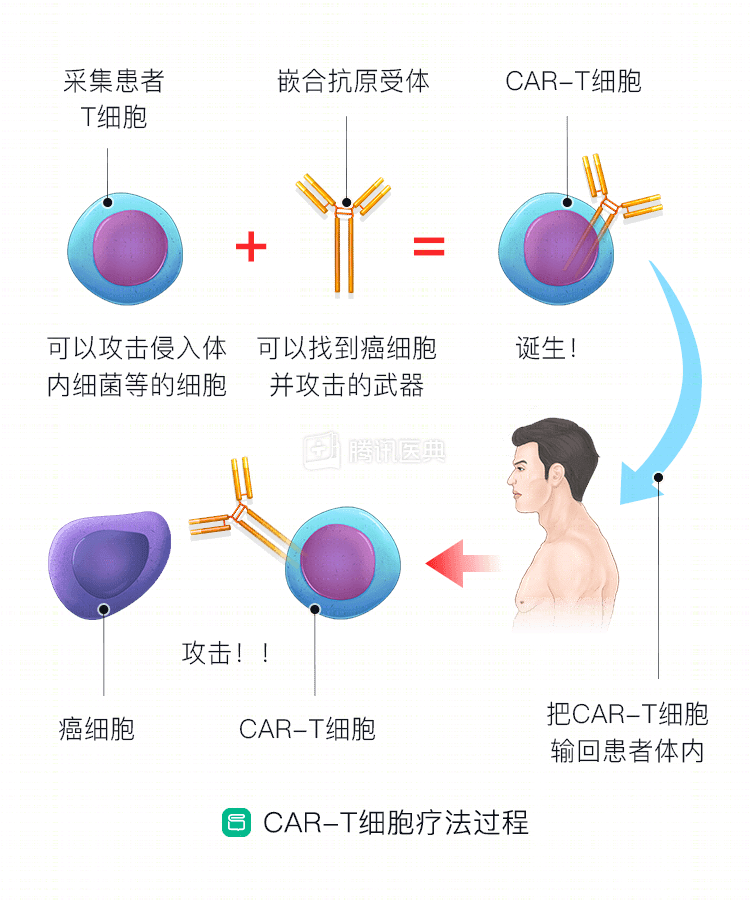
How does CAR-T cell therapy work?
CAR-T cell therapy is currently used primarily in clinical trials. In one clinical trial, about 1/3 of the patients had complete resolution of tumor symptoms. Other patients had smaller tumors, but they didn’t go away completely.
CAR-T cells can continue to work for many years, so it is assumed that patients’ tumors will not come back easily. However, some experts have expressed reservations, saying that it is too early to discuss relapse and that further studies are needed to determine how the disease will progress.
Some other changes in the body may also occur because the treatment regimen affects the patient’s immune system.
Cytokine release syndrome (CRS)
When T cells start to attack tumor cells, they can trigger an immune response in the body that can cause such side effects. For some patients, the symptoms of cytokine release syndrome are similar to severe flu. But in another group of patients, it can cause blood pressure to drop to very low levels, with high fever and difficulty breathing.
Clinicians are still exploring how to optimize the management of these symptoms. One option is to treat with an anti-arthritis drug called tolimumab. If doctors are able to administer the drug in a timely manner, it can effectively suppress cytokine release syndrome.
Brain and neurological symptoms
Usually occurring in the first 2 months after infusion, the most common clinical manifestations are headache and anxiety. It may also persist for several days with confusion, generalized seizures, or loss of speech.
The vast majority of symptoms eventually resolve, but some patients may be at risk for fatalities as a result.
Severe infections
CAR-T cell therapy also kills B cells, another type of white blood cell that fights off foreign invading pathogens, and when B cells are reduced, patients are more likely to develop infections. In addition, if the patient has had hepatitis B before, the hepatitis B condition may be reactivated at this time.
Formation of new tumors
Patients may develop a new tumor after CAR-T cell therapy or have a recurrence of a previous tumor. Therefore, patients need regular follow-up visits thereafter and lifelong monitoring of all tumor indicators to facilitate early detection of tumor signs.
How much does CAR-T cell therapy cost?
CAR-T cell therapy requires only a one-time treatment, but it is very expensive, costing hundreds of thousands of dollars. For patients in the United States, if you add in the associated hospitalization and home care costs, the total could be close to $1.5 million.