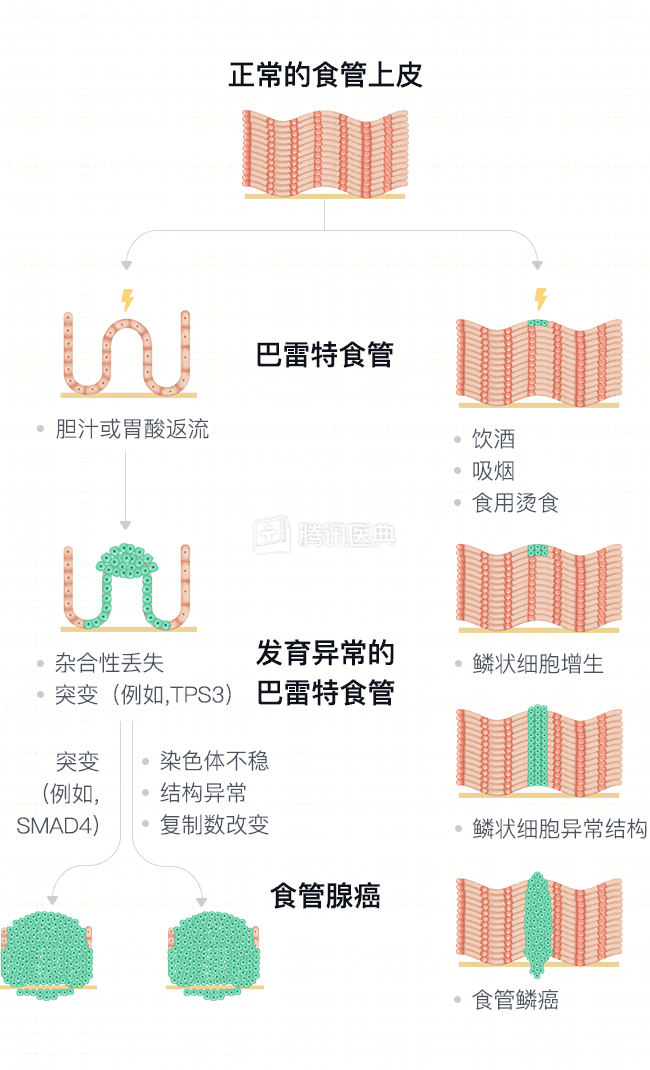
When doctors looked under the microscope, they found that the cancerous cells of esophageal cancer showed two main types:
- Adenocarcinoma: abnormal columnar cells from the gastrointestinal tract that have replaced the squamous epithelium of the normal esophagus (a process called “chemosis”), and these cells have become cancerous;
- Squamous cell carcinoma: Squamous carcinoma is a cancer caused by the malignant transformation of the squamous epithelium of the esophagus.
The main differences between squamous and adenocarcinoma of the esophagus are as follows:
In terms of incidence
1. Squamous carcinoma accounts for about 90% of esophageal cancer cases worldwide and more than 90% in China, and it is the predominant type in Asian, African, and South American countries. Adenocarcinoma accounts for about 10% and is highly prevalent in the United States, the United Kingdom, and other North American and European countries.
2. Gender-wise, there is a trend for both squamous and adenocarcinoma of the esophagus to be more common in men than in women, as seen in the figure below, with both squamous and adenocarcinoma of the esophagus occurring in about a 3:1 ratio in men to women in Asian populations.
It is worth noting that although esophageal cancer is more prevalent in men, the risk of its development is largely unrelated to gender factors.

Note: Figure shows the age-standardized incidence of esophageal cancer by region worldwide
From the site of occurrence
Squamous cancers are mainly caused by food friction and irritation, so the upper and middle esophagus, which is responsible for food transport, is the “hardest hit” area.
Adenocarcinoma mostly arises from gastroesophageal reflux disease (also called “reflux esophagitis”), in which fluid such as gastric juice and bile refluxes into the esophagus, causing the “columnar epithelium” normally found in the gastric mucosa to invade the “aboriginal” esophagus. The “squamous epithelium” invades the territory of the “native” esophagus. The junction of the stomach and esophagus is the “front line” for its invasion, so adenocarcinoma mostly occurs in the distal esophagus (ventral esophagus).
In terms of causative factors
- Squamous carcinoma: smoking and alcohol consumption are the most important inciting factors
Studies have confirmed that the risk of squamous esophageal cancer is nine times higher in smokers than in nonsmokers.
But in China, smoking is less of a “contributor” to the risk of esophageal cancer, and factors related to “eating” are more important, such as drinking alcohol, eating hot food, eating a lot of pickled vegetables, and not getting enough vitamins. These factors can cause repeated damage to the esophageal mucosa, and in the process of repairing the wound, atypical hyperplasia of the squamous epithelium can easily occur, eventually developing into cancer.
In addition, human papilloma virus (HPV) has an average infection rate of 40% in Chinese patients with esophageal squamous carcinoma, with HPV-16 being the most common, and is also a risk factor for esophageal squamous carcinoma.
- Adenocarcinoma: obesity and gastroesophageal reflux are the main triggers
The main triggers of adenocarcinoma of the esophagus are obesity, gastroesophageal reflux disease and its resultant Barrett’s esophagus. Gastric acid or bile reflux into the esophagus can cause the squamous epithelium to slowly turn into abnormal columnar epithelium, eventually leading to adenocarcinoma.
One study showed that people with GERD have 3.48 times the risk of developing adenocarcinoma of the esophagus compared to the general population.
The process of esophageal squamous carcinoma and adenocarcinoma, as shown in the following diagram: