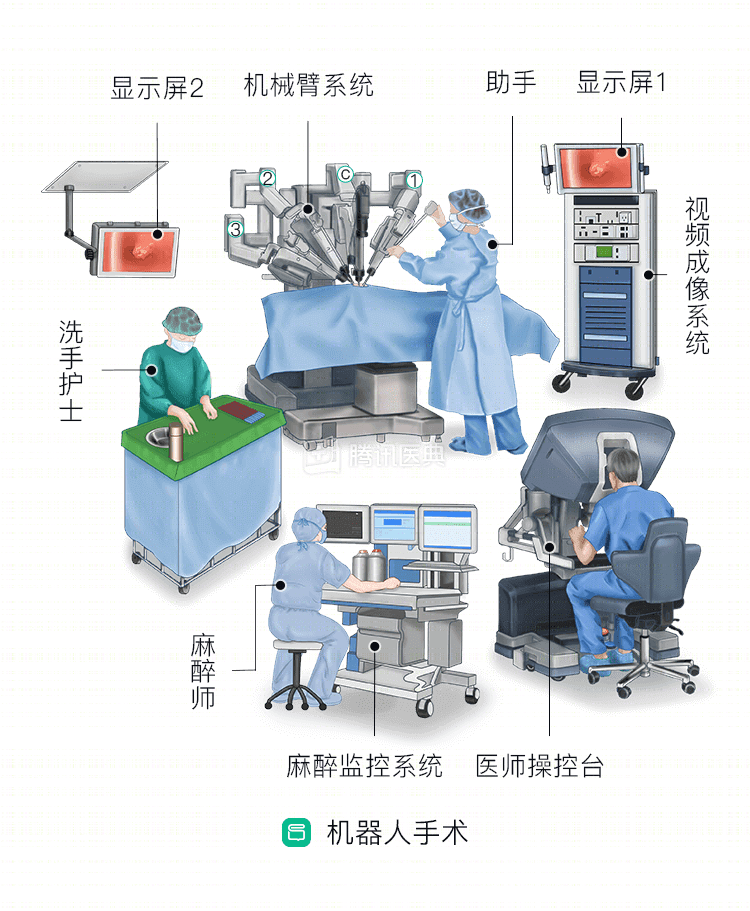
The surgical robot is a controlled, multifunctional, automated manipulator that is the product of multiple technological advances combined with clinical medicine to effectively assist physicians in surgical operations and improve surgical precision, dexterity, and stability.
The evolution of surgical robots
In 1997, Dr. Himpens and others performed the first laparoscopic cholecystectomy with a robot in Brussels. 2000, the da Vinci robotic system was approved for surgery in the United States, and the first da Vinci robot was introduced into China in 2006. It can be said that the advent and continuous progress of robotic surgical systems has ushered in a new era of minimally invasive surgery.
In 2002, Hashizume et al. first reported da Vinci robotic-assisted radical gastric cancer surgery. The exploration of robotic gastric cancer surgery is now in full swing worldwide.
How is it being performed in China?
The first surgical robotic system was introduced in China in 2006, and more clinical reports of robotic surgery for gastric cancer began to appear in 2010. Because of the high cost of robotic systems, the total number of installations in China is currently much less than in developed countries in Europe and the United States, and most of the robotic surgeries performed are relatively small surgeries such as gynecology and urology.
However, robotic surgery in gastric cancer is developing rapidly in China, and more and more medical centers are able to perform complete robotic surgery for gastric cancer, which is bound to become more popular in the future.
Which patients can receive robotic gastric cancer surgery
The population for robotic gastric cancer surgery is similar to that of laparoscopic surgery and can be used for the following patients:
- Tumor infiltration depth not greater than stage T4a;
- Preoperative and intraoperative staging of stage I, II, and III.
Robotic gastric cancer surgery is contraindicated when:
- Lymph node metastases that are fused and encircle important blood vessels;
- Severe other systemic disease that does not tolerate surgery or anesthesia;
- Extensive and severe adhesions seen in the abdominal cavity;
- Acute surgery in the presence of perforation, hemorrhage, etc;
- Severe coagulation disorders;
- Pregnancy.
What are the main advantages of the surgical robot?
For the surgeon, the ability to sit and perform surgery with relative ease is more conducive to completing long, difficult procedures without fatigue. The system filters out manual tremors, reducing inadvertent damage to tissues and organs. The realistic 3D imaging system and high magnification allow the surgeon to observe the surgical area more carefully. The robot’s multi-joint system is even more flexible and bendy than a human hand, allowing it to perform movements that cannot be done during laparoscopic surgery. Moreover, the robot is highly stable and can perform continuous precision movements. It is worth mentioning that remote surgery is also possible via the robot via the internet.
What are the shortcomings of the surgical robot?
What are the shortcomings of surgical robots?
The robot lacks the human sense of touch and cannot distinguish between hardness, toughness, pulsation, and temperature. There is no “force feedback” for manipulating delicate objects, and the operator can only judge visually. However, clinical studies worldwide have shown no difference in the safety and efficacy of robotic surgery compared with laparoscopic surgery and traditional open surgery.
At present, robotic surgery has demonstrated its advantages in appropriate patients with gastric cancer. The advantages of robotic surgery will continue to grow as technology advances, and it is an important development direction for future surgical approaches. (Coauthored by Hanyu Chen, Department of Gastrointestinal Oncology, The First Hospital of China Medical University)