The staging of thyroid cancer follows the same internationally accepted staging system of T (for primary tumor lesions), N (for lymph node metastases), and M (for distant metastases) (below), which classifies tumors into stages I-IV, with the later the stage, the worse the patient’s outcome.
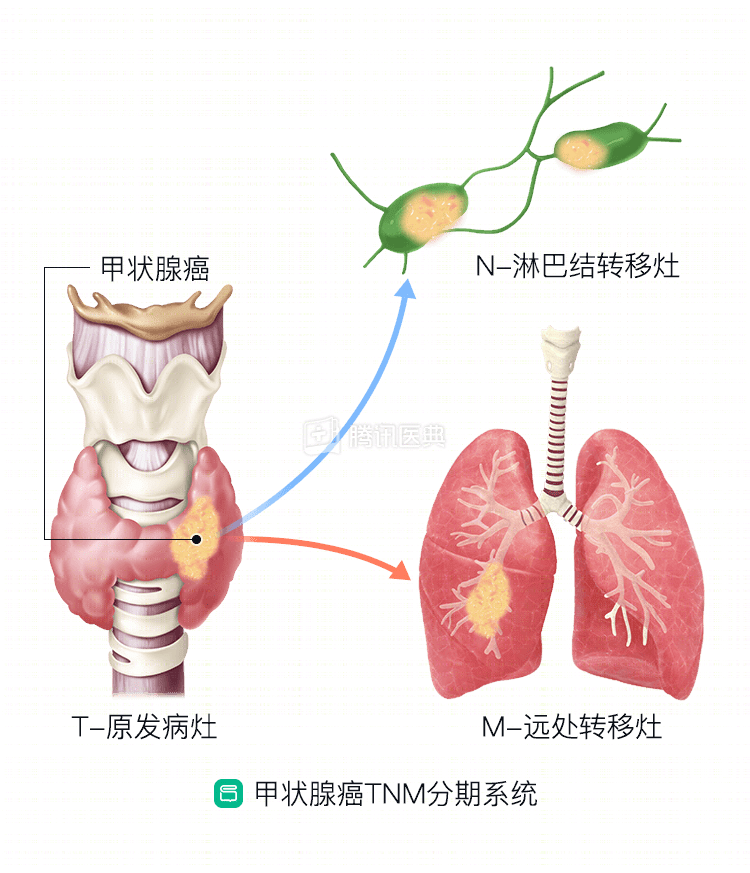
Differentiated thyroid cancer (DTC) mainly includes papillary thyroid carcinoma (PTC) and follicular thyroid carcinoma (FTC), which account for 90% of thyroid cancers.
The staging of DTC is related to age at first diagnosis, with 55 years of age as a “cutoff”, as follows:
Under age 55, all are early (stage I or II) (Table 1):
| Table 1. DTC Staging Under Age 55 | |
| Meaning | |
| I Period | No distant metastases, regardless of tumor size or metastasis to regional lymph nodes |
| Stage II | Distant metastases (e.g., lung, bone, brain) |
55 years and older, classified as stage I-IV based on normal TNM staging (Table 2):
| Table 2. Staging at age 55 and older | |
| Staging | Meaning |
| I Period |
Tumor confined to the thyroid with a maximum diameter of ≤ 4 cm; No lymph node metastasis or distant metastasis |
| Stage II |
Meets one of the following two conditions:
|
| Stage III |
invasion of subcutaneous soft tissues, larynx, trachea, esophagus, or laryngeal recurrent nerve, regardless of lymph node metastasis or not, regardless of tumor size; No distant metastasis |
| IVA stage |
invasion of the prevertebral fascia, or encirclement of the carotid artery or mediastinal vessels, regardless of tumor size; No distant metastases |
| Stage IVB |
Distant metastases occurred regardless of the primary lesion and regional lymph node metastatic lesions |
Why do we draw an age line for DTC staging?
Briefly, the reason for age delineation is that numerous studies have shown that DTC outcomes are strongly correlated with age at onset. outcomes are very different in patients who develop before age 55 versus after, with younger patients having a better prognosis.
As early as 1979, a study found that age at onset of DTC was associated with survival, with patients older than 45 years having a significantly shorter survival time than those younger than 45 years. Therefore, the 1983 version of TNM staging used 45 years as the cutoff. Several studies since then have also found that age is an independent determinant of patient outcome.
Subsequent studies have shown that when the age cutoff was set at 55 years, 12% of patients were classified as early (stages I-II) compared with 45 years from previously advanced (stages III-IV), and that staging was a more significant predictor of survival. Accordingly, the new age cutoff was changed to 55 years.
Co-written by Dr. Ben Ma, Cancer Hospital, Fudan University