What is a kidney?
Normally, a person has two kidneys. The rest of the urinary tract consists of two ureters (tubes that connect the kidneys to the bladder), the bladder, and the urethra (which is connected to the bladder and thinks outside the body). Each kidney continuously produces urine, which flows at a low pressure through the ureter into the bladder. It is then expelled from the bladder via the urethra.
The kidneys are shaped like fava beans, about 12 cm long, and are located on either side of the lumbar spine. Each kidney receives blood from the renal artery from the aorta, and blood from the renal artery gradually flows into the secondary arteries and then through the minor arteries into the glomerulus, forming a plexus of microvessels called the capillary bulb. Blood also flows out of the glomerulus through the small arteries and into the small veins. Several small veins converge to form a large renal vein through which blood flows out of the kidney.
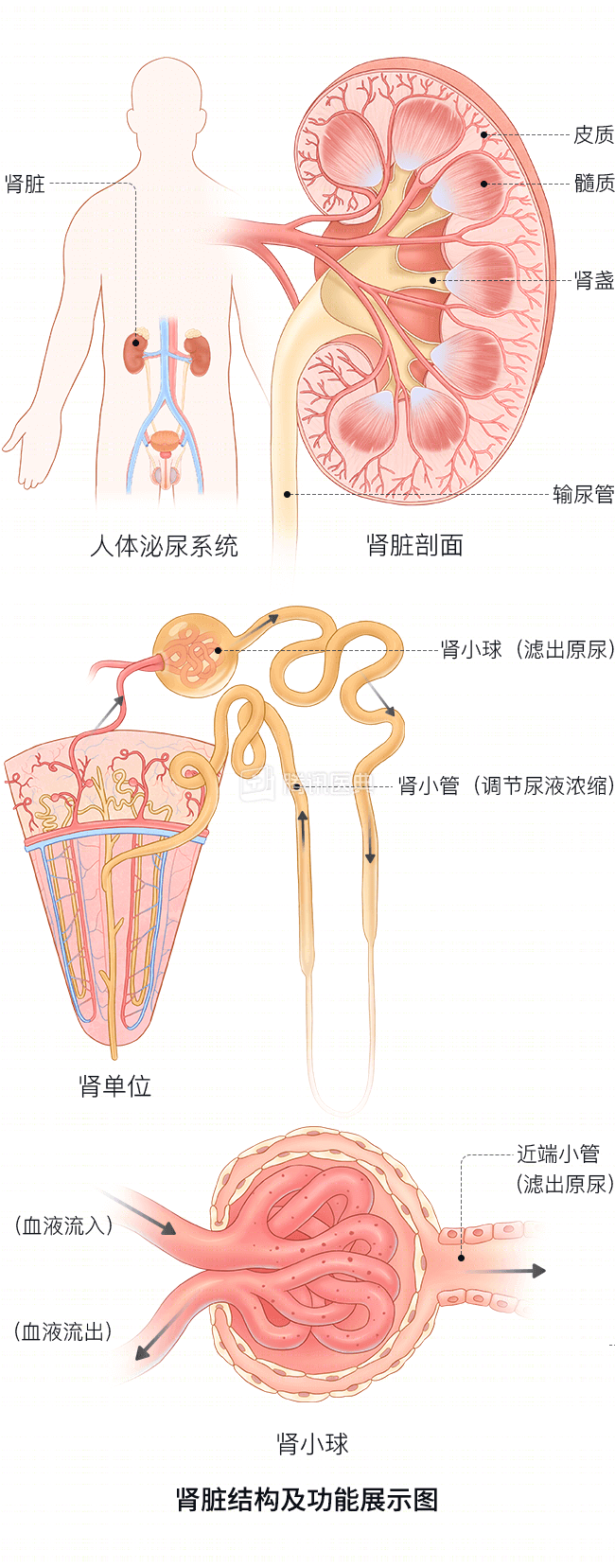
The kidney unit is the microscopic unit that filters blood and produces urine, and each kidney contains about 1 million kidney units. Each renal unit consists of the glomerulus, tubules, and collecting ducts, and each tubule is composed of the proximal convoluted tubule (proximal convoluted tubule), the Henry collaterals, and the distal convoluted tubule (distal convoluted tubule).
The kidney consists of an outer cortical layer and an inner medulla. All the glomeruli are located in the cortex, while the tubules are distributed between the cortex and the medulla. Urine is directed from thousands of collecting ducts into a cup-like structure called the calyces. Each kidney contains several calyces, which divert urine into a central cavity, the renal pelvis, from which urine flows into the ureter.
What are the main functions of the kidneys?
Under normal circumstances, all the functions of two kidneys can be performed entirely by one healthy kidney. However, some people are born with only one kidney, others donate one kidney for some reason (organ transplant), or they may lose one kidney due to disease or trauma.
The main functions of the kidney include:
- Maintaining the balance of water and minerals (including electrolytes) in the body: If there is a mismatch between the amount of water the body takes in and the amount of water it excretes, the water balance is broken and people get sick or even die. Too much water in the body dilutes electrolytes and too little water concentrates electrolytes, so they must be maintained at a certain concentration range. The kidneys regulate and maintain the proper balance of water and electrolytes.
- Filtration and excretion: The food we eat is metabolized in the body to produce some waste products, such as protein, which is metabolized to urea nitrogen and can be excreted in the urine. Some other metabolites such as acids, toxins and drugs are also excreted by the kidneys.
- Blood pressure regulation: The kidneys can regulate blood pressure in the body by excreting excess sodium and also by producing an enzyme called renin. In contrast, patients with kidney failure have a reduced ability to regulate blood pressure, so they often have hypertension.
- Secreting hormones: The kidneys secrete hormones to regulate other important functions, such as erythropoietin, which promotes red blood cell production. The kidneys also help regulate levels of minerals such as calcium and phosphorus to promote bone growth and maintain bone health.
As you can see, the kidneys have an important role in the body, and once kidney failure occurs, patients may be dependent on dialysis or a kidney transplant to survive. Compared to other vital organs, such as the lungs, liver, and stomach, the kidneys are relatively unlikely to develop tumors, with kidney cancer accounting for only 2% to 3% of cancers in adults. However, most kidney tumors are malignant, with renal cell carcinoma accounting for the vast majority. Therefore, we must protect our kidneys well.