In reality, because there is so much uncertainty in life, we cannot predict exactly when and in what way the end of one’s life will come.
Some people with big brains may be able to imagine some dramatic scenarios about “death”. But there is a type of cancer that makes some people see death early at a young age and appreciate life more because of it.
This cancer is thyroid cancer.
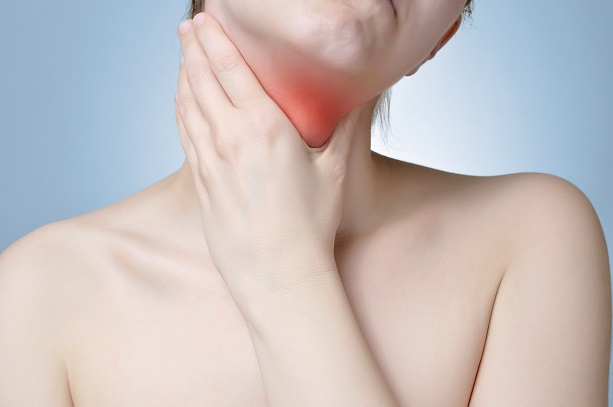
As the mildest form of cancer, thyroid cancer has a very high ten-year survival rate for patients, the highest of almost any cancer.
Indeed, compared to familiar malignancies such as lung, stomach, and liver cancers, thyroid cancer grows and metastasizes more slowly, and most patients have a 10-year survival rate of more than 90%.
With such a high survival rate, thyroid cancer cells are “really not giving a damn”, so it seems to be the legendary “lazy cancer”.
Is it lucky or unlucky to have “lazy cancer”?
What’s the point of having lazy cancer?
Before we answer that question, let’s look at one figure. According to the National Tumor Registry, the number of thyroid cancer patients in China will continue to grow at a rate of 20% per year.
It’s scary to think about.
Then we look at two more figures: in 2013, there were about 143,900 new cases of thyroid cancer and 6,518 deaths nationwide, a gap of more than 10 times between the number of cases and the number of deaths. The majority of patients are glad to have the “best” ending cancer, but on the other hand, they have to undergo long-term treatment and are on edge to prevent the cancer from returning, which is hardly a blessing.
At the end of the day, although thyroid cancer is not as “hardworking” and “diligent” as its big brothers like lung cancer and stomach cancer, it is still a malignant tumor, and about 1% to 2% of undifferentiated cancers metastasize early, and some patients do not even have the opportunity to have surgery. None ……
Not all thyroid cancers are “lazy cancers”
We often hear the concept of “differentiated” and “undifferentiated” types of thyroid cancer.
We often hear about “differentiated” and “undifferentiated” thyroid cancer, and whether it is “lazy” depends on how the cancer cells themselves change, whether they follow the rules, or whether they are bizarre and unpredictable.
Many cells in the body start out like babies and do not grow into adults instantly, but need a process. The cancer cells from the thyroid gland, if they have problems during the “differentiation” process, may be stuck in the “infantile” stage and not grow.
As a result, “differentiated” (or “highly differentiated”) tumor cells resemble normal cells and grow and spread more slowly, while “undifferentiated” tumor cells have a shorter growth cycle and are more likely to grow and spread more slowly. The “undifferentiated” tumor cells are “fast-growing” due to their short growth cycle, and although they are all “defective”, they grow and spread very fast. The “hypodifferentiated” cells are in between.
The thyroid gland is said to be like a butterfly, so we can use this diagram to reflect how the three types of thyroid cancer differ.
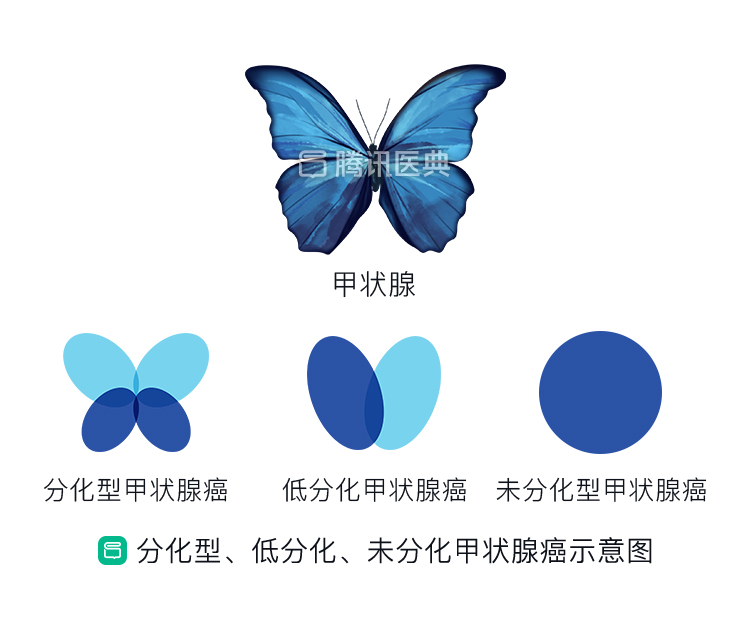
As you can see, as differentiation decreases, the butterfly becomes more and more out of shape and the cancer cells grow out of control. Undifferentiated thyroid cancer is certainly not “lazy cancer” anymore.
The mainstays of thyroid cancer – papillary and follicular carcinomas, which account for more than 90% of all cancers – are differentiated and are more common in women. There is also a medullary carcinoma that originates in the parafollicular cells of the thyroid, which accounts for about 5% of all nail cancers and is more malignant than papillary carcinoma and may also cause endocrine problems.
Another meaning of “lazy cancer”
There is another implication of calling thyroid cancer “lazy cancer,” and it starts with the function of the thyroid gland.
The thyroid gland is an endocrine organ that grows in the front of our neck, shaped like a butterfly, and secretes mainly thyroid hormones. When we see the word “hormone,” we know that the thyroid is not a simple function.
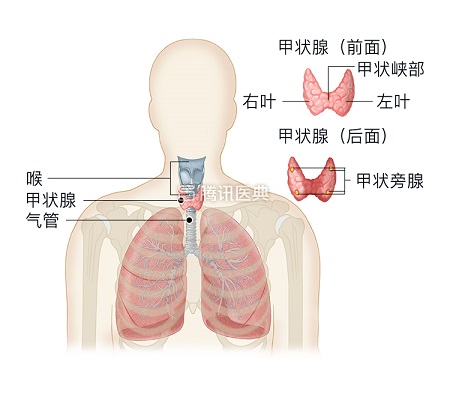
The thyroid gland secretes hormones whose primary role is to promote growth and development and maintain normal metabolism. If the fetus develops without thyroid hormones, there may be problems with the nervous system and the baby may be born with low intelligence and short stature, which is often referred to as “cretinism”.
If adults lack thyroid hormone, their metabolism slows down and they may experience weight gain, sluggishness, memory loss, sleepiness, fear of cold, anorexia, bloating, and a host of other problems, just as people become “lazy”.
There is a link between the way thyroid cancer makes people “lazy” and the way it is treated. The first thing you need to do is to have your thyroid gland cut out if you have a serious cancer that has metastasized to the lymph nodes, and to have the lymph in your neck cleared.
To remove the thyroid gland is to dismantle the thyroxine “factory” and not produce it elsewhere. To prevent people from becoming “lazy,” patients need to take long-term thyroxine supplements, usually synthetic levothyroxine (also called levothyroxine, levothyroxine sodium).
Thyroxine supplementation, more or less, is not an option, and taking a lifetime of medication has even become the destiny of many patients.
Facing “lazy cancer” head on, you’re braver than you think
In fact, thyroid cancer is much more than just “lazy cancer”.
From “this nodule is not very reassuring” to “why me” to “under a cloud”…. The first time I saw a nodule, I had to go to the hospital. The company’s main goal is to provide a comprehensive range of products and services to the public.
Qiu Chen said, “The fight against disease and ‘death’ is an incredibly long long run …… to face death head on in order to fight it.”
Not to mention, thyroid cancer is still far from death, so you should not take it lightly or worry about fear. As long as they are treated aggressively and followed closely, long-term high-quality survival is not a dream for 90% of thyroid cancer patients.
Who is at risk for thyroid cancer? Is thyroid cancer hereditary?
What tests should I have if I suspect thyroid cancer? Can thyroid cancer be prevented?
Welcome to follow Tencent Medical Dictionary Tumor for more information on thyroid cancer.