Detecting thyroid cancer by perceived symptoms? Unreliable!
Early thyroid cancer is usually asymptomatic, and once common symptoms such as a neck lump, hoarseness, difficulty breathing, and difficulty swallowing occur, the lump has often been present for a longer period of time, or has progressed to a certain point.
These are not “exclusive” symptoms of thyroid cancer, and even if they do occur, we cannot tell if we have thyroid cancer.
Therefore, early detection of thyroid cancer by perceived symptoms is not reliable.
Does a “self-test” of a neck lump help?
When there is an observable lump in the neck, it can be detected.
When there is an observable or palpable neck lump, the tumor has also been developing for a long time. Even if the lump is felt, it is difficult to determine its nature. Therefore, self-examination is of very limited use for early detection of thyroid cancer. But conversely, if you feel a lump in your neck, be sure to seek medical attention as soon as possible.
Summary
Thyroid self-exams are only supportive and suggestive and should not be used to detect early thyroid cancer. Regular thyroid ultrasound and thyroid function tests are the key to early detection of thyroid cancer. In particular, people with a family history of thyroid cancer, a history of radiation exposure, and other high-risk factors should be screened regularly at the hospital.
Extended reading
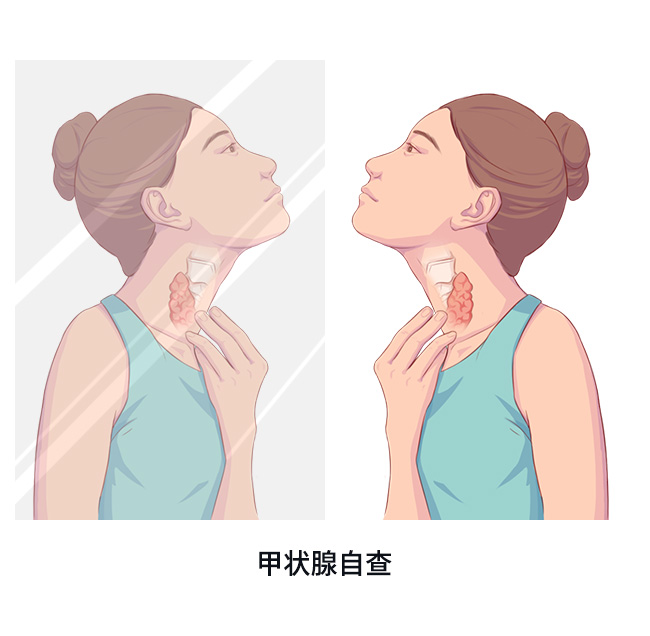
How to do a thyroid self-exam
Choose a well-lit environment, fully expose your neck, and look at your neck carefully, facing a mirror or through the help of another person.
Observe the neck for symmetry and localized protrusions, then keep your eyes forward and flat, and do several swallowing motions repeatedly to observe any lumps or enlarged glands moving up and down with swallowing.
When observing a suspected lump, try palpating the lump yourself. The thyroid gland is located in the middle of the anterior neck below the laryngeal node. To palpate it, gently push the trachea toward one side of the thyroid gland and slide your finger up and down to feel the texture, nodules, and tenderness of the thyroid gland.
Co-written by Dr. Kai Qian, Cancer Hospital of Fudan University