Key points of this article:
- Chronic lymphoblastic leukemia (CLL) is a blood tumor formed by the “lymphocytes” in white blood cells.
- Lymphocytes help the body fight infection. They come from the bone marrow, the soft tissue in the center of the patient’s bones. People with chronic lymphocytic leukemia have large numbers of abnormal mature lymphocytes, and these abnormal cells do not work properly.
- Most adults are more likely to develop chronic lymphocytic leukemia than other types of leukemia, and the disease progresses slowly, and patients may not have noticeable symptoms for years.
- Some patients do not yet need treatment, and if treatment is necessary, it is aimed at slowing disease progression and relieving clinical symptoms. Now that chronic lymphocytic leukemia can be diagnosed earlier, patients can survive longer with treatment.
Cause of the disease
In most cases, doctors do not know what causes chronic lymphocytic leukemia. There may be a higher risk of developing the disease if it is accompanied by:
- A parent, sibling, or child with chronic lymphocytic leukemia;
- A parent, sibling, or child with chronic lymphocytic leukemia
- Middle-aged or older populations;
- White people;
- Have an Eastern European or Russian Jewish relative.
The risk of developing chronic lymphocytic leukemia may be higher if there has been exposure to Agent Orange, a herbicide used extensively in the Vietnam War.
Symptoms
Patients may be asymptomatic for some time, but symptoms may appear gradually over time:
- Massive lymph nodes in the neck, axilla, retroperitoneum, or groin. Lymph nodes are pea-sized glands of the immune system present in various parts of the patient’s body;
- Shortness of breath;
- distension or abdominal pain due to enlargement and compression of the spleen;
- Lack of energy;
- night sweats;
- Fever and infection;
- loss of appetite and weight loss.
Diagnosis
If the patient has more than one enlarged lymph node, the doctor may ask the following questions:
- Have there been any recent infections?
- Has there been a recent infection?
- Has there been any recent injury?
- Has there been a recent injury?
- Any concomitant immune system disorders?
- Have there been any signs of fever?
- Any signs of fever?
- Is there shortness of breath?
- Any signs of shortness of breath?
- Is there unexplained weight loss?
- Has there been any unexplained weight loss?
- What medications have you taken?
If a doctor thinks a patient has suspected chronic lymphocytic leukemia, he or she will order a hematology test. The results of the test will show how many lymphocytes, platelets, red blood cells, and white blood cells are in the patient’s blood.
If the patient has a high white blood cell count, a bone marrow aspiration and biopsy will be needed:
- Puncture: The doctor inserts a thin needle into the patient’s bone (usually in the iliac bone) and draws out a small amount of bone marrow fluid.
- Biopsy: The doctor uses a slightly thicker needle to remove a small amount of bone tissue, bone marrow, and blood.
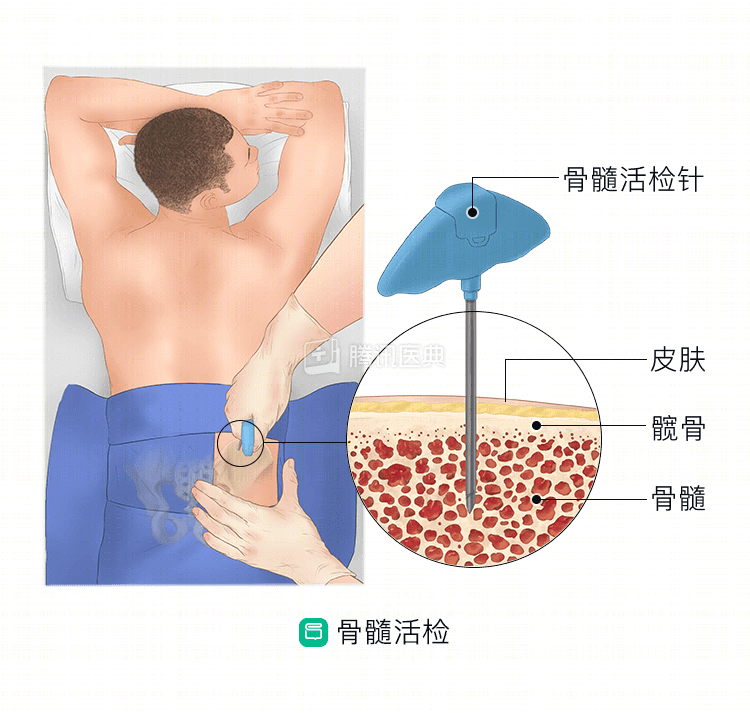
The physician will complete the process of taking samples for both of these tests in the same operation.
By examining the abnormal cells in the sample under the microscope, the doctor is able to determine whether chronic lymphocytic leukemia is occurring in the patient’s body and how quickly the abnormal cells are proliferating. Further tests can also be done to see what genetic changes have occurred in the cells. This information helps doctors and patients plan treatment accordingly.
Treatment
Chronic lymphocytic leukemia progresses very slowly and may not require treatment if the patient is in the early stages, or if they have not yet developed any symptoms. Studies have shown that treatment in this case is not very helpful.
Even so, patients need to have regular follow-up appointments. Doctors will monitor indicators closely to make sure the patient’s disease is not progressing.
If the doctor notices a change in the patient’s condition, such as a rapid increase in the number of lymphocytes in the blood, a decrease in the number of red blood cells, or enlarged lymph nodes, then it may be time to start treatment.
Treatment options available to patients include:
Chemotherapy
Chemotherapy drugs can destroy or suppress tumor cells. Doctors usually combine two or more chemotherapy drugs with different mechanisms of action. They are given as tablets, injections, and intravenous drips. The drugs travel through the bloodstream to all parts of the body to contain rapidly dividing cells, including some normal cells and tumor cells.
Patients generally receive chemotherapy medication in cycles of 3 to 4 weeks, which includes both dosing and non-dosing times. The non-drug time is used for the patient’s normal cells to recover and rebuild.
Side effects include mouth ulcers, nausea, and lower blood counts, although patients can eventually return to normal. Almost all side effects go away with treatment termination. And most chemotherapy side effects can be alleviated or prevented with certain measures.
Immunotherapy
The drugs used in immunotherapy are synthetic immune system proteins that help the patient’s immune system recognize and destroy tumor cells (doctors call them monoclonal antibodies). The drug binds to specific proteins produced by the tumor cells. The drug is given into the patient’s body through an intravenous drip or injection. Doctors may administer an immunotherapy single-drug regimen, but more often it is combined with chemotherapy.
Immunotherapy causes different side effects than chemotherapy. Possible side effects include headache, fever, rash, changes in blood pressure, etc. Some of these side effects can be prevented beforehand, and all of them can be alleviated with certain measures.
Targeted therapy
Targeted drugs block specific proteins that tumor cells need to survive and spread. They target proteins on abnormal cells in chronic lymphocytic leukemia and do not harm normal cells. The drugs are taken orally in tablet form.
The types of side effects depend on which targeted therapy the patient is receiving. Possible side effects include lower blood counts, diarrhea, nausea, weakness, and rash. These can be alleviated with certain measures, and most side effects will go away by the end of treatment.
The following treatment options, which are less commonly used:
- Radiotherapy: This treatment uses high-energy rays, such as X-rays, to destroy tumor cells. Radiotherapy can shrink enlarged lymph nodes, the spleen, or treat bone pain.
- Surgery: Surgery is very rare. If chemotherapy or radiation therapy does not shrink the enlarged spleen, it can be removed surgically to improve blood count levels.
- White blood cell removal: If a patient is diagnosed with a very high number of tumor cells in the bloodstream, doctors use this method to quickly reduce the number of tumor cells. Special instruments are used to filter the tumor cells out of the patient’s blood. This treatment is only effective for a short period of time, and the patient will still need other treatment options to control the tumor cells, such as chemotherapy or immunotherapy.
- Clinical trials: Participating in a clinical trial may be a way for patients to try a new treatment before it is publicly available to all patients. Patients may be able to get the most optimal conventional treatment in a clinical trial, or they may receive a new drug treatment that is under investigation. A physician can help a patient find an ongoing clinical trial and inform him or her of the specific study protocol, and ultimately the patient decides whether to participate in the clinical trial.
- Stem cell transplantation: Researchers are investigating drug combinations with other options to treat chronic lymphocytic leukemia so that patients can achieve longer disease remission. One such combination regimen is chemotherapy combined with stem cell transplantation, but most patients do not need this combination therapy.
.
Everyday
Treatment for chronic lymphocytic leukemia can cause side effects, such as nausea and weakness. If these occur, inform your doctor so that the necessary measures to relieve symptoms can be carried out.
- You can ask your doctor which antiemetic medications you should take. Massage and acupuncture can also help control nausea and vomiting.
- You can try moderate exercise, such as walking, yoga, breathing exercises, and meditation, to help control lethargy and increase physical fitness.
- If a patient experiences poor physical and mental performance, try accomplishing a small goal, such as taking a walk, talking with a friend, or taking a relaxing bath, to soothe the mood and boost confidence.