We often hear the concepts of “differentiated” and “undifferentiated” in relation to thyroid cancer. What does this mean? Which one is more malignant? Do they transform into each other? We will answer each of these questions in turn.
What is “undifferentiated”?
What is “differentiation”?
What is “differentiation”?
Let’s start by understanding what “differentiation” is. “Differentiation is a process by which cells of the same origin gradually give rise to populations of cells that differ in form and function and play different roles. Tumor cells have a disrupted differentiation process and are in the “infantile” stage, unable to grow into their normal “siblings” and perform their corresponding functions.
The “differentiated” type, also known as “hyperdifferentiated,” has well differentiated tumor cells that resemble the cells from which they came and grow and spread more slowly; at the other extreme is the “undifferentiated” type. At the other end of the spectrum are “undifferentiated” cells, which are “unrecognizable” from their source cells and grow and spread very rapidly. The other extreme is “undifferentiated,” which is a very fast-growing and spreading cell compared to its source.
Because the thyroid gland looks like a butterfly, we can use the figure below to reflect the difference between these three types of thyroid cancer.
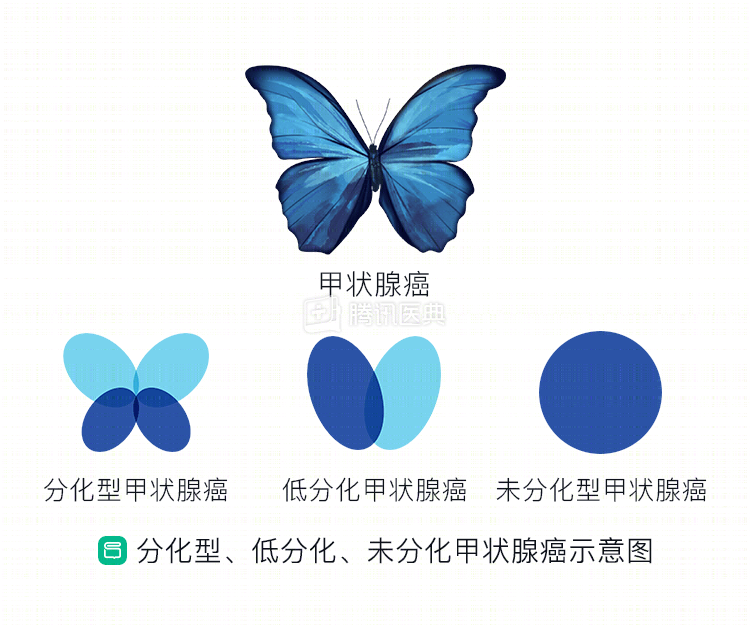
The less differentiated a tumor is, the more uncontrolled it grows and the more it deviates from normal cell behavior. This explains why undifferentiated thyroid cancer is so malignant.
What are each of the differentiated and undifferentiated thyroid cancers?
What are the differences between differentiated and undifferentiated thyroid cancer?
After understanding the concept of “differentiation,” let’s look at the different degrees of differentiation of thyroid cancer.
Differentiated thyroid carcinoma (DTC) includes papillary thyroid carcinoma (PTC) and follicular thyroid carcinoma (FTC). FTC). It is the most common type of thyroid cancer, accounting for more than 90% of all thyroid cancers. It originates in the follicular epithelium of the thyroid, is more common in women, and is usually slower growing, less malignant, and has a better patient outcome.
Anaplastic carcinoma (ATC), which accounts for only 1% of all thyroid cancers. It is the least differentiated and most malignant, and infiltration and metastasis may occur early. It occurs mostly in the elderly.
Do different types of thyroid cancer transform into each other?
It is possible.
Usually, cell differentiation is irreversible. However, under certain conditions, differentiated cells can also become unstable and return to an undifferentiated state, a process called dedifferentiation. There is evidence that undifferentiated thyroid cancer can also result from the dedifferentiation of cancer cells in follicular cells.
Co-written by Dr. Tingting Zhang, Cancer Hospital of Fudan University