Leukemia is a hematopoietic malignancy with a very high mortality rate, and the main treatment is currently cytotoxic drug chemotherapy combined with hematopoietic stem cell transplantation. Although it has improved survival in some patients, most patients are still at risk of relapse and refractory to treatment, and adverse effects such as severe infection and bleeding accompany almost every chemotherapy treatment.
Targeted therapy, a form of treatment that targets a well-defined oncogenic site (the site can be a protein molecule within a tumor cell or a gene fragment) at the cellular or molecular level. The main targeted therapies for leukemia at this stage are as follows:
Targeted gene mutation drugs
FLT-3 inhibitors
FLT-3 plays a key role in hematopoiesis. Patients with acute myeloblastic leukemia (AML) have a high rate of FLT-3 gene mutations and can be divided into 2 types, including ITD and TKD, with ITD having a poor prognosis.
Drugs targeting FLT3-ITD include:
- midostat
- midostaurin (midostaurin): an oral multi-target FLT3-ITD inhibitor that has no effect on FLT3-TKD gene mutations.
- Sorafenib: FDA-approved for the treatment of metastatic renal cell carcinoma and advanced hepatocellular carcinoma, also inhibiting FLT3-ITD, VEGFR, KIT, and RETr9.
.
- Quizartinib: A second-generation FLT3-ITD-targeting agent with higher selectivity and affinity for FLT3.
.
Isocitrate dehydrogenase gene mutation inhibitor
Isocitrate dehydrogenase gene (IDH) is a family of enzymes that are essential in normal cellular metabolism. IDH mutations account for about 15% to 30% of AML and are classified as IDHl and IDH2.
Ivosidenib (AG-120) is an IDHl mutation inhibitor, and Enasidenib (AG221) induces differentiation in leukemic cells with IDH2 mutations. This class of drugs is well tolerated and efficacious in combination with chemotherapeutic agents for the treatment of patients with AML.
Targeted therapy of the JAK-STAT signaling pathway
.
Ruxolitinib is a JAK1/JAK2 small-molecule kinase inhibitor that has also shown considerable efficacy in patients with leukemia with JAK2-V617F mutations.
Drugs targeting fusion genes
Patients with chronic myeloid leukemia or Philadelphia chromosome (Ph) -positive acute lymphoblastic leukemia with a BCR-ABL fusion gene can be treated orally with tyrosine kinase inhibitors, including imatinib, dasatinib, and nilotinib, which can significantly improve remission rates and long-term survival.
Small molecule-targeted novel drugs
- B lymphocytoma 2 (BCL2) antagonists: The BCL2 family is the major anti-apoptotic protein. venetoclax is the primary highly selective BCL2 antagonist used in the clinic, and a phase III clinical trial is underway in combination with chemotherapy for AML.
- Cytokine-receptor-mediated targeted therapies: such as FDA-approved DAB486-IL-2 for the treatment of IL-2R in advanced refractory hematologic malignancies.
Inhibitors of epigenetic regulatory molecules
Most AML-associated gene mutations affect downstream transcription factors or important epigenetic regulatory elements. Epigenetic modifying enzymes may be potential therapeutic targets for refractory AML because of their conserved structures and catalytic subunits.
- Methylesterase inhibitors: Many oncogenes are highly methylated and inactivated in leukemia patients. Both dexitabine, which targets DNA methylesterase, and azacitidine, which targets DNA/RNA, are effective in improving median patient survival.
- Terminal silencing-like blocking proteininhibitor (DOT1L inhibitor): EPZ-5676 is a highly targeted DOT1L histone methyltransferase inhibitor that is 37,000 times more selective than other methyltransferases and is in clinical trials. times more selective than other methyltransferases, and has entered clinical trials.
- Histone deacetylasesinhibitors (HDACs inhibitors): HDAC inhibitors cause cycle arrest, growth inhibition, or apoptosis in leukemic cells. Both the foreign Vorinostat and our own cidabendiamine have been effective in patients with leukemia.
Immune-targeted therapy
- Gituzumab ozomicin (GO): is an anti-CD33 antibody analogue constructed with DNA insertion of the antibiotic carboxymycin as the payload. It is primarily used for the treatment of newly diagnosed CD 33+ adult AML and for the treatment of relapsed/refractory CD33+ AML in adults and children 2 years of age and older. GO can be used in combination with erythromycin and cytarabine for the treatment of newly diagnosed adult AML and as monotherapy for the treatment of primary adult and pediatric AML.
- SGN-CD33A: A coupled drug targeting CD33 monoclonal antibodies that induces cell death by cross-linking DNA and blocking cell division, used in leukemia-related clinical trials.
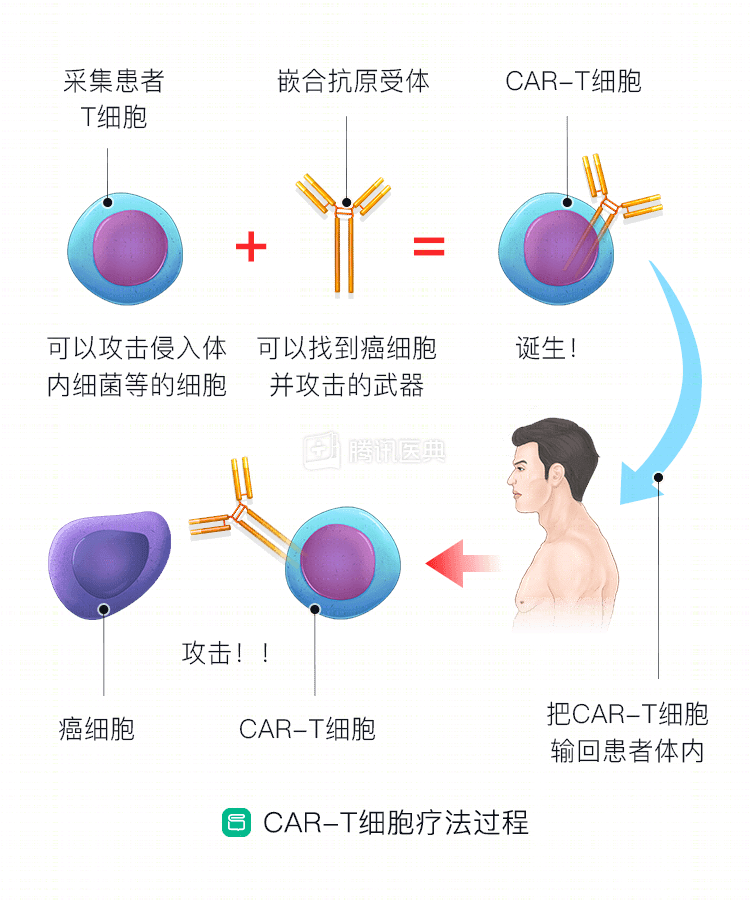
CAR-T therapy
In recent years, T-cell therapeutic strategies have gained significant progress in the treatment of acute lymphoblastic leukemia, and the advent of CAR-T has made a cure for leukemia possible, but with the emergence of a number of adverse reactions that occur in therapy, mainly including target/de-tumor toxicity, cytokine release syndrome, and gene mutations.
With the development of immunology, cytogenetics, molecular genetics, and molecular biology, research on targeted therapies for leukemia is promising, and new drugs are emerging with inconsistent efficacy in different populations. The rational use of the above-mentioned targeted drugs promises new breakthroughs and individualized, more precise therapy.