After a physical examination reveals a thyroid nodule, you should go to a regular hospital where your doctor will recommend tests to evaluate the nature of the nodule.
First you need a neck ultrasound and blood TSH test
Ultrasound
Ultrasound is the preferred method for evaluating thyroid nodules. Your doctor will usually recommend a neck ultrasound if you have previously found a thyroid nodule or lump by palpation, X-ray, CT, magnetic resonance imaging (MRI), or PET.
Ultrasound can confirm whether a nodule or mass is actually present and determine the size, number, location, texture (solid or cystic), shape, borders, envelope, calcification, blood supply, and relationship to surrounding tissue; it can also assess the size, shape, and structural characteristics of the lymph nodes in the neck. Certain ultrasound features can also help the physician identify the benignity or malignancy of the nodes.
Related reading:
Blood TSH levels
TSH (thyroid-stimulating hormone) is a hormone secreted by our pituitary gland and released into the blood, which regulates the proliferation and secretion of thyroid cells, and it is an important reference indicator to identify benign and malignant thyroid nodules.
Depending on the TSH level, your doctor will recommend the next test
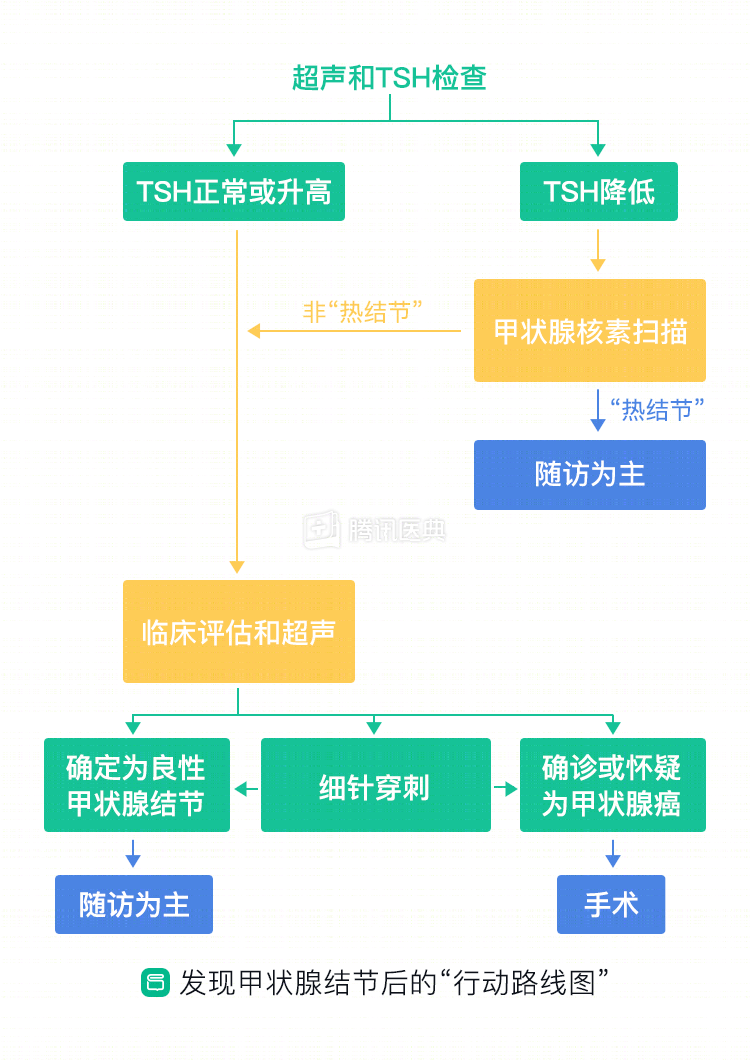
For lower-than-normal TSH levels, do a thyroid nuclear scan
If the nodule is larger than 1 cm in diameter and also has a lower-than-normal serum TSH, your doctor may recommend an iodine-131 (I-131) or 99mTc radionuclide scan.
The nodules have been referred to professionally as hot, warm, cool, and cold nodules, depending on their ability to take up iodine contrast from high to low.
The vast majority of “hot nodules” are benign and usually do not require fine-needle aspiration biopsy; you will need regular follow-up. However, most thyroid nodules are “cool” or “cold” nodules, which require further evaluation by your doctor in conjunction with ultrasound results and, if necessary, a fine needle biopsy to confirm the diagnosis.
Related reading:
Normal or elevated TSH levels, or below normal TSH but not “hot nodules” on nuclide imaging, fine needle aspiration biopsy
In both cases, if the clinical evaluation and ultrasound are still inconclusive, the physician will add fine-needle aspiration (FNA) to identify benign and malignant nodules, usually larger than 1 cm in diameter.
If the result is benign, you may not need surgery and regular follow-up is sufficient; if it is malignant or suspected to be malignant, it can also help your doctor determine the appropriate surgical option.
Doctors recommend that if a physical exam reveals a suspicious thyroid nodule and you are torn about whether to have surgery, you may want to have a fine needle aspiration first. Even if the report suggests benign, regular follow-up should continue.
Related reading:
Here’s a roadmap for you to follow after finding a thyroid nodule:
What conditions warrant CT, MRI, and PET-CT?
If you go to the hospital with a thyroid nodule found on physical examination, CT, MRI, and PET-CT are usually not needed on your first visit; they may be used to accurately assess the extent of tumor invasion when your doctor has a high suspicion or has confirmed that the nodule is malignant and is ready for surgery.
You can click on the article below to learn more.
Related reading:
Co-written by Dr. Kai Qian, Cancer Hospital of Fudan University