Radiotherapy is not commonly used when you have thyroid cancer
.
External radiation therapy, or “radiotherapy” for short, is a treatment that uses radiation to kill the tumor. However, thyroid cancer is not very sensitive to radiotherapy, and radiotherapy alone is not very beneficial for most patients, but may cause adverse effects and make subsequent surgery more difficult.
For differentiated or medullary carcinomas that are potentially curable with surgery, conventional or postoperative radiotherapy is not recommended. Even if a differentiated cancer has small residual lesions after surgery, treatment with radioactive iodine (RAI) is effective and does not require external radiation therapy.
When is radiotherapy likely to be used?
Undifferentiated carcinoma
If surgery is possible, radiation therapy can be used as a preoperative or postoperative adjunct; if surgery is not possible, radiation therapy can help shrink the tumor, relieve symptoms, and make the patient more comfortable.
-
Differentiated carcinoma
Surgical failure to completely resect and large residual lesions where the cancer is not iodine uptake (not treatable with RAI) or is iodine uptake but not at a therapeutic dose.
Local recurrence after surgical failure to remove, or recurrence after RAI treatment.
Medullary carcinoma
If radical surgery is not possible, radiation therapy is done after surgery.
In summary, in thyroid cancer, the use of radiotherapy is more limited, mostly as an adjunct to surgery or RAI treatment.
What is the radiotherapy process?
Determining the dose and course of radiation therapy is a complex process that involves experts from several related disciplines. The physician first determines the purpose and method of radiation therapy, then determines the site and extent of exposure, or “target area,” and then develops a treatment plan that is reviewed, positioned, and modified on a simulator. After treatment has begun, periodic checks are required and treatment plans may be adjusted if necessary. See the diagram below for more details on the radiotherapy process.
After the total dose of treatment is determined, it is not irradiated all at once, but rather in fractions, with the goal of reducing acute adverse effects and allowing time for normal tissue repair.
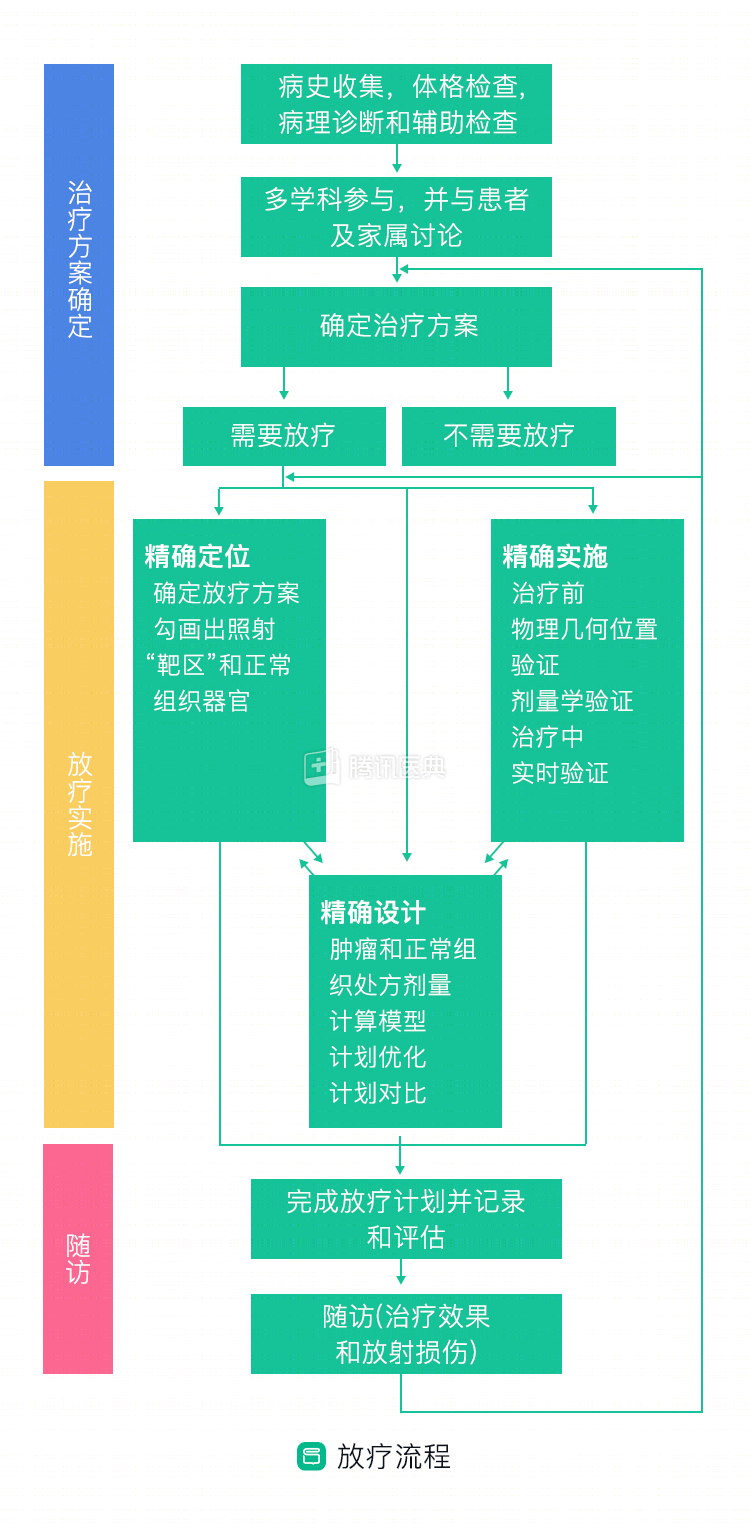
How do you determine efficacy?
The effects of radiation therapy last for some time after the course of treatment. Therefore, your doctor will evaluate during the course of treatment, at the end of the course of treatment, and at 1 month or 3 months after the end of the course of treatment to determine if the radiation therapy is working by referring to strict professional criteria, as shown in the table below.
| Table 1. Radiotherapy efficacy evaluation criteria | ||
|
Target lesions (“Measurable lesions”) |
Non-target lesions (“non-measurable lesions”, such as pleural effusion, peritoneal effusion, bone metastases, etc.) |
|
| Complete remission (complete response, CR) | Disappearance of all lesions | All lesions disappeared and blood tumor markers returned to normal levels |
| Partial response (PR) | More than 30% reduction in total lesion diameter from before treatment started | |
| Progressive disease (PD) | Total increase in diameter of more than 20% compared to the smallest lesion after the start of treatment, or the appearance of a new lesion. | ≥1 new lesion appearance, and/or progression of existing lesions |
| Stable disease (SD): | Target lesion reduction did not reach PR and increase did not reach PD. | ≥1 lesion persists and/or tumor markers are above normal |
Can radiation therapy be repeated?
Whether radiation therapy can be repeated depends on the dose of radiation therapy, the interval, the maximum radiation dose that the surrounding healthy tissue can tolerate, and the health status of the patient.
The longer the interval between radiation treatments, the lower the radiation dose, and the smaller the range, the better the general state of the patient and the better the chance of having another radiation treatment. The opposite is often not true.
It is important to note that repeated radiation therapy can have more serious side effects and may significantly affect quality of life. Therefore, doctors usually choose to re-radiate only when there is no other good option.
Can radiation therapy be used in combination with RAI?
A portion of patients with differentiated thyroid cancer need to be treated with RAI after surgery for two main purposes: to remove residual thyroid tissue after surgery (“nail clearing”) and to remove metastases that cannot be removed by surgery (“focal clearing”).
This shows that the use of radiotherapy and RAI do not largely overlap, and the combination of the two is relatively uncommon. For patients with differentiated thyroid cancer with a small amount of localized residual cancer tissue that is inoperable, RAI therapy is usually done first, and most patients can achieve radical, or long-term, remission. When RAI is not effective, local radiotherapy may be used.
What are the side effects of radiation therapy? How can I protect myself?
| Table 2. Common adverse reactions and management measures | ||
| Side effects | Performance | Self-protection |
| Dermal reactions | Erythema, burning sensation, itching, hyperpigmentation, flaking and breakout | Keep irradiated skin clean and dry, prevent infection, avoid irritation, apply protective ointment, severe cases may require interruption of radiotherapy |
| Mucosal inflammation of the larynx and pharynx |
Mucosal congestion, edema, and ulceration, with clinical manifestations such as dry throat, sore throat, and difficulty swallowing. In severe cases, laryngeal edema can develop during and after radiotherapy, leading to choking. |
Eat slowly, eat warm, soft foods, and avoid spicy and irritating foods |
| Low thyroid function | e.g. fatigue, coldness, weight gain |
Take thyroid hormone tablets |
Other common side effects include radioactive spinal cord injury, hyposalivation, and gum inflammation, which will be treated differently by your doctor depending on the severity.
Co-written by Dr. Kai Qian, Cancer Hospital of Fudan University